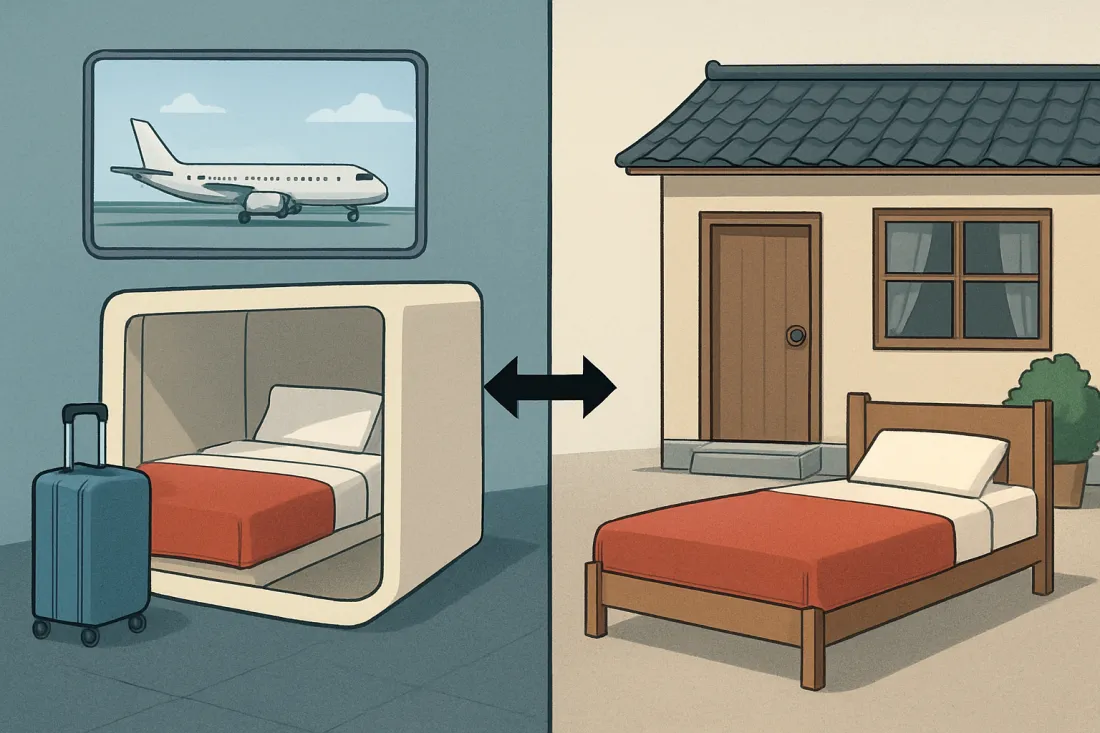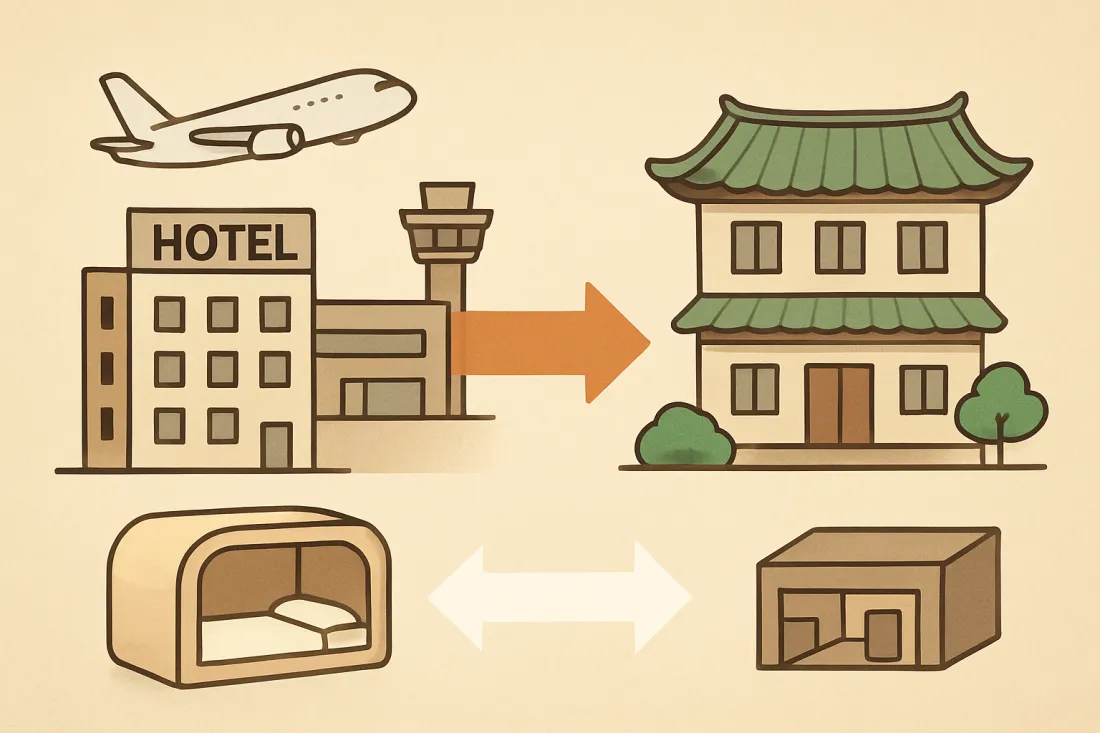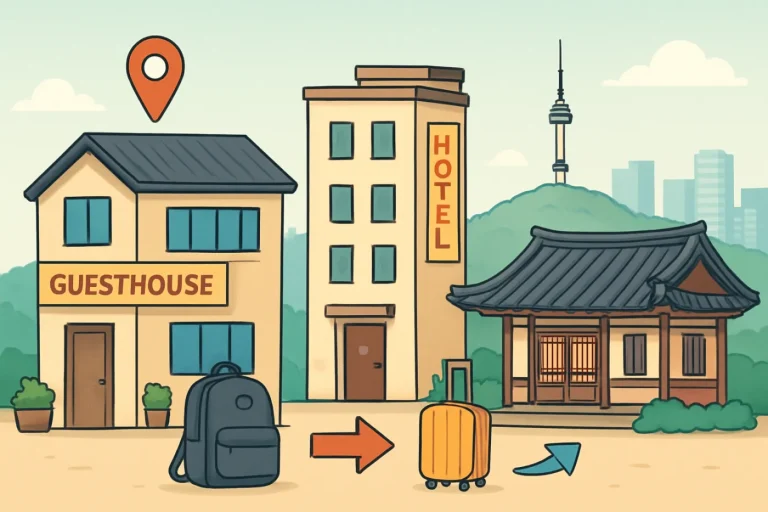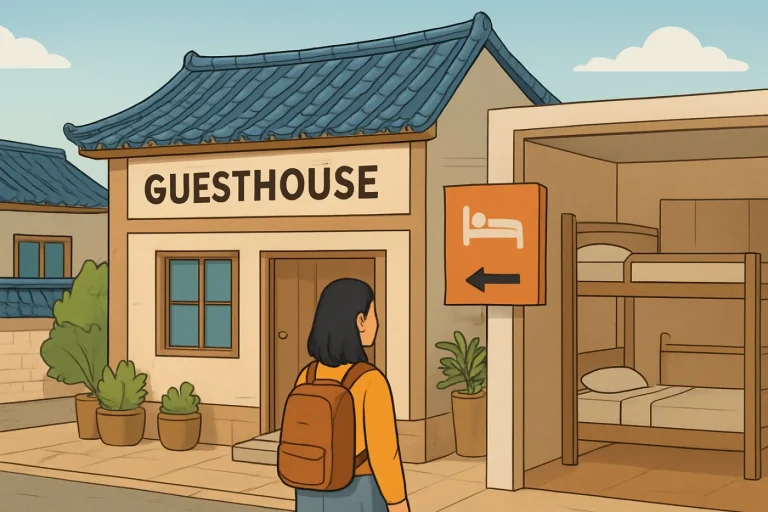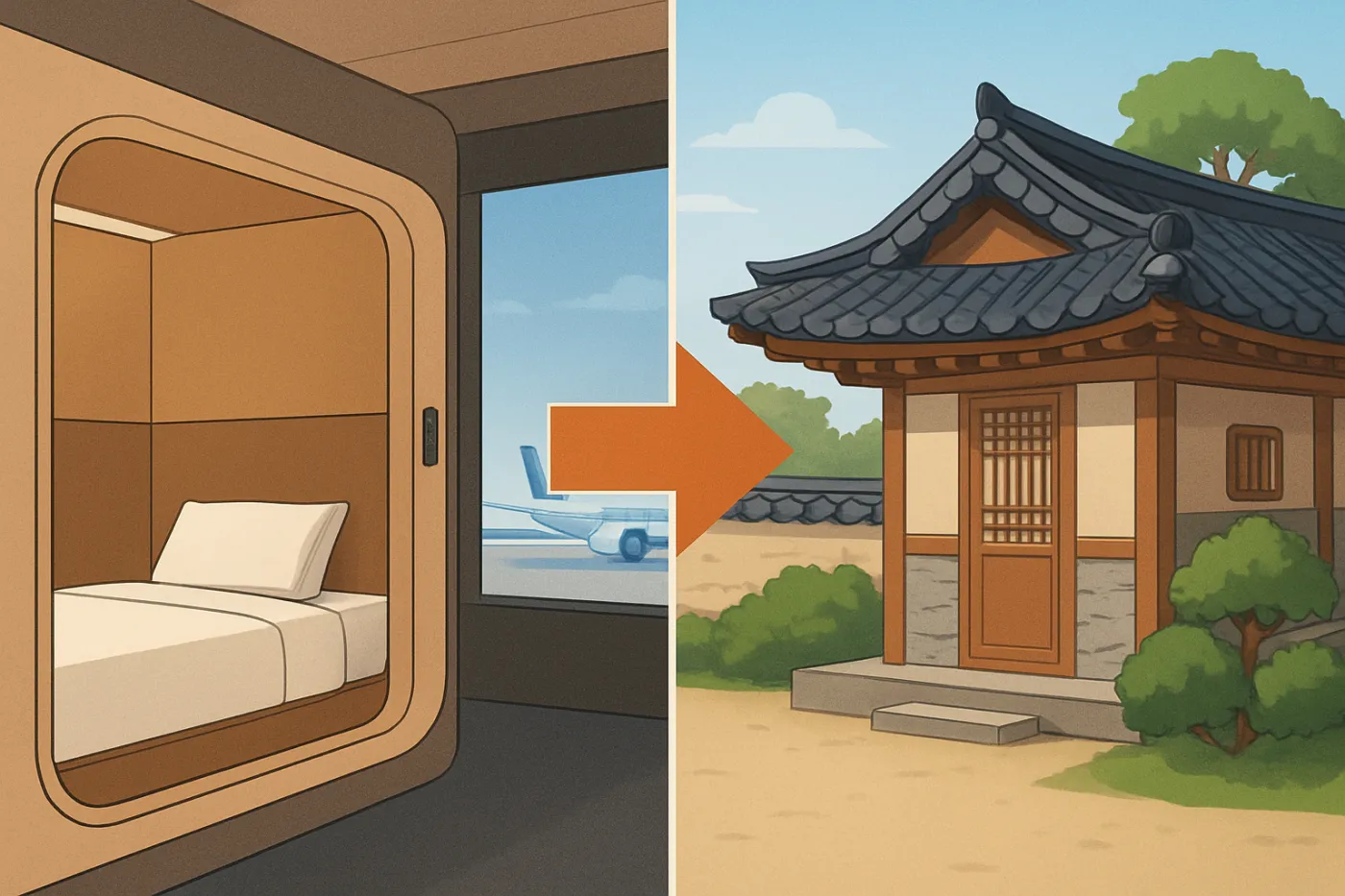
Incheon Airport transit hotel vs nearby guesthouse: which one actually fits your layover?
If you only care about sleep and convenience, book the Incheon Airport transit hotel or capsule hotel when you have a short, overnight layover and you are staying airside between flights. If you want more comfort for the money, or you plan to leave the airport anyway, a nearby guesthouse usually gives you a bigger room, more facilities, and a quieter night for a similar or lower total cost once you include food. The right choice depends on three things:
- Are you staying airside in transit, or will you go through immigration?
- How long is your layover (and what time of day)?
- What matters more to you: maximum convenience or better value and space?
this guide walk through each option, compare them side by side, and end with a checklist you can run through before you book.
Transit hotel vs landside hotel at Incheon: what is the difference?
Before comparing specific options, it helps to understand two key categories of accommodation at Incheon International Airport:
- Transit (airside) hotels – located inside the secure area of the terminal, after security and immigration.
- Landside hotels and guesthouses – located outside security, either inside the terminal public area or in nearby neighborhoods connected by shuttle, bus, or train.
What is an Incheon Airport transit hotel?
A transit hotel at Incheon is designed for passengers who:
- Arrive on an international flight
- Do not pass through immigration into South Korea
- Have a connecting international flight from the same terminal or another terminal
>
Key points about transit hotels:
- You must have a valid onward boarding pass and be checked in (or able to check in airside).
- You stay within the secure transit area; you do not collect checked luggage.
- Rooms are usually compact, windowless, and sold in blocks of hours or overnight.
- They are extremely convenient: a few minutes’ walk from your gate.
If your itinerary requires you to clear immigration (for example, separate tickets or a domestic connection), you generally cannot use the transit hotel because you will not be in the transit area anymore.
What is a landside hotel or guesthouse near Incheon?
Landside options include:
- Guesthouses and small hotels in nearby areas such as Unseo or around airport town
- Full-service hotels with shuttle buses to the terminals
- Occasional capsule-style or nap facilities in the public (landside) part of the terminal
To use these, you must:
- Pass through immigration and customs into South Korea
- Have any required visa or entry permission
- Allow time to travel to and from the property and repeat security checks
These properties usually offer:
- Larger rooms than transit hotels
- More facilities (restaurants, convenience stores, sometimes laundry)
- Better value per hour of sleep, especially for longer overnight stays
Capsule hotels, nap zones, and showers in Incheon’s terminals
Incheon Airport offers several ways to rest without leaving the airport. The exact brands and locations can change, so always confirm on the official airport map before you travel, but the main types are consistent.
Capsule or “sleeping pod” hotels
Capsule hotels at Incheon are compact sleeping pods, usually located inside or very close to the terminals. Typical features include:
- Private pod with bed, light, power outlet, and small storage
- Shared bathrooms and sometimes shared showers
- Hourly or block pricing (for example, a few hours up to an overnight block)
- Options both airside (for transit passengers) and landside (for anyone)
They are ideal when:
- You have a short layover and just need a few hours of horizontal rest
- You are traveling solo and do not mind compact space
- You want more privacy than a public nap zone but cheaper than a full hotel room
Free and paid nap zones
Incheon is known for having designated rest areas and nap zones with reclining chairs or padded benches. These are usually:
- Located both airside and landside in each terminal
- First-come, first-served (no booking)
- Free to use, though space can be limited during busy hours
Nap zones are useful when:
- You have a tight budget and do not want to pay for a room
- You are comfortable sleeping in a public area with your luggage nearby
- You only need a few hours of rest and can sleep through some noise and light
Shower facilities
If you only want to freshen up, not sleep, you can look for:
- Paid shower rooms in the terminals
- Showers inside some lounges (access rules vary by airline and ticket)
- Showers inside capsule hotels or transit hotels
These are especially helpful on long-haul connections when you want to feel human again before your next flight but do not need a full overnight stay.
Transit hotel vs capsule vs nearby guesthouse: comparison table
| Option | Best for | Comfort & privacy | Time & convenience | Typical cost level (relative) | Key risks or downsides |
|---|---|---|---|---|---|
| Transit hotel (airside) | Overnight or 6–12 hour layovers when you stay in transit and want maximum convenience | Private room, real bed, usually quiet but compact and often windowless | Fastest: a short walk from your gate, no immigration or extra security checks | High per hour compared with guesthouses; you pay for location and convenience | Only for eligible transit passengers; limited room availability; less space and fewer facilities than landside hotels |
| Capsule / sleeping pod (airside or landside) | Short layovers, solo travelers, or budget-conscious passengers who still want privacy | Private pod with bed; shared bathrooms; less space for luggage; can feel cramped | Very convenient if inside the terminal; slightly less convenient if in a connected building | Medium: usually cheaper than a full transit hotel room, more than free nap zones | Limited storage; may be noisy; not ideal for families with small children or lots of luggage |
| Free nap zones (airside or landside) | Very tight budgets, flexible sleepers, or daytime layovers | Reclining chairs or benches; public, bright, and sometimes noisy; minimal privacy | Convenient if you find a spot near your gate; no check-in process | Free, but you “pay” with comfort and sleep quality | Hard to sleep deeply; need to watch your belongings; may not feel comfortable for everyone |
| Nearby guesthouse (landside) | Overnight layovers when you can clear immigration and want better value and space | Private room, usually larger than transit hotels; more homely feel; sometimes shared bathrooms | Requires immigration, travel to/from property, and extra time for security next day | Low to medium: often good value per night, especially for couples or families | Need to manage transport and timing; cannot use if you are not allowed to enter Korea; less convenient for very short layovers |
Because exact prices change frequently, treat the “cost level” column as a relative guide and always check current rates before you decide.
Who should choose the Incheon transit hotel, and who is better off in a guesthouse?
When a transit hotel is usually worth it
A transit hotel (or airside capsule) is usually the best choice when:
- Your layover is short – for example, an overnight connection of around 6–10 hours where every minute of sleep matters.
- You are staying airside – your flights are on one ticket, you remain in transit, and you do not need to collect checked bags.
- You arrive late and depart early – leaving the airport would mean spending half your layover in queues and transport.
- You are exhausted or jet-lagged – you want a guaranteed bed, shower, and quiet without any extra logistics.
- You are nervous about immigration or visas – staying airside avoids any entry issues.
In these cases, the higher price per hour can be justified by the extra rest and lower stress.
When a nearby guesthouse is usually the better choice
A nearby guesthouse or hotel outside the airport often makes more sense when:
- Your layover is long – for example, 12 hours or more, especially if much of it is during the day.
- You want more space and comfort – a proper room with windows, a desk, and more room to unpack.
- You are traveling as a couple or family – one guesthouse room can be better value than multiple transit hotel rooms or pods.
- You plan to see a bit of Korea – even a short trip to nearby neighborhoods or into Seoul can be easier from a landside base.
- You are budget-conscious – guesthouses often include extras like common kitchens, laundry, or free water that reduce your overall spend.
If you are considering going into Seoul itself, it is worth reading a detailed guide on the AREX vs airport bus vs taxi Incheon to Seoul options so you can estimate travel time and decide whether a city stay fits your layover.
Who should avoid transit hotels
You may want to skip the transit hotel and choose a different option if:
- You are on separate tickets that require immigration – for example, arriving on one airline and checking in again landside for another.
- You want to explore outside the airport – booking a transit hotel locks you into staying airside.
- You are very sensitive to small spaces – many transit rooms are compact and windowless.
- You have a very tight budget – free nap zones or a budget guesthouse can save a noticeable amount.
Overnight rules, check-in times, and immigration considerations
Because Incheon is a major international hub, overnight stays are common, but there are still rules and timing issues to think about.
Staying airside overnight
If you remain in the transit area overnight:
- Airport security generally allows passengers with valid onward flights to stay in the secure area.
- Some shops and restaurants close late at night, so food options may be limited during certain hours.
- Transit hotels and capsules may have fixed check-in/out windows or minimum hour blocks; check these when you book.
- Boarding pass and passport checks are common when entering hotel or capsule areas.
If you plan to sleep in a nap zone instead of a hotel, confirm that your gate area stays open overnight and that you can access rest zones without leaving the secure area.
Leaving the airport for a guesthouse
If you decide to stay in a nearby guesthouse:
- You must pass through immigration and customs, which takes extra time on arrival and departure.
- You need to meet South Korea’s entry requirements (visa, passport validity, onward ticket, and any current health or entry rules).
- You must allow enough time to return to the airport, clear security, and reach your gate before boarding.
A simple way to plan is to work backward from your departure time:
- Boarding usually starts 30–60 minutes before departure.
- Add time for security and immigration queues.
- Add travel time from your guesthouse back to the terminal.
- Subtract this total from your departure time to find your latest safe checkout time.
If this leaves you with only a few hours of real sleep, a transit hotel or capsule inside the terminal may be more sensible.
Check-in times and minimum stays
Transit hotels and capsule hotels often:
- Sell rooms in fixed blocks (for example, a minimum number of hours)
- Have different day and night rates
- Require check-out before a specific time even if your flight leaves later
Guesthouses outside the airport usually:
- Follow standard hotel check-in (afternoon) and check-out (morning) times
- May offer early check-in or late check-out for a fee, depending on availability
- Sometimes allow luggage storage before check-in or after check-out
Always read the property’s conditions carefully so you do not pay for hours you cannot actually use.
How to book: airline, online agencies, or walk-in
You generally have three ways to secure a place to sleep around Incheon Airport.
1. Through your airline (including possible free stopover hotels)
Some airlines offer hotel accommodation for long layovers or disrupted flights under certain conditions, such as:
- Very long connection times on a through ticket
- Late-night arrivals with no immediate onward flight
- Schedule changes or cancellations caused by the airline
Whether this is available depends on:
- Your ticket type and booking class
- The specific airline’s policies
- Whether your layover meets their minimum time and routing rules
If you are flying with a major Korean carrier and wondering whether they provide a free hotel, the only reliable way to know is to:
- Check the airline’s official website for “stopover” or “transit hotel” information
- Contact the airline or your travel agent with your exact booking details
Do not assume a free hotel is included unless it is clearly confirmed in writing.
2. Online booking platforms
Most travelers book transit hotels, capsule hotels, and nearby guesthouses through online travel agencies or the property’s own website. This approach lets you:
- Compare different options and read recent reviews
- See photos of rooms and facilities
- Check whether the property offers airport shuttles and at what times
- Filter by free cancellation or pay-at-property options
When booking a transit hotel, double-check that you are choosing the correct terminal and that the room is indeed airside if that is what you need.
3. Walk-in bookings at the airport
In quieter periods, it may be possible to walk up to a transit hotel, capsule hotel, or information desk and ask about availability. This can work if:
- You have a flexible budget
- You are traveling outside peak holiday seasons
- You are comfortable with the risk that rooms might be sold out
However, for overnight layovers and peak travel times, advance booking is strongly recommended, especially if you need a specific bed type or are traveling with children.
Decision checklist: questions to ask before booking an Incheon transit hotel
Use this checklist as a step-by-step filter before you commit to any option.
Step 1 – Transit status and immigration
- Will I stay airside between flights, or must I pass through immigration to collect bags or re-check in?
- Do I meet South Korea’s entry requirements if I plan to leave the airport?
- Is my layover long enough to justify leaving the secure area and coming back?
Step 2 – Time calculations
- What is my actual “sleep window” after subtracting immigration, security, and transport time?
- Is that window at night (when I want to sleep) or during the day (when I might explore instead)?
- Would staying inside the terminal give me at least one extra hour of rest compared with going landside?
Step 3 – Comfort and travel style
- Can I sleep in public spaces, or do I need a private room to feel safe and rested?
- Am I okay with a compact, windowless room, or do I prefer more space and natural light?
- Am I traveling solo, as a couple, or with children who need more room to move?
Step 4 – Budget and value
- How much am I realistically willing to spend for this layover, including food and transport?
- Does a guesthouse offer better value per hour of real sleep than a transit hotel?
- Is paying extra for maximum convenience worth it for this particular trip (for example, after a red-eye flight)?
Step 5 – Practical details
- Does the property match my terminal and side of the border (airside vs landside)?
- What are the check-in and check-out times, and do they align with my flights?
- Is there an airport shuttle, and how often does it run if I choose a guesthouse?
- Can I safely store my luggage if I arrive before check-in or leave after check-out?
If you answer these questions honestly, the right option usually becomes obvious.
Common mistakes when choosing where to sleep at Incheon Airport
Avoid these frequent errors that cause stress and extra costs.
Booking the wrong side (airside vs landside)
Many travelers accidentally book:
- An airside transit hotel when their itinerary forces them to go landside, or
- A landside hotel when they planned to stay in transit and do not have time for immigration
Always confirm:
- Whether the hotel is inside the secure area or outside
- Which terminal it is in or connected to
- Whether your ticket allows you to stay in transit
Underestimating travel and queue times
Another common mistake is assuming that leaving the airport is always quick. In reality, you need to factor in:
- Immigration and customs queues on arrival
- Transport time to and from your guesthouse
- Security and immigration queues on departure
If you plan to go into Seoul, it is worth reading a step-by-step guide such as AREX Incheon Airport to Seoul first time so you understand how long the journey can take and whether it fits your layover.
Ignoring check-in and check-out windows
Booking a full night at a guesthouse for a layover that runs from early morning to late afternoon can leave you paying for hours you cannot use. Similarly, booking a transit hotel block that ends several hours before your flight can leave you tired in the terminal. Always match your booking times to your actual rest window, not just the calendar date.
Not checking shuttle schedules
Some guesthouses and hotels offer free or paid shuttles, but:
- They may not run 24/7
- They may require advance reservation
- They may pick up from specific terminals only
If your flight arrives very late or leaves very early, confirm that you can actually get to and from your accommodation at those hours.
Forgetting about luggage and security
If you plan to sleep in nap zones or use a capsule hotel with limited storage, think about:
- How you will secure your valuables while you sleep
- Whether you need a small cable lock or money belt
- Whether your carry-on fits inside the pod or needs to stay in a locker
FAQ: sleeping at Incheon Airport, transit hotels, and guesthouses
Where is the best place to stay overnight at Incheon Airport?
The “best” place depends on your layover type:
- Short overnight transit (6–10 hours, staying airside): a transit hotel or airside capsule hotel is usually best because you maximize sleep and minimize walking and queues.
- Long overnight layover with time to spare: a nearby guesthouse or hotel outside the airport often gives you more comfort and better value, as long as you can clear immigration.
- Very tight budget: free nap zones inside the terminals are workable if you can sleep in public and keep an eye on your belongings.
What are some good guesthouses near Incheon Airport?
Guesthouse quality and popularity change over time, so instead of chasing specific names, focus on these checks:
- Look for properties that clearly mention “Incheon Airport” in their description and specify shuttle or train access.
- Check recent reviews for comments about noise, cleanliness, and shuttle reliability.
- Use the map view on booking platforms to confirm the distance to the terminal and nearby transport stops.
- Filter for free cancellation if your flight schedule might change.
Guesthouses in areas one or two stops away on the airport train can be a good balance between price and convenience.
Is there a transit hotel at Incheon Airport, Korea?
Yes, Incheon Airport has transit hotel facilities and capsule-style options inside its international terminals. These are located in the secure transit area and are designed for passengers who remain airside between international flights. Because locations and brands can change, always confirm on the official airport website or map for your specific terminal and date. When booking, make sure the listing clearly states that it is inside the transit area if that is what you need.
Does Korean Air offer free hotels for overnight layovers?
Whether Korean Air (or any other airline) offers a free hotel for an overnight layover depends on several factors:
- Your route and ticket type
- The length of your layover
- Whether the long layover is a normal part of the schedule or caused by a disruption
Airline policies can change, and conditions are often detailed. To find out if you qualify:
- Check the airline’s official website for information about stopover or transit hotel programs
- Contact the airline directly with your booking reference
- Ask your travel agent if you booked through one
Do not rely on second-hand stories; always confirm directly with the airline before you make separate accommodation plans.
Is it safe to sleep in Incheon Airport’s nap zones?
Incheon Airport is generally considered orderly and well-monitored, and many travelers do sleep in nap zones overnight. However, you should still take basic precautions:
- Keep valuables (passport, wallet, phone) on your person, such as in a money belt or inside your clothing.
- Use a small lock or strap to secure your bag to your seat or to itself.
- Choose a spot near other travelers rather than in a completely isolated corner.
- Set an alarm so you do not oversleep and miss boarding calls.
If you are a very light sleeper or anxious about your belongings, a capsule or transit hotel room may feel more comfortable.
How noisy are the transit hotels and capsule hotels at Incheon?
Noise levels vary by location and time of day, but you can expect:
- Some hallway noise from other guests arriving and leaving at odd hours
- Occasional announcements or background airport sounds, especially in capsule areas close to gates
To improve your sleep:
- Bring earplugs and an eye mask
- Request a quieter room or pod location if the property allows it
- Avoid rooms directly next to reception or main corridors when possible
Can I store my luggage if I stay in a guesthouse or go into Seoul during a long layover?
Many guesthouses and hotels offer luggage storage before check-in or after check-out, but policies differ. Before booking, check:
- Whether luggage storage is available and if there is a fee
- What hours the front desk is staffed
- Whether there are size limits for stored bags
If you plan to go into Seoul for part of your layover, you can also look into luggage storage options at the airport or major train stations. When planning your city visit, a guide to the cheapest way from Incheon Airport to Seoul can help you balance time and cost.