Budget accommodation in South Korea: the practical overview
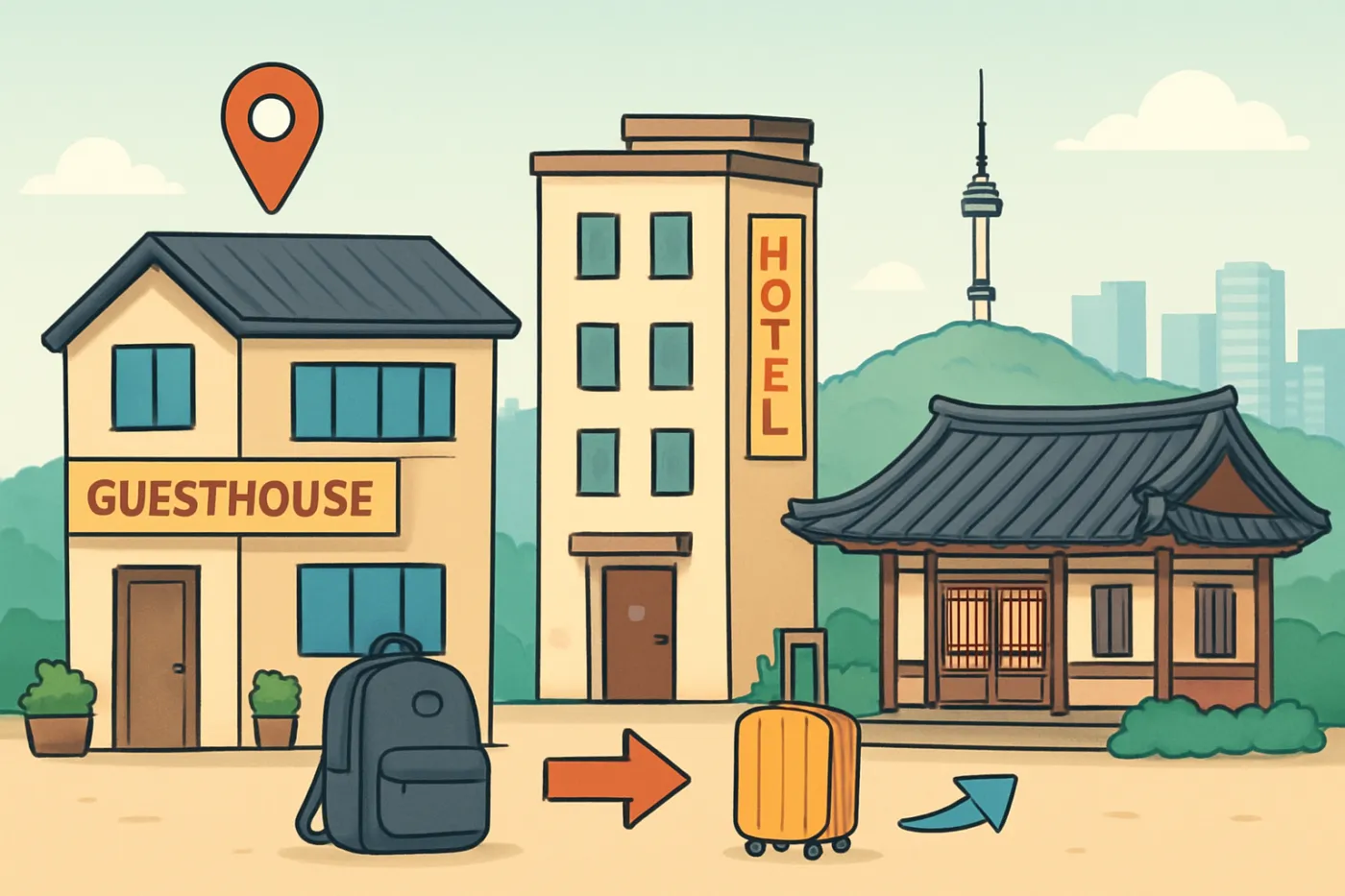
If you want to keep costs low in South Korea, you will usually choose between:
- Guesthouses and hostels (dorms or simple private rooms)
- Budget hotels (compact rooms with private bathroom)
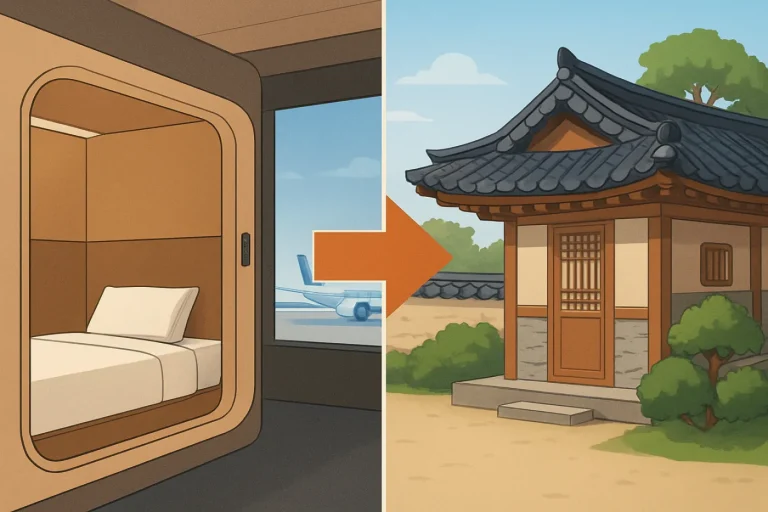
- Goshiwon / goshi-tel (tiny long-stay rooms, usually for students or workers)
- Short-term rentals and officetels (small studios, often via local platforms)
- Love motels and older local motels (cheap but mixed quality)
- Hanok guesthouses (traditional houses, more about experience than rock-bottom price)
For most short-term travelers, a guesthouse or budget hotel in a convenient neighborhood is the best balance of price, comfort, and safety. Goshiwon rooms and small studios make more sense if you are staying several weeks or months and are comfortable with very small spaces.
The rest of the guide explains what each option actually feels like, how to compare them, where to stay in major cities, and how to avoid common booking mistakes.
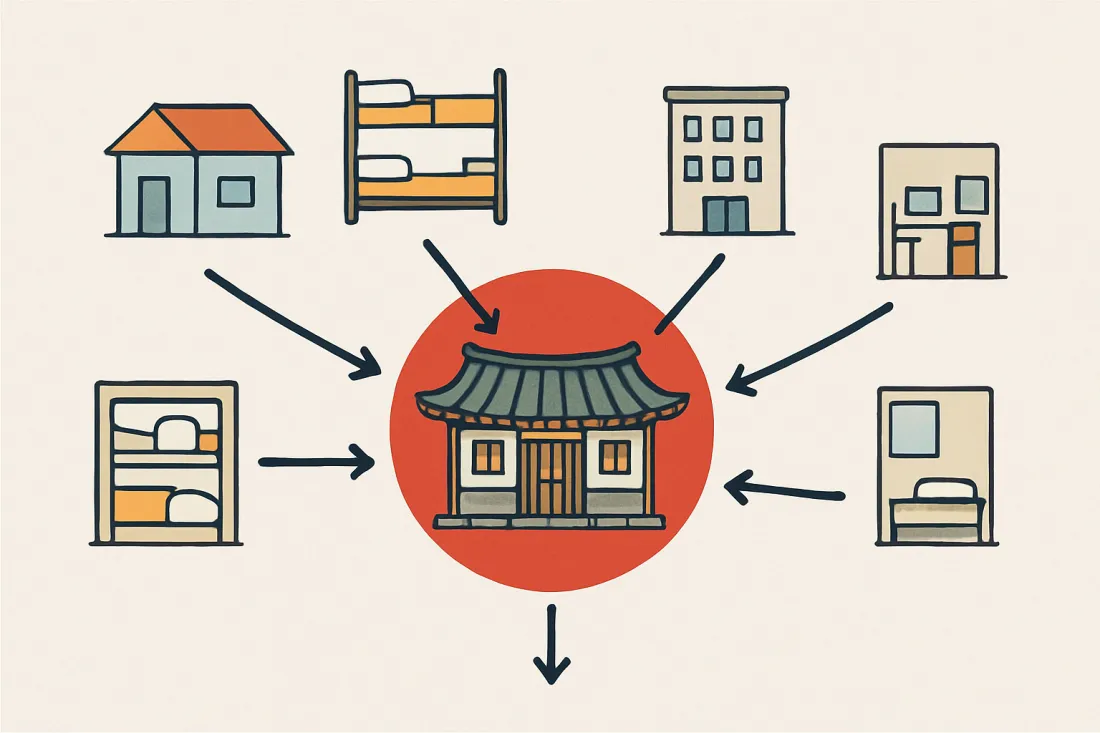
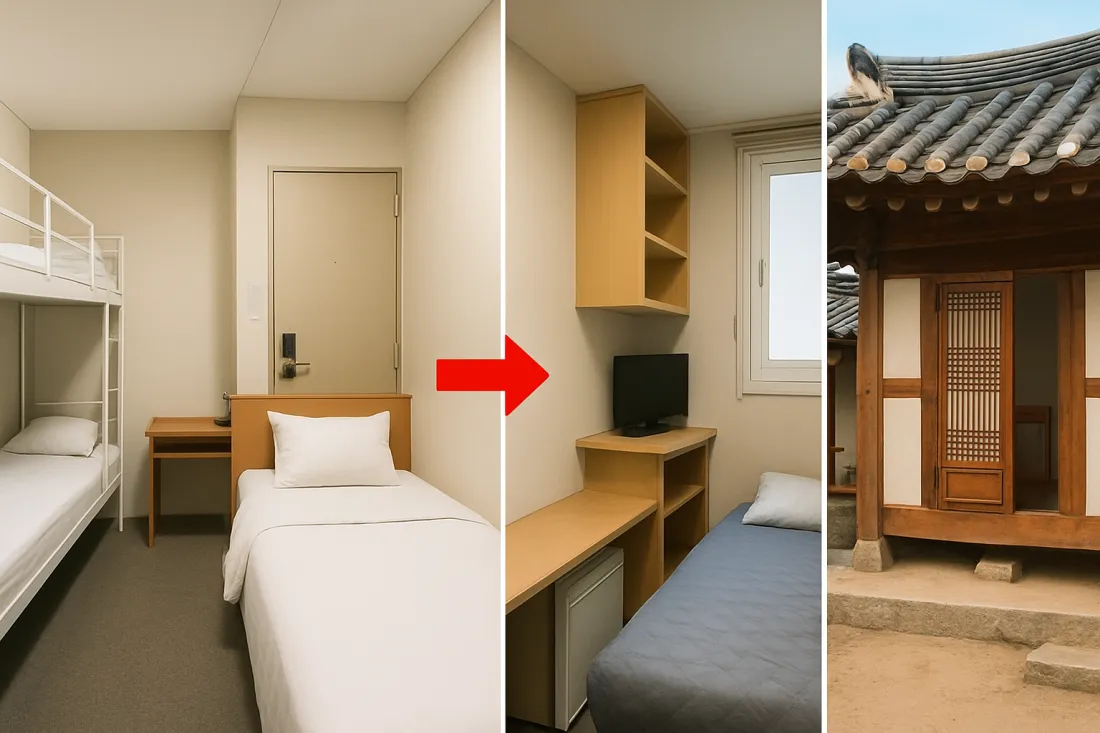
Plain-language definitions of Korea’s budget stay options
These are the main types of budget accommodation in South Korea and what they usually mean in practice.
Guesthouse
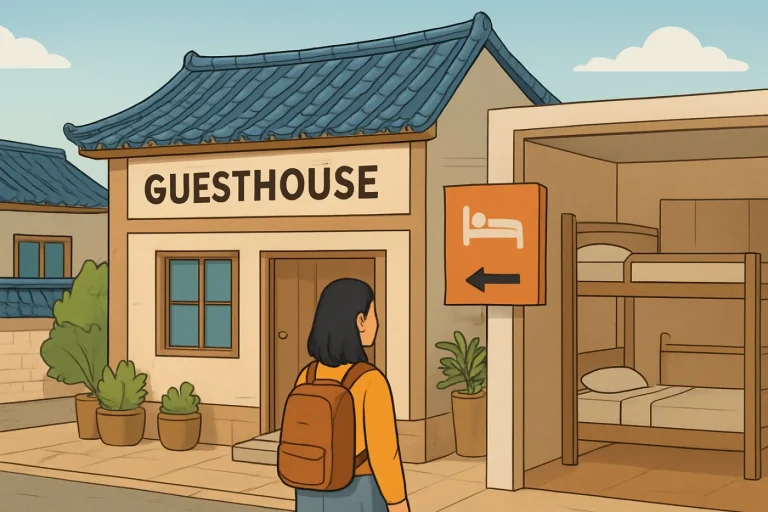
A small, usually independent place with a mix of dorm beds and simple private rooms. Bathrooms may be shared or private. Guesthouses are common in tourist areas and popular with backpackers, solo travelers, and small groups. Many include a simple breakfast and have a shared kitchen or lounge.
Hostel
Similar to a guesthouse but often with more dorm beds, bunk beds, and shared facilities. Some Korean hostels are modern and stylish, with female-only dorms, keycard access, and social common areas. They are usually the cheapest per-night option for solo travelers.
Budget hotel
A basic hotel with compact private rooms, usually with an en-suite bathroom, TV, Wi‑Fi, and air-conditioning. Many belong to local or regional chains. You get more privacy than in a guesthouse, but less of a social atmosphere. Rooms can be very small, especially in central Seoul.
Love motel / local motel
Originally designed for couples, but many now function as cheap hotels. Rooms are private and often spacious, with large beds and bathtubs, but decor can be dated or themed. Quality varies a lot by area. They can be good value for short stays if you are not bothered by the adult-oriented image.
Goshiwon (goshi-tel)
A very small, often windowless room with a single bed, desk, and sometimes a private toilet or shower. Kitchens and laundry are shared. Goshiwon buildings are popular with students and workers who need a low monthly cost and are willing to trade space and comfort.
Officetel / studio rental
A small studio apartment in a mixed office–residential building. Often rented short-term through local platforms or agencies. Includes a private bathroom and basic kitchen, sometimes a washing machine. Better for longer stays when you want to cook and work in the same space.
Hanok guesthouse
A traditional Korean house converted into a guesthouse. Rooms usually have floor bedding (yo or futon-style), shared bathrooms, and a courtyard. Heating is often underfloor (ondol). Hanok stays are more about cultural experience and atmosphere than the very lowest price.
Comparison table: which budget option fits your trip?
Use this table to match each accommodation type to your travel style and priorities.
| Option | Best for | Privacy level | Typical stay length | Main advantages | Main drawbacks / risks |
|---|---|---|---|---|---|
| Guesthouse / hostel dorm | Solo travelers, backpackers, very tight budgets | Low (shared room and bathroom) | 1–14 nights | Lowest per-night cost, social vibe, staff used to foreigners, often central | Noise, limited privacy, shared bathrooms and kitchen, less secure for valuables |
| Guesthouse private room | Couples, friends, light sleepers who still want social spaces | Medium (private room, shared or private bathroom) | 2–14 nights | Good balance of price and comfort, local tips from hosts, often simple breakfast | Small rooms, thin walls, shared facilities in cheaper places |
| Budget hotel | First-time visitors, business on a budget, families wanting privacy | High (private room and bathroom) | 1–10 nights | Predictable comfort, 24/7 reception in many cases, easy late check-in | Less social, very compact rooms in central areas, some in nightlife streets |
| Love motel / local motel | Short stays, last-minute bookings, flexible check-in | High (private room and bathroom) | 1–3 nights | Often spacious rooms, many near stations, late-night availability | Adult decor, mixed cleanliness, not ideal for families or conservative travelers |
| Goshiwon | Students, digital nomads, long stays on strict budget | Medium (private tiny room, shared kitchen/bathroom) | 1–12+ weeks | Low monthly cost, simple move-in, utilities often included | Extremely small space, possible lack of windows, basic shared facilities |
| Officetel / studio rental | Remote workers, couples staying several weeks | High (private unit) | 1 week–3 months | Kitchen and laundry in unit, home-like, good for cooking and working | May require deposit, more complex booking, cleaning not always included |
| Hanok guesthouse | Cultural travelers, couples, photographers | Medium (private room, shared courtyard) | 1–4 nights | Traditional architecture, unique atmosphere and photos | Thinner walls, shared bathrooms in some, less sound insulation |
How to choose the right budget stay for your Korea trip
Instead of scrolling endless listings, use these decision criteria to narrow your options quickly.
1. Trip length and base city
- Up to 7 nights in one city: a guesthouse private room or budget hotel in a central area is usually the easiest choice. You get predictable comfort and do not need to learn how long-stay housing works.
- 2–4 weeks in one city: consider a goshiwon or small studio if you are comfortable with basic spaces and want to save on food by cooking. Check whether utilities and Wi‑Fi are included in the monthly rate.
- Multi-city itinerary: stick to guesthouses and budget hotels near major train or bus stations to reduce transit time and luggage hauling.
2. Privacy vs. price
- Lowest possible cost: dorm bed in a hostel or guesthouse. Good for sociable solo travelers who do not mind shared bathrooms.
- Balance of cost and privacy: guesthouse private room or cheaper budget hotel. Works well for couples and friends.
- Maximum privacy on a budget: budget hotel, local motel, or officetel studio if staying longer. You pay more than a dorm, but still less than full-service hotels.
3. Comfort expectations
- If you need quiet and a good mattress, avoid the very cheapest dorms and older motels. Look for newer guesthouses or chain-style budget hotels with many recent positive reviews about sleep quality.
- If you are okay with tiny rooms and shared bathrooms, you can save a lot with guesthouses and goshiwon-style places. Just be realistic about luggage size and personal space.
- If you want a cultural atmosphere, plan at least one night in a hanok guesthouse in Seoul, Jeonju, or Gyeongju, and spend the rest of your stay in more practical budget accommodation.
4. Location and transport
In Korean cities, being near a subway station usually matters more than being next to a single tourist sight. A place that is a 5–10 minute walk from a busy station can save you time and transit costs every day.
If you are flying into Incheon and want to keep arrival costs low, compare the cheapest way from Incheon Airport to Seoul with your accommodation location so your airport transfer and hotel choice work together.
5. Flexibility and booking style
- Planners: if you like to know everything is settled, book guesthouses or budget hotels in advance, especially for weekends and holidays.
- Spontaneous travelers: love motels and some hostels can be found on the day, but you may have to compromise on location or room type.
- Long-stay visitors: for goshiwon and studios, it is common to confirm details directly with the property or agency and sometimes view the room before committing.
Broad price range breakdown for budget stays
Exact prices change with season, city, and demand, and you should always check current rates before booking. The ranges below are intentionally broad and meant only as a planning tool, not fixed quotes.
- Dorm bed in a hostel or guesthouse: usually the lowest nightly cost you will find in major cities.
- Simple private room with shared bathroom: typically a bit more than a dorm bed, but still in the budget category and often cheaper than a full budget hotel.
- Budget hotel room with private bathroom: commonly in the lower to middle price band for city accommodation, depending on area and brand.
- Love motel / local motel: can overlap with budget hotel prices, sometimes cheaper on weeknights and higher on weekends or holidays.
- Goshiwon monthly rate: often comparable to roughly a week or a bit more in a budget hotel, making it attractive for longer stays.
- Officetel or studio monthly rate: usually higher than a goshiwon but lower per night than staying in hotels for the same period.
When comparing options, calculate the total cost for your whole stay, including any cleaning fees, deposits, or utility charges for long-stay rooms, not just the nightly headline rate. For example, a slightly more expensive nightly rate with no extra fees can end up cheaper than a low nightly rate with a large cleaning fee.
Best neighborhoods in South Korea for budget travelers
South Korea’s cities are dense, and each area has a different feel. Choosing the right neighborhood can matter as much as choosing the right room type.
Budget-friendly areas in Seoul
- Hongdae / Hapjeong / Sangsu: Youthful, full of cafes, nightlife, and street performances. Many guesthouses and hostels. Great for solo travelers and friends who do not mind some noise at night.
- Myeongdong: Very central for shopping and sightseeing, with many budget hotels and some guesthouses. Good for first-time visitors who want easy access to major sights and airport transport.
- Insadong / Jongno: More traditional atmosphere, hanok guesthouses, and small hotels. Convenient for palaces and historic sites, with quieter streets once shops close.
- Dongdaemun area: Good if you like late-night shopping and want easy bus and subway connections. Mix of budget hotels and motels.
- Near major universities (Ewha, Korea University, Konkuk, etc.): Often have cheaper food and some budget accommodation options aimed at students, including goshiwon buildings and small guesthouses.
If you are still deciding where to base yourself, it can help to read a focused guide on the best area to stay in seoul on a budget and match the neighborhood vibe to your travel style.
Budget bases in Busan
- Seomyeon: Central transport hub with many restaurants and shops. Good base for exploring different parts of the city by subway and bus.
- Nampo-dong / Jagalchi: Near markets and the harbor, with a mix of cheap hotels and guesthouses. Great for food lovers and people who enjoy traditional markets.
- Haeundae (back streets): The beachfront area can be pricey, but streets a bit away from the sand often have more affordable guesthouses and small hotels.
Smaller cities and countryside
- Jeonju: Known for its hanok village; you can find traditional guesthouses at various price levels. Staying slightly outside the most famous streets can reduce costs.
- Gyeongju: Historic city with guesthouses and small hotels near the main bus or train stations. Good base for exploring tombs and temples.
- Jeju Island: Outside peak summer and holidays, you can find guesthouses and pensions at reasonable rates, especially away from the most famous beaches and resort clusters.
Pros and cons of the main budget options
Each type of budget accommodation has clear trade-offs. Use these summaries to match them to your priorities.
Guesthouses and hostels
- Pros
- Lowest nightly cost for solo travelers.
- Easy to meet other travelers and get local tips.
- Staff usually speak some English and are used to foreign guests.
- Often include simple breakfast or free coffee/tea.
- Cons
- Shared bathrooms and kitchens can get busy at peak times.
- Dorms can be noisy; light sleepers may struggle without earplugs.
- Less secure for valuables unless there are lockers or safes.
Budget hotels
- Pros
- Private bathroom and better privacy.
- Reception often 24/7, helpful for late arrivals or early departures.
- Predictable facilities like air-conditioning and heating.
- Daily or regular cleaning in many properties.
- Cons
- Less social; you may not meet other travelers easily.
- Rooms can be very compact, especially in central Seoul.
- Some cheaper hotels may be in nightlife or red-light streets, which not everyone enjoys.
Goshiwon and long-stay rooms
- Pros
- Very low monthly cost compared to hotels.
- Private room, even if small.
- Often no long-term lease or complex paperwork.
- Utilities and Wi‑Fi are often included in the price.
- Cons
- Extremely small, sometimes windowless rooms.
- Shared bathrooms and kitchens can be basic or crowded.
- Noise and ventilation can be an issue in older buildings.
Love motels and local motels
- Pros
- Often spacious rooms with large beds and bathtubs.
- Flexible check-in and check-out times.
- Many locations near stations and bus terminals.
- Same-day bookings are often possible.
- Cons
- Adult-oriented atmosphere may feel awkward for some travelers.
- Quality and cleanliness vary widely between properties.
- Not always family-friendly or suitable for children.
Officetel and studio rentals
- Pros
- Kitchen and laundry in your unit, which can reduce food and laundry costs.
- More space than a typical budget hotel room.
- Feels more like a home, good for remote work or study.
- Cons
- May require a deposit or additional fees.
- Cleaning is not always included; you may need to arrange it yourself.
- Booking process can be less straightforward for foreigners than hotels.
Practical checklist before you book budget accommodation
Use this checklist to avoid common mistakes when choosing budget accommodation in South Korea.
- Check the exact location
- Look up how many minutes it is on foot from the nearest subway station or bus stop.
- Check if the area is mainly residential, nightlife, or business; choose what fits your comfort level.
- For late-night arrivals, confirm that the streets between the station and property are reasonably busy and well lit.
- Confirm bed type and room size
- See if the bed is single, semi-double, or double; some budget rooms have narrower beds than you might expect.
- Look for room size in square meters to understand how tight the space will be, especially if you have large luggage.
- In goshiwon listings, check whether the room has a window and how high the ceiling is.
- Look at bathroom details
- Is the bathroom private or shared?
- Is it a “wet room” style (shower over the toilet) or a separate shower stall?
- For hanok and older buildings, check whether bathrooms are inside the room or across a courtyard.
- Check heating and cooling
- Make sure there is air-conditioning for summer stays.
- For winter, confirm there is proper heating (often floor heating called ondol) and that it is available all night.
- If you are sensitive to temperature, read reviews mentioning “too hot” or “too cold.”
- Read recent reviews
- Filter for reviews from the last 6–12 months.
- Pay attention to comments about cleanliness, noise, and staff communication.
- Look for repeated patterns: if several people mention the same issue, assume it is real.
- Understand house rules
- Check quiet hours, check-in/check-out times, and whether luggage storage is available.
- If you plan to cook, confirm that guests can use the kitchen and what is provided (pots, dishes, basic spices).
- See whether there are curfews or locked doors at night, especially in smaller guesthouses.
- Confirm total cost
- Look for any cleaning fees, service charges, or deposits, especially for long-stay rooms and studios.
- Check cancellation policy and whether payment is on arrival or in advance.
- For monthly stays, ask whether utilities, Wi‑Fi, and building maintenance fees are included.
- Check access from the airport
- See how you will get from Incheon or Gimpo to your accommodation (train, bus, taxi).
- Compare options like the airport train, bus, or taxi so you do not overspend on arrival. Tools such as the AREX vs airport bus vs taxi Incheon to Seoul guide can help you choose.
- If you arrive very late, confirm that public transport is still running or budget for a taxi.
Safety, etiquette, and cultural tips for budget stays
Safety basics
- South Korea is generally considered safe, but always use common sense: lock your door, keep valuables in a locker or safe when available, and do not leave passports or electronics unattended in shared spaces.
- In hostels and guesthouses, use a small padlock or combination lock for lockers if they are not provided.
- In goshiwon or older motels, look for clear emergency exit signs and note the stairwell location when you arrive.
- Keep a digital copy of your passport and key booking details in case you misplace documents.
Etiquette in shared spaces
- Noise: Many places have quiet hours after around 10–11 p.m. Keep voices low in hallways and dorms, and use headphones for music or videos.
- Shoes: It is common to remove shoes at the entrance of guesthouses and some hotels. Follow signs and copy what locals do; use indoor slippers if provided.
- Bathrooms: In shared bathrooms, take your toiletries in a small bag and do not leave them scattered around the sink or shower. Wipe down wet areas if you splash water.
- Kitchens: Label your food if you store it in a shared fridge, wash dishes immediately after use, and leave the area clean for the next person.
Respecting local norms
- Keep public displays of affection modest, especially in more traditional areas and family-run guesthouses.
- Dispose of trash and recycling according to the property’s instructions; waste sorting is taken seriously in many Korean cities.
- If you stay in a hanok, walk gently and keep luggage wheels off wooden floors where possible to avoid noise and damage.
- Be patient with language barriers; many hosts will use translation apps and appreciate simple, clear English.
Common mistakes when booking budget accommodation in South Korea
- Focusing only on price, not location: A very cheap room far from the subway can cost you more in time and transport than a slightly more expensive central option.
- Underestimating room size: Some travelers are surprised by how compact Korean budget rooms can be. Always check photos and measurements if space matters to you.
- Ignoring reviews about noise: If multiple guests mention thin walls or street noise, assume it will affect you unless you are a very heavy sleeper.
- Not checking check-in times: Many small guesthouses have limited reception hours. If you arrive late at night, confirm how to get your key in advance.
- Assuming all places allow cooking: Some budget hotels and guesthouses do not allow guests to cook, or only provide a microwave and kettle.
- Booking a goshiwon without understanding what it is: Photos can make rooms look larger than they are. If you are claustrophobic or carry large luggage, a goshiwon may not be comfortable.
- Forgetting about weekend and holiday surcharges: In popular areas, prices can rise on Fridays, Saturdays, and national holidays, so check rates across several dates.
FAQ about budget accommodation in South Korea
Is $1000 enough for a week in South Korea if I stay in budget accommodation?
Whether $1000 is enough for a week depends on your travel style, but many visitors manage a week on that budget by choosing guesthouses or budget hotels, using public transport, and eating mainly at local restaurants and street food stalls. To see if it works for you, sketch a rough daily budget that covers accommodation, food, transport, and sightseeing, then multiply by seven and add a buffer for shopping or unexpected costs. If your daily estimate fits comfortably under roughly one-seventh of your total budget, $1000 can be workable.
How much does it cost to rent a room in Korea on a budget?
For short stays of a few nights, a budget room in a guesthouse or hotel will usually be priced per night, with dorm beds at the lower end and private rooms higher. For longer stays of several weeks or months, goshiwon rooms and small studios are often rented by the month and can work out cheaper per night than hotels. Because prices change with city, neighborhood, and season, the most reliable approach is to search your target dates in the area you want, compare at least three properties of each type, and calculate the total cost for your full stay, including any deposits or utility fees.
What is the cheapest place to live in South Korea for a longer stay?
Smaller cities and university areas tend to have lower accommodation costs than central Seoul or popular coastal districts. If you are flexible about location, look at neighborhoods near universities or in secondary cities that still have good transport links. For long stays, goshiwon rooms and simple studios in these areas are often among the most affordable options. Always balance price with access to transport, supermarkets, and any school or workplace you need to reach.
How much is a budget hotel per night in Korea?
Budget hotel rates vary by city, season, and how early you book. In general, you can expect budget hotels to cost more than a dorm bed but less than full-service hotels in the same area. To get a realistic figure for your trip, search your exact dates, filter for budget or two- to three-star hotels, and compare several options in similar neighborhoods. Pay attention to whether taxes and service charges are included in the displayed price so you are comparing like with like.
Is it safe to stay in a love motel or goshiwon as a foreigner?
Many foreigners stay in love motels and goshiwon rooms without problems, but you should be selective. Choose properties with multiple recent positive reviews, clear photos, and a location near busy streets or stations rather than isolated alleys. On arrival, check that doors and windows lock properly and that you can easily find the emergency exit. If anything feels unsafe or very different from what was advertised, it is better to change accommodation than to try to endure a bad situation.
Should I book budget accommodation in advance or wait for last-minute deals?
For peak seasons, weekends, and popular areas of Seoul and Busan, booking in advance usually gives you better choice and more predictable prices. Last-minute deals do exist, especially for motels, but you may have to compromise on location or room type. If you have specific needs such as a private bathroom, female-only dorm, or proximity to a particular venue, it is safer to book early and treat any last-minute discount as a bonus rather than a plan.