Choosing a guesthouse in Korea can make the difference between a fun, social trip and a stressful, sleepless one. With so many options in areas like Hongdae, Myeongdong, and Busan’s beach districts, it helps to use a clear checklist instead of just picking the cheapest room.
How to choose a guesthouse in Korea in 7 clear steps
To quickly narrow down good options and avoid bad ones, follow this practical order:
- Decide your priorities: social vibe, quiet sleep, private room, or lowest price.
- Filter by location: near your subway line and sights, but not directly on the noisiest street.
- Check minimum standards: cleanliness, basic safety, heating/AC, and bathroom quality.
- Study photos and reviews for red flags: dirt, clutter, unclear beds, noise, or rude staff.
- Confirm room type and layout: dorm vs private, bunk vs ondol, ensuite vs shared bathroom.
- Tick off key amenities and policies: Wi‑Fi, lockers, laundry, kitchen, curfew, luggage storage.
- Save a backup option nearby in case the place is not as described when you arrive.
The rest of the guide walks through each of these steps with concrete checks and examples specific to Korean guesthouses.
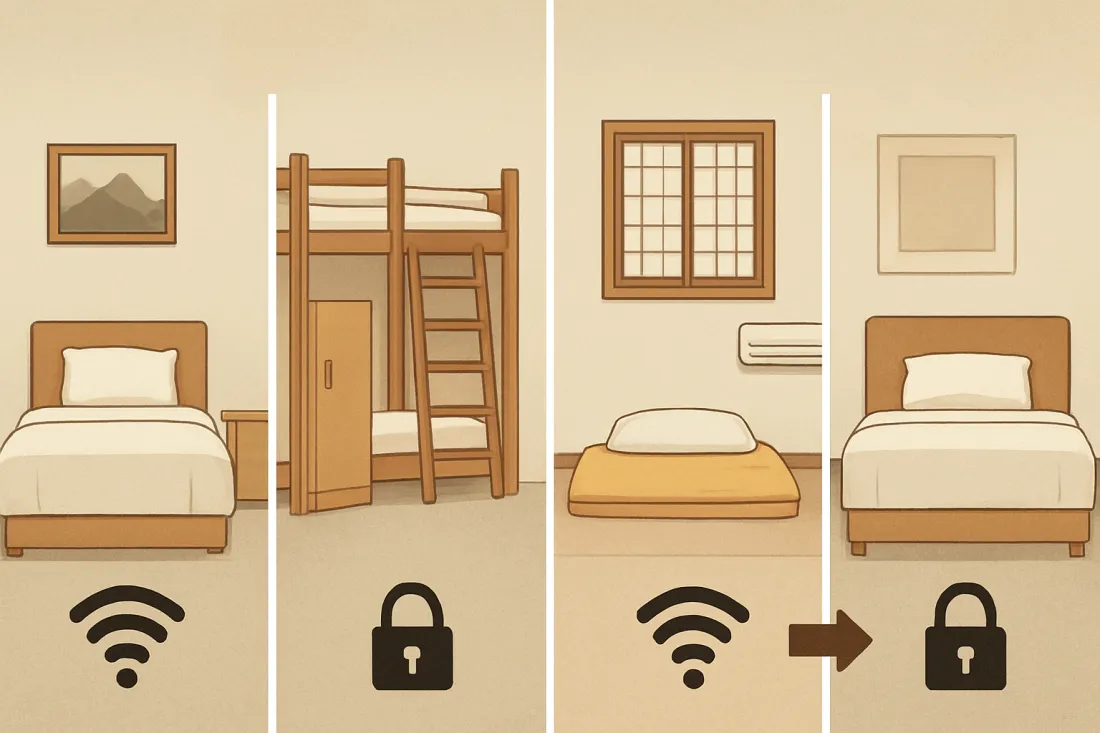
Minimum standards to expect from a Korean guesthouse
Guesthouses in Korea range from simple family homes to modern, hostel-style buildings. Even at the budget end, you can reasonably expect some basic standards. If any of these are missing or look doubtful in photos and reviews, think twice.
- Clean bedding and rooms – Sheets and pillowcases should look fresh in photos, not wrinkled and gray. Reviews should mention “clean” or “well maintained” more than “dusty” or “smelly.”
- Lockable entrance and rooms – A main entrance with a code or key, and at least a lock on dorm doors or private rooms. Lockers are a plus.
- Working heating and air conditioning – Winters in Korea are cold and summers are humid. Look for mentions of warm rooms in winter and strong AC in summer.
- Reasonable bathroom facilities – Shared bathrooms are common, but they should look clean in photos, with separate wet/dry areas or at least a shower curtain, and reviews should not complain about mold or constant flooding.
- Wi‑Fi throughout the property – Internet is widely available in Korea, so a guesthouse without Wi‑Fi or with only lobby Wi‑Fi is unusual.
- Basic safety awareness – Clear fire exits, not too much clutter in hallways, and no obvious exposed wiring in photos.
If a listing looks extremely cheap but fails several of these checks, it is usually better to pay a little more for a more reliable place.
Red flags in guesthouse photos and reviews
Photos and reviews are your best tools to avoid disappointing guesthouses. Instead of just skimming star ratings, look for specific warning signs.
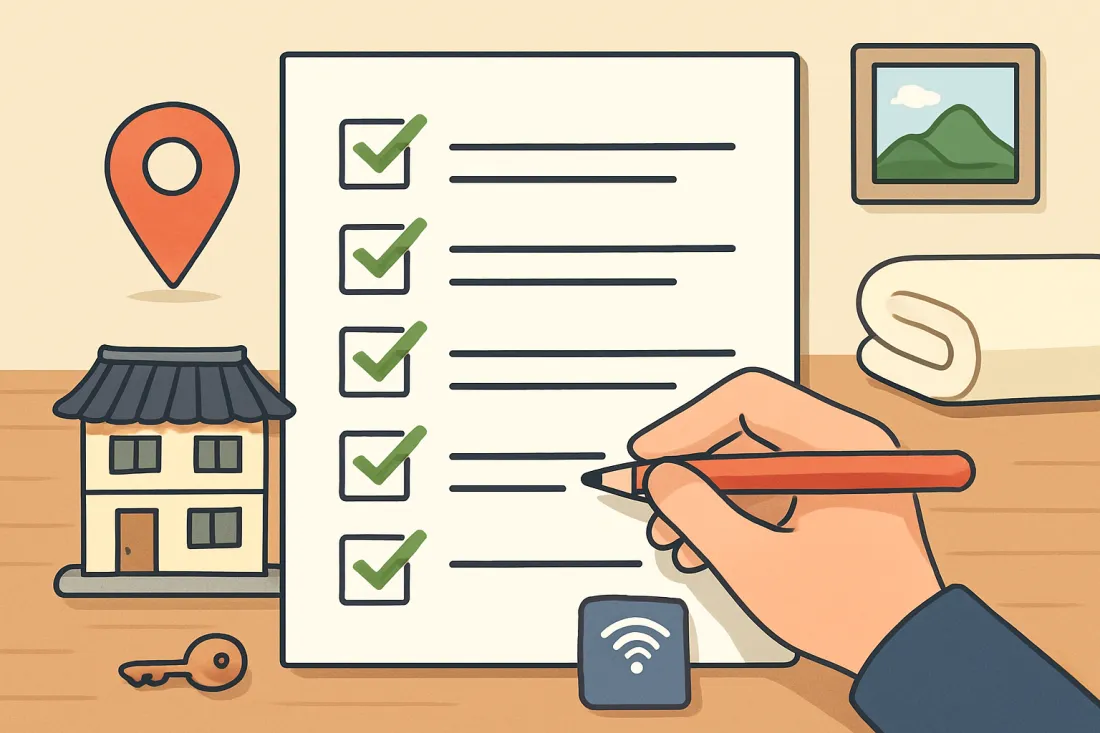
Photo red flags
- Only close‑up or artistic photos – Lots of photos of plants, coffee, or wall art, but none clearly showing the full room, beds, or bathrooms, can mean the owner is hiding cramped or worn spaces.
- Messy or cluttered common areas – Piles of personal items, boxes, or laundry in the living room or kitchen suggest poor housekeeping and less space for guests.
- Unmade or wrinkled beds in official photos – If the best photos show untidy bedding, the real‑life standard may be worse.
- No bathroom photos at all – This often signals very old or poorly maintained bathrooms.
- Windows blocked by heavy curtains or frosted glass – Rooms may have little natural light or face a wall or alley. That can feel claustrophobic, especially in basement rooms.
- Very low ceilings or steep, narrow stairs – Common in older houses and rooftop additions. This can be uncomfortable if you are tall or carrying large luggage.
Review red flags
Do not rely only on the average score. Read several of the most recent reviews and look for patterns, not one‑off complaints.
- Repeated mentions of noise – Words like “party,” “loud,” “thin walls,” “noisy street,” or “club downstairs” are important if you are a light sleeper.
- Comments about smell or mold – Mentions of “damp,” “mold,” or “bad smell” in rooms or bathrooms are hard to fix and usually do not improve quickly.
- Complaints about overbooking or last‑minute changes – If several guests say they were moved to a different room or another building, the management may be disorganized.
- Reports of staff rudeness or ignoring messages – Occasional misunderstandings happen, but repeated comments about being shouted at, ignored, or refused help are a serious warning.
- Many very short, generic 5‑star reviews – A long list of “Good!” or “Nice place” with no detail can be less trustworthy than fewer, more detailed reviews.
How to read between the lines of English and Korean reviews
In Korea, many guesthouses have a mix of international and local guests. Reviews may appear in English, Korean, or both. Each group tends to focus on slightly different things, and understanding that can help you interpret the comments more accurately.
What English‑language reviews often highlight
- Social atmosphere – Words like “friendly,” “met lots of people,” or “great for solo travelers” point to a social, hostel‑like vibe.
- Bed comfort and privacy – Look for mentions of “privacy curtains,” “comfortable mattress,” or “hard bed.”
- Location for sightseeing – Comments about being “close to the subway,” “easy to reach from the airport,” or “walking distance to main sights.”
- Language ability of staff – Mentions of “staff speak good English” can matter if you are nervous about communication.
What Korean‑language reviews often highlight
If you do not read Korean, you can still use automatic translation tools to get the gist. Common themes include:
- Cleanliness and facilities – Many Korean guests comment in detail on how clean the room and bathroom are, and whether facilities like hairdryers and toiletries are provided.
- Noise and building quality – You may see comments about “thin walls,” “soundproofing,” or “noisy upstairs neighbors.”
- Heating and cooling – Look for translated words like “warm,” “cold,” “AC,” or “too hot.”
- Exact walking time from station – Korean reviewers often mention how many minutes it really takes to walk from the nearest subway stop.
When English and Korean reviews agree on something (for example, “very clean but noisy at night”), you can treat that as a strong signal.
Location checks: map, hills, noise, nightlife, and safety
On a map, many Korean guesthouses look “central,” but the reality on the ground can be very different. Use these checks before you book:
- Distance to the nearest subway station – Check the walking route in a map app. A place that looks close “as the crow flies” may require a long detour around a hill or main road.
- Hills and stairs – Some neighborhoods, especially in older parts of Seoul and Busan, are built on steep hills with many stairs. Street‑view images and elevation lines can help you see if you will be climbing daily with luggage.
- Main street vs side street – Staying directly on a busy shopping or nightlife street can be noisy until late at night. A side street one or two blocks away is often much quieter while still convenient.
- Nightlife zones – Areas like Hongdae and other student or club districts are lively and fun but can be loud. Decide whether you want to be in the middle of that or just near it.
- Nearby facilities – Look for convenience stores, cafes, and late‑night food within a short walk. This makes early mornings and late returns easier.
- Perceived safety – Korea is generally considered safe, but you may still prefer well‑lit streets with some foot traffic at night. Street‑view images and reviews mentioning “felt safe walking back” can help.
If you are unsure, compare the guesthouse location with a known landmark or station you plan to use often. A few extra minutes’ walk each way, multiplied by several outings per day, can add up quickly.
Room types in Korean guesthouses explained
Korean guesthouses use a mix of international and local room types. Understanding the terms prevents surprises when you arrive.
| Room type | What it usually means | Best for | Things to check |
|---|---|---|---|
| Dormitory (mixed or female‑only) | Shared room with several bunk beds. Mixed includes all genders; female‑only is restricted to women. | Solo travelers, backpackers, anyone on a tight budget who does not mind sharing. | Number of beds per room, privacy curtains, lockers, age range of typical guests, and noise comments in reviews. |
| Twin room | Private room with two separate single beds. | Friends traveling together, siblings, or travelers who prefer their own bed. | Whether bathroom is private or shared, bed size, and whether beds can be pushed together if desired. |
| Double room | Private room with one double or queen‑size bed. | Couples or solo travelers who want more space and privacy. | Exact bed size, window or no window, and whether the bathroom is ensuite. |
| Ondol room | Traditional Korean heated floor with thin mattresses or futons laid directly on the floor. | Travelers curious about Korean style, families with kids who like floor space. | Number of futons provided, thickness of bedding, and whether you are comfortable sleeping on the floor. |
| Family room | Larger room designed for 3–5 people, often with a mix of beds or futons. | Families or small groups wanting to stay together. | Exact bed configuration, whether children are allowed, and if there is enough space for luggage. |
| Rooftop or terrace room | Room located on the top floor, sometimes with direct access to a rooftop terrace. | Guests who value views and outdoor space. | Stairs (no elevator), potential heat in summer or cold in winter, and noise from rooftop gatherings. |
Always check the maximum occupancy and whether the price shown is per person or per room, especially for dorms and family rooms.
Amenity checklist: Wi‑Fi, laundry, kitchen, lockers, heating/AC
Before you book, run through this amenity checklist and match it to your travel style.
- Wi‑Fi
- Is Wi‑Fi available in rooms as well as common areas?
- Do reviews mention stable or unstable connections?
- Laundry
- Is there a washing machine guests can use, and is it free or paid?
- Is there a dryer or at least indoor drying racks, especially in the rainy season?
- Kitchen or pantry
- Is there a shared kitchen with a fridge, microwave, and basic utensils?
- Is breakfast included, and if so, is it simple (toast and coffee) or more substantial?
- Lockers and storage
- Are lockers provided in dorms, and do they fit a full backpack or only small valuables?
- Are locks provided or do you need your own?
- Heating and air conditioning
- Is there individual control in each room or central control?
- Do reviews mention rooms being too hot or too cold in the season you are visiting?
- Bathrooms
- How many bathrooms are there per floor or per number of guests?
- Are toiletries (shampoo, body wash) and towels provided, or do you need to bring your own?
- Common areas
- Is there a lounge or rooftop where guests can relax or socialize?
- Are quiet hours respected in these spaces?
Policies to check: curfew, luggage storage, age limits, children
Policies can affect your daily schedule more than you might expect. Always read them carefully before confirming a booking.
- Curfew and quiet hours
- Some smaller guesthouses lock the main door at a certain time or ask guests to return before late night. Others have no curfew but enforce quiet hours.
- If you plan to enjoy nightlife or arrive late from day trips, make sure late entry is possible.
- Luggage storage
- Check whether you can leave bags before check‑in or after check‑out.
- Ask if storage is in a locked room or just in the lobby.
- Age limits
- Some hostels and guesthouses do not accept guests under a certain age in dorms.
- Others may prefer a quieter environment and not accept very young children.
- Children and extra beds
- Confirm whether children are allowed in the room type you choose.
- Check if extra futons or baby cots are available and whether there is an additional fee.
- Payment and cancellation
- See whether payment is taken in advance or on arrival.
- Check the cancellation deadline and any non‑refundable conditions.
- Smoking policy
- Most indoor spaces are non‑smoking, but some properties allow smoking on balconies or rooftops.
- If you are sensitive to smoke, look for reviews mentioning smoke smells in rooms or hallways.
Comparison: guesthouse vs other budget accommodation in Korea
If you are still unsure whether a guesthouse is right for you, compare it with other common budget options.
| Option | Typical vibe | Privacy level | Best for | Key trade‑offs |
|---|---|---|---|---|
| Guesthouse / hostel | Casual, social, often with shared spaces and activities. | Low to medium (dorms) to medium (private rooms with shared bathrooms). | Solo travelers, backpackers, people who like meeting others. | Cheaper and more social, but more noise and less privacy than hotels. |
| Budget hotel | More formal, less social, focused on private rooms. | Medium to high (private ensuite rooms). | Couples, business travelers, light sleepers. | More privacy and quiet, but usually fewer shared facilities like kitchens. |
| Short‑stay studio or apartment | Independent, home‑like, with your own kitchen. | High (entire space to yourself). | Longer stays, families, or groups wanting to cook. | Less on‑site support, may have stricter house rules or cleaning fees. |
If you want a deeper overview of all these options, you can also read about budget accommodation in South Korea and how they compare.
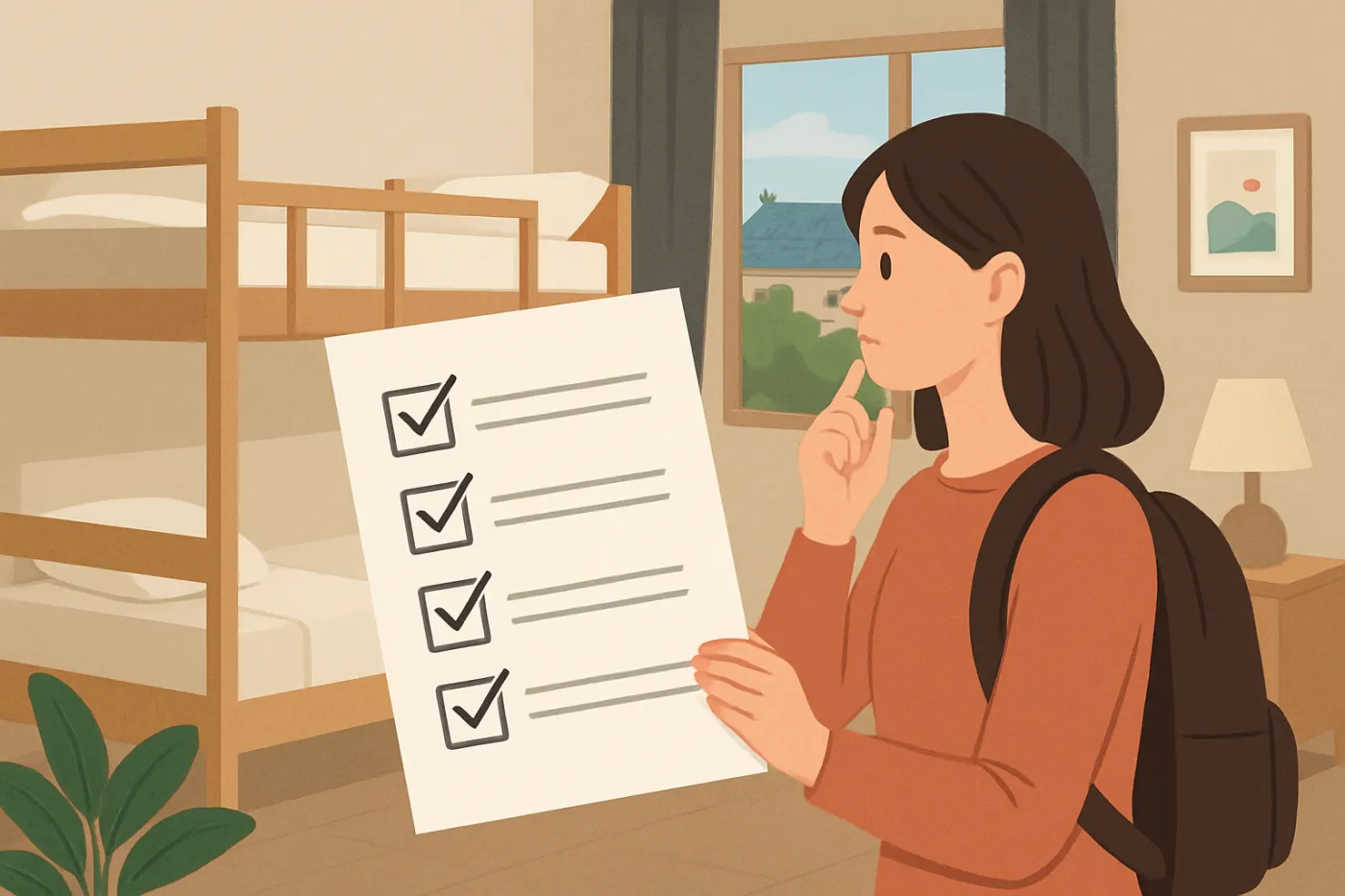
Structured checklist: pre‑booking guesthouse evaluation
Use this step‑by‑step checklist before you click “book.” It helps you compare several guesthouses quickly and consistently.
You have found one or more guesthouses in Korea that fit your rough budget and dates, but you are not sure which one will actually suit your travel style and comfort needs.
For each guesthouse you are considering, gather: the listing page, recent photos, at least five recent reviews (including any in Korean, translated if needed), and a map view showing the nearest subway station and main streets.
Evaluate each guesthouse in this order: (1) Check location: walking time to the subway, hills, and whether it is on a main nightlife street or a quieter side street. (2) Confirm room type and capacity: dorm vs private, bed type, ensuite or shared bathroom, and whether the price is per person or per room. (3) Scan photos for red flags: missing bathroom photos, clutter, blocked windows, or very low ceilings. (4) Read reviews for patterns: repeated comments about noise, cleanliness, staff attitude, or temperature problems in the season you will visit. (5) Tick off key amenities: Wi‑Fi in rooms, lockers, laundry, kitchen access, heating/AC, and luggage storage. (6) Read policies: curfew, age limits, children, smoking, and cancellation rules. (7) Score each place from 1 to 5 on your top three priorities (for example, quiet sleep, social vibe, and location) and choose the one with the best overall match, not just the lowest price.
After choosing, double‑check that your booking confirmation shows the correct room type, number of guests, and dates. Save screenshots of the listing details, especially photos and key promises (like private bathroom or breakfast included). If anything in the confirmation does not match what you saw earlier, contact the property immediately to clarify or adjust before your trip.
Common mistakes when choosing a guesthouse in Korea
Avoid these frequent errors that lead to disappointment:
- Choosing only by price – The cheapest option can be far from the subway, on a steep hill, or in a very noisy area. A slightly higher price often buys much better sleep and convenience.
- Ignoring room type details – Booking a “room” without noticing it is a dorm bed, or assuming “private room” means private bathroom when it does not.
- Not checking the season – A room that is fine in spring may be uncomfortably hot in summer or cold in winter if heating and AC are weak.
- Overlooking curfew and access rules – Arriving late to find the door locked or being told you cannot check in after a certain time can ruin your first night.
- Assuming all reviews match your priorities – Some guests love a party atmosphere; others hate it. Read reviews from people with similar travel styles to yours.
- Not having a backup plan – Very occasionally, a place may look different from the photos. Having a second option saved nearby reduces stress.
What to do if you arrive and the place is not as described
Even with careful research, you might occasionally arrive at a guesthouse that feels very different from what you expected. Stay calm and follow a simple process.
- Check whether the problem is minor or major
- Minor: missing towel, light bulb out, slightly smaller room than expected, temporary noise from nearby construction.
- Major: room type is wrong (dorm instead of private), serious cleanliness issues, strong mold smell, unsafe feeling, or no working heating/AC in extreme weather.
- Speak to the staff politely first
- Explain the issue clearly and show your booking confirmation or screenshots if the room type or facilities are different from what was advertised.
- Ask for a solution: a different room, extra cleaning, or fixing the problem.
- Decide whether to stay or move
- If the staff respond quickly and fix the problem, the stay may still be comfortable.
- If major issues remain and you do not feel comfortable, it may be better to move to your backup option.
- Document your experience
- Take photos or short videos of any serious mismatch between the listing and reality.
- Keep notes of conversations and any offers made by the property.
- Follow up with the booking platform if needed
- If you booked through a platform and feel the listing was misleading, use the platform’s support channels to report the issue and request help.
- Provide your documentation to support your case.
- Leave a fair, detailed review afterward
- Describe both positives and negatives, and mention how the staff handled the problem.
- This helps future travelers make better decisions and encourages properties to improve.
FAQ about choosing a guesthouse in Korea
What is a Korean guesthouse, and how is it different from a hotel?
A Korean guesthouse is usually a small, budget‑friendly place that combines elements of a hostel and a homestay. You often find dormitory beds and simple private rooms, shared kitchens and lounges, and a more casual, social atmosphere than in hotels. Hotels focus on private ensuite rooms and professional service, while guesthouses focus more on community spaces and value for money.
Is a guesthouse in Hongdae too noisy for light sleepers?
Hongdae is known for nightlife, live music, and busy streets, so some guesthouses there can be noisy, especially on weekends. If you are a light sleeper, look for places a few minutes’ walk away from the main club and bar streets, and read reviews carefully for comments about noise. Choosing a private room on a higher floor or facing a side street can also help.
How can I tell if a Korean guesthouse is safe for solo travelers?
Look for clear entrance security (keypad or key), lockers in dorms, and reviews from other solo travelers mentioning that they felt comfortable. A staffed reception, well‑lit entrance, and a location near a subway station and main streets also contribute to a sense of safety. If reviews mention guests feeling uneasy or staff ignoring concerns, consider another option.
What should I check if I want to stay in an ondol room?
Ondol rooms use heated floors and thin mattresses on the floor instead of raised beds. Check how many futons are provided, whether extra bedding is available, and read reviews about comfort. If you have back problems or are not used to sleeping on the floor, you may prefer a regular bed or limit ondol stays to one or two nights as an experience.
Do Korean guesthouses usually have a curfew?
Some small, family‑run guesthouses still have curfews or prefer guests to return by a certain time, while many modern hostel‑style places allow 24‑hour access with a door code. Always read the house rules and reviews; if you plan to enjoy nightlife or arrive late from day trips, choose a place that clearly states 24‑hour access or no curfew.
How far from the subway is too far for a guesthouse in Seoul?
Comfortable walking distance depends on your fitness, luggage, and how often you will go in and out each day. Many travelers find that being within several minutes’ walk of a subway station feels convenient, especially if the route is flat and well lit. If the walk includes steep hills or many stairs, even a short distance can feel long when you are tired or carrying bags, so always check the actual walking route on a map.