Family accommodation in Korea on a budget usually means choosing between a small hotel room, a larger family or ondol room, or an apartment-style guesthouse. The best value for most families is often one larger room or a small apartment in a guesthouse, booked with clear confirmation of how many people are included in the price and what counts as a child.
Below is a practical guide to comparing options, avoiding surprise extra charges, and planning logistics for kids, luggage, and strollers in South Korea.
How Korean accommodation pricing works for families and groups
To keep a family or group stay in Korea on budget, it helps to understand how properties usually count guests and set prices.
Per room vs per person pricing
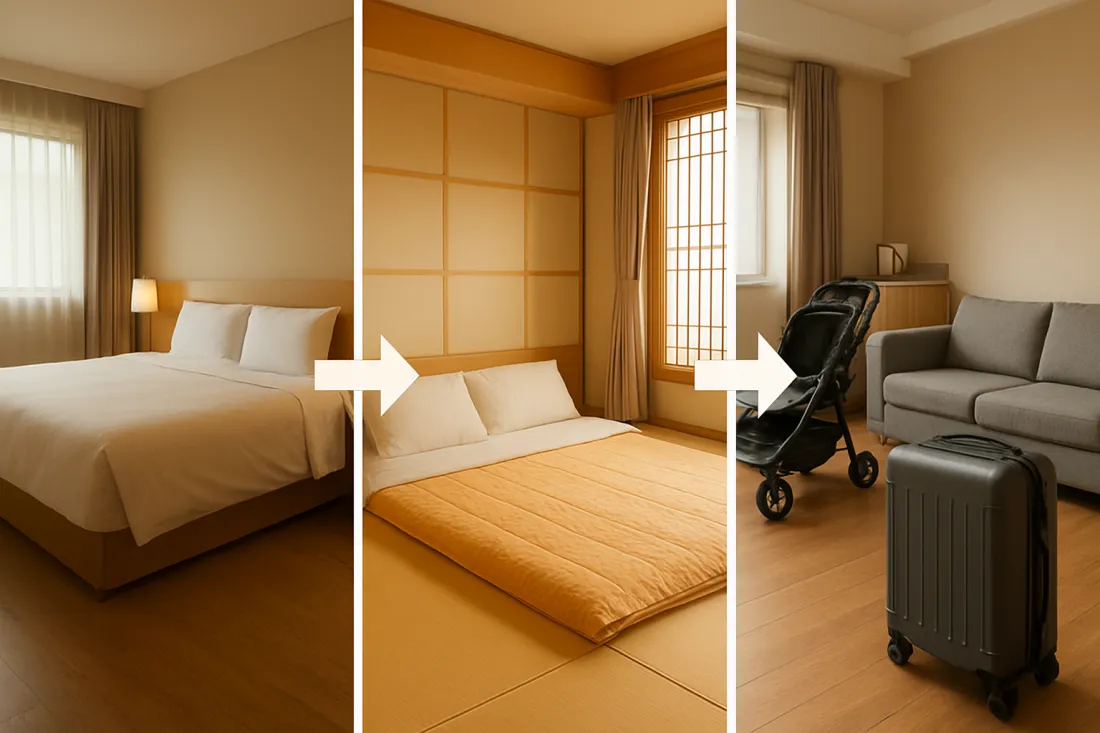
- Most hotels: Price is shown per room, but only up to a stated maximum occupancy (for example, 2 adults + 1 child). Adding more people often triggers an extra-person fee or requires a different room type.
- Many guesthouses and small inns: Price may be closer to per person, especially in dorms or simple rooms. The base rate might assume 2 people, then a small extra charge per additional guest.
- Apartment-style stays: Often show a base price for a certain number of guests, then a clear extra charge for each additional person above that number.
Always check the “maximum occupancy” and how many people are included in the base price before you compare options.
How children are counted
Child rules vary by property, so you cannot assume one standard. Typical patterns include:
- Infants: Often stay free if they share existing bedding. Some places define infants as under 24 months, others under 36 months. You need to confirm the exact age rule.
- Young children: Some properties allow one child under a certain age to stay free when using existing beds; others charge a reduced extra-person fee.
- Older kids and teens: Commonly counted as adults for occupancy and pricing, especially in city hotels.
Because rules differ, always check the property’s child policy and send a short message with your children’s exact ages before you finalize a booking.
Common extra charges that affect a family budget
Even when the nightly rate looks good, families and groups can face add-ons that push the total cost higher than expected. Typical extra charges include:
- Extra bedding: Floor mattresses (yo), extra duvets, or an additional bed for a child or adult may cost extra per night. Some guesthouses include a set number of floor mattresses in the room price; others charge per piece.
- Breakfast: Budget stays sometimes do not include breakfast. Paying for breakfast for four or five people every day can add up quickly, especially in hotel restaurants.
- Towels and amenities: In some low-cost guesthouses, only one small towel per person is included. Extra towels or amenities may have a small fee.
- Late check-out or early check-in: Families arriving early with tired kids or leaving late for a night flight may pay a half-day or hourly fee to access the room outside standard times.
- Cleaning fees (apartments): Apartment-style stays sometimes add a one-time cleaning fee on top of the nightly rate. This can be good value for longer stays, but expensive for just one night.
- Parking: If you rent a car, some city hotels charge for parking, while many guesthouses in residential areas may not have parking at all.
When you compare options, look at the total cost for your whole stay, including any likely extras, not just the base nightly rate.
Room types for families in Korea and how they usually price
Understanding common room types helps you match your family’s needs and avoid paying for space you will not use.
Standard hotel room
- Typical layout: One double bed or two single beds.
- Best for: Solo travelers or couples; sometimes a couple with a baby sharing the bed.
- Budget impact: Often the cheapest per room, but not always the cheapest per person for a family of four or more.
Family room
- Typical layout: One double plus one or two single beds, or multiple single beds in one room.
- Best for: Families with two or three kids who prefer beds rather than floor sleeping.
- Budget impact: Higher nightly rate than a standard room, but often cheaper than booking two separate rooms in the same hotel.
Ondol (floor-heated) room
- Typical layout: Heated floor with foldable mattresses and bedding stored in a closet.
- Best for: Families comfortable with sleeping on the floor, especially with younger kids who roll around at night.
- Budget impact: Can be very good value for 3–5 people in one space. The price often scales with the number of guests.
Connecting rooms
- Typical layout: Two separate rooms with an internal door between them.
- Best for: Larger families or groups who want more privacy and two bathrooms.
- Budget impact: Usually similar to booking two separate rooms, but more convenient. Sometimes a small discount is offered for a family package, but this is not guaranteed.
Apartment-style guesthouse or serviced apartment
- Typical layout: One or two bedrooms, small living area, basic kitchen, and sometimes a washing machine.
- Best for: Families staying several nights in one city, or small groups who want to cook simple meals and do laundry.
- Budget impact: Nightly rate can be higher than a single hotel room but competitive or cheaper than two hotel rooms once you factor in cooking, laundry, and shared space.
Sample cost comparison: two rooms vs one family room vs small apartment
The exact prices change by city, season, and property, but the pattern of costs is fairly consistent. The table below shows how a family of four (two adults, two children) might compare options for a three-night stay in a major Korean city.
| Option | What you get | Typical cost pattern for 3 nights | When it is usually best value | Main risks or trade-offs |
|---|---|---|---|---|
| Two standard hotel rooms | 2 rooms, 2 bathrooms, 2 beds per room | Often higher total cost than one family room; sometimes similar to a small apartment | Families with teens who want privacy; groups of 4 adults | Need to pay for two rooms; rooms may be on different floors if not guaranteed together |
| One family room | 1 larger room with 3–4 beds or bed + sofa bed | Usually cheaper than two rooms in the same hotel for the same dates | Families with younger kids who sleep at similar times | Less privacy; lights-out time must suit everyone; limited space for luggage |
| Ondol room for 4 | 1 room, floor mattresses, shared bedding space | Often among the lowest per-person costs for 3–4 people | Families comfortable with floor sleeping and sharing one open space | Not ideal for people with knee/back issues; may feel crowded with lots of luggage |
| Small apartment-style guesthouse | 1 bedroom + living area, basic kitchen, washing machine | Base rate may be similar to or slightly above a family room; good value for 3+ nights | Stays of several nights where you can cook simple meals and do laundry | Cleaning fee can make short stays expensive; may have stricter house rules |
Before you decide, compare the total stay cost for your exact dates and group size, including any cleaning fees, breakfast, and likely extra bedding charges.
Strategies to keep family accommodation in Korea on budget
1. Consider apartment-style guesthouses for stays of 3 nights or more
For a short city break, a family room in a hotel can be simple and cost-effective. For longer stays, a small apartment or guesthouse unit often becomes better value because you can:
- Prepare simple breakfasts and snacks instead of eating out every time.
- Do laundry, which lets you pack lighter and avoid extra baggage fees.
- Use the living area as a separate space once kids are asleep.
When comparing, remember to include any one-time cleaning fee in your calculation.
2. Look slightly outside the busiest tourist cores
In big cities, accommodation right next to the most famous sights is usually more expensive. Staying one or two subway stops away can reduce your nightly rate while still keeping travel times short. For example, if you are researching the best area to stay in Seoul on a budget, you will find several neighborhoods that balance price and convenience.
When you look outside the core, check:
- Walking distance to a subway station or major bus stop.
- Presence of nearby convenience stores and simple restaurants.
- Whether the area feels comfortable to walk in the evening with kids.
3. Travel in shoulder or off-peak periods when possible
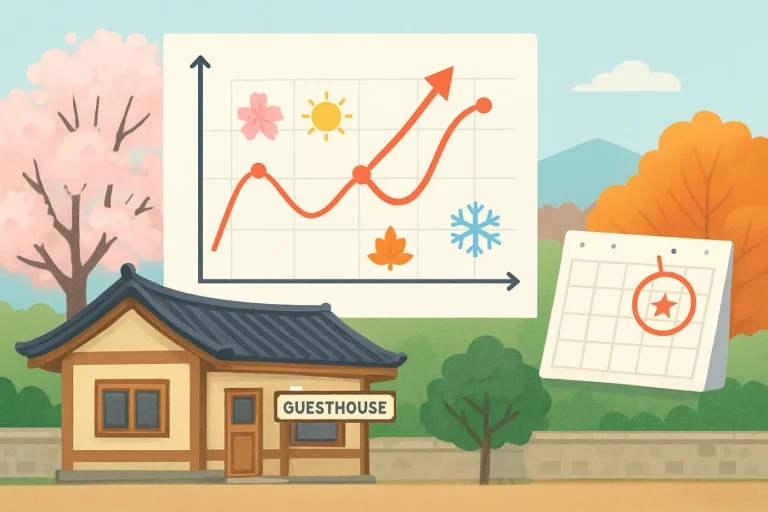
Accommodation prices in Korea can rise during major holidays, cherry blossom season, autumn foliage, and big festivals. If your dates are flexible, shifting your trip by a few days away from peak weekends or holidays can open up more budget-friendly options and family rooms that sell out quickly at busy times.
4. Use guesthouses strategically
Guesthouses in Korea range from simple dorm-style places to cozy family-run properties with private rooms. They can be especially good value for independent travelers and small groups. If you are not sure how they work, it helps to read more about what is a guesthouse in Korea before you book.
Guesthouses can be budget-friendly if you:
- Choose private family rooms instead of multiple dorm beds.
- Confirm whether towels, toiletries, and breakfast are included.
- Check quiet hours and whether children are welcome, as some guesthouses focus on younger backpackers.
5. Balance location with transport costs
Cheaper accommodation far from the subway can become expensive once you add daily taxi fares, especially with strollers or tired kids at night. When you compare options, think about:
- How many times per day you will travel in and out of the area.
- Whether you are comfortable walking 10–15 minutes with children and luggage.
- How easy it is to reach the airport or train station from the property.
Decision guide: which option suits your family or group?
The right choice depends on your group size, ages, and travel style. The table below compares the main options by scenario.
| Family / group scenario | Best-fit accommodation type | Why it often works best | What to double-check before booking |
|---|---|---|---|
| 2 adults + baby or toddler | Standard hotel room or small guesthouse room | Baby can share existing bed or use a travel cot; you avoid paying for extra beds | Child age rules, availability of a baby cot, and whether the room size is enough for a cot and stroller |
| 2 adults + 2 young kids | Family room, ondol room, or small apartment | Everyone in one space keeps costs lower and makes bedtime easier | Maximum occupancy, number of actual sleeping places, and extra bedding fees |
| 2 adults + 2 teens | Two standard rooms or connecting rooms | Teens get privacy and their own beds; two bathrooms reduce morning stress | Whether rooms can be guaranteed close together and how many people are allowed per room |
| Group of 4–6 adults | Apartment-style guesthouse or multiple rooms in a guesthouse | Shared living space for social time; kitchen for simple meals | House rules on noise, maximum number of guests, and any per-person extra charges |
| Family staying 5+ nights in one city | Apartment-style guesthouse or serviced apartment | Kitchen and laundry save money over time; more space for kids to play | Cleaning fee, deposit rules, and check-in instructions (self check-in vs host meeting) |
Structured checklist: questions to ask before booking family or group accommodation
You have narrowed down a few accommodation options in Korea for your family or small group and want to avoid surprise charges or unsuitable house rules. You know your travel dates, group size, and the ages of all children, but the booking details are not completely clear.
Before confirming any reservation, send a short, clear message to the property (or check the listing details) using this checklist:
- Guest count and ages
“We are [number] adults and [number] children aged [list ages]. Is this room type suitable and within your maximum occupancy?” - Child policy and extra-person fees
“Are there any extra charges for children of these ages if they share existing beds? If we need extra bedding, what is the nightly fee?” - Bed and bedding details
“How many separate beds or floor mattresses are included in the price? Are pillows, blankets, and sheets provided for each person?” - Breakfast and kitchen use
“Is breakfast included for all guests? If not, what are the options nearby? If there is a kitchen, are we allowed to cook simple meals?” - Check-in and check-out times
“What are your standard check-in and check-out times? What are the fees for early check-in or late check-out, if available?” - Stroller, luggage, and access
“Is there an elevator? Are there many stairs? Is there space in the room or apartment to store a stroller and several suitcases?” - Noise and quiet hours
“What are your quiet hours? Are there any restrictions on children playing or making noise in the evenings?” - Parking and transport
“If we arrive by car, is parking available and is there a fee? How far is the nearest subway or bus stop on foot?” - House rules for visitors
“Are outside visitors allowed during the day? Is there a maximum number of people allowed in the room or apartment at any time?”
After you receive answers, check that: (1) the total number of guests and ages are clearly accepted, (2) all extra fees are written down in your notes, and (3) the room layout and access match your stroller and luggage needs. If any answer is vague or inconsistent with the listing, ask for clarification or choose another property before you pay.
Strollers, car seats, and luggage: how they affect your costs
Transport logistics can quietly increase your budget if you do not plan for them.
Strollers
- Subway and buses: Major subway stations often have elevators, but not always in the most direct location. Allow extra time for transfers with a stroller.
- Taxis: Standard taxis can usually fit a compact stroller in the trunk, but large double strollers plus multiple suitcases may require a bigger vehicle.
- Accommodation: In small guesthouses without elevators, carrying a stroller up narrow stairs can be tiring. Ask about elevators and room floor level before booking.
Car seats
- Airport transfers: If you want car seats for young children, you may need to pre-book a private transfer service that can provide them, which usually costs more than a standard taxi or train.
- Rental cars: Renting car seats adds to the daily rental cost. Compare this with the cost and convenience of using public transport, especially in large cities where parking can be limited.
- Bringing your own: If you bring car seats from home, factor in airline baggage rules and how you will store them in your accommodation.
Luggage
- Number and size of bags: Multiple large suitcases can push you toward taxis or larger vehicles instead of cheaper public transport, especially when moving between cities.
- Storage space in rooms: Compact hotel rooms may feel crowded with several suitcases, especially in family rooms or ondol rooms where floor space is also sleeping space.
- Luggage delivery services: In some cases, sending one large suitcase ahead between cities can be more comfortable than carrying everything with you, though it adds a separate fee.
To keep costs down, try to pack lighter, choose compact strollers, and confirm elevator access when booking multi-story accommodation.
Safety and noise-related house rules families should know
Many Korean accommodations have clear house rules that help keep buildings quiet and safe, especially in mixed residential areas.
- Quiet hours: Guesthouses and apartments commonly set quiet hours at night. Families with very energetic children may prefer properties with thicker walls or more space to avoid stress about noise.
- Balcony and window safety: In high-rise buildings, always check balcony doors and window locks as soon as you arrive, especially with younger children.
- Shoes-off policy: Many places ask guests to remove shoes at the entrance or inside the room. This keeps floors clean for children who play or sleep on the floor.
- Cooking and fire safety: If your accommodation has a gas stove or hotplate, check how to use it safely and where the ventilation is. Some properties limit heavy cooking to avoid smells and fire risk.
- Visitor limits: Apartment-style stays may restrict parties or extra visitors. If you plan to meet local friends or relatives, confirm the rules to avoid penalties.
Common mistakes that increase family accommodation costs
A few avoidable errors often make a “budget” trip more expensive than planned.
- Not listing all guests when booking: Trying to save money by booking for fewer people can lead to extra-person fees at check-in or even refusal of entry if occupancy rules are strict.
- Ignoring child age rules: Assuming that all children stay free can backfire. Always match your children’s real ages to the property’s policy.
- Overlooking cleaning and service fees: Focusing only on the nightly rate and forgetting cleaning or service fees can make an apartment stay more expensive than a hotel for short trips.
- Booking far from public transport: A cheaper room that requires multiple taxis per day can end up costing more than a slightly pricier place near a subway station.
- Not checking for elevators: Carrying strollers and heavy luggage up several flights of stairs can be exhausting and may push you toward taxis instead of walking or using the subway.
- Assuming breakfast is included: Paying for hotel breakfast for four or five people every day can quickly exceed the savings from a slightly cheaper room rate.
Step-by-step process to choose budget-friendly family accommodation in Korea
- Define your priorities. Decide what matters most: lowest price, shortest commute, kitchen access, separate bedrooms, or hotel-style services.
- Set a realistic nightly budget range. Use a flexible range rather than a single number so you can compare different types of stays. If you need more detail, you can also review general patterns for South Korea budget accommodation cost.
- Choose 1–2 target neighborhoods. Look for areas with good public transport, food options, and a safe feel for walking with kids.
- Filter by room type and occupancy. Search specifically for family rooms, ondol rooms, or apartments that clearly allow your full group size.
- Check total stay cost, not just nightly rate. Add up the base price, cleaning fees, likely breakfast costs, and any extra bedding or parking fees.
- Read house rules and child policies carefully. Confirm quiet hours, visitor rules, and whether children of your kids’ ages are accepted.
- Use the checklist to message the property. Clarify any doubts about beds, extra charges, stroller access, and check-in times.
- Compare 2–3 finalists. Weigh location, space, and total cost. For example, compare one family room, one ondol room, and one apartment-style guesthouse for the same dates.
- Book the option that fits your real daily routine. Think about nap times, meal prep, and how often you will move luggage. The cheapest option on paper is not always the easiest for your family.
Clarification: what this site does and does not do
This guide is designed to help you understand your options and ask the right questions when booking family or group accommodation in Korea. It does not handle reservations, payments, or family packages, and it cannot confirm availability or prices for specific dates. Always complete bookings directly with your chosen accommodation or a trusted booking platform.
FAQ about budget family accommodation in Korea
Is $1000 enough for a week in South Korea for a family?
Whether $1000 is enough for a week depends on how many people are traveling, your accommodation style, and how much you spend on food and activities. For a solo traveler or a very frugal couple staying in budget guesthouses and eating mostly simple local meals, $1000 might cover a week comfortably. For a family of four paying for accommodation, transport, food, and attractions, $1000 for the entire trip is likely to feel tight. A practical approach is to estimate a daily range for accommodation, then add a reasonable amount per person for meals and transport, and see how that compares with your total budget.
What are some family-friendly accommodation options in Seoul on a budget?
Budget-friendly family options in Seoul typically include small hotels with family rooms, guesthouses offering private ondol rooms, and compact apartment-style stays with a kitchenette. Areas one or two subway stops away from the busiest tourist streets often offer better value while still being convenient for sightseeing. When you search, filter for properties that explicitly mention family rooms, extra beds, or child-friendly facilities, and always confirm maximum occupancy and child policies before booking.
What is the 52-hour rule in South Korea, and does it affect tourists?
The 52-hour rule is a term related to working hours for employees in South Korea. It does not directly affect tourists or how you book accommodation. The main impact you might notice as a visitor is that some attractions, shops, or services may have specific opening hours based on local labor rules, so it is always wise to check current opening times for museums, theme parks, and other attractions you plan to visit.
Is 30,000 won a lot in Korea for daily spending?
How far 30,000 won goes in a day depends on your spending style. For a budget traveler who eats simple local meals, uses public transport, and visits mostly free or low-cost attractions, 30,000 won per person can cover basic daily expenses excluding accommodation. For a family paying for multiple attraction tickets, cafe visits, and occasional taxis, 30,000 won per person may not be enough. When planning, separate your expected accommodation cost from your daily spending money so you can see clearly whether your daily allowance is realistic.
How can a family of four avoid surprise extra charges at Korean hotels and guesthouses?
To avoid surprise charges, always book for the full number of guests, check child age rules, and confirm in writing how many beds or floor mattresses are included in the price. Ask specifically about extra-person fees, extra bedding, breakfast costs, and any cleaning or service fees. Use the structured checklist above as a template for your message to the property, and keep their reply so you can refer to it at check-in if needed.
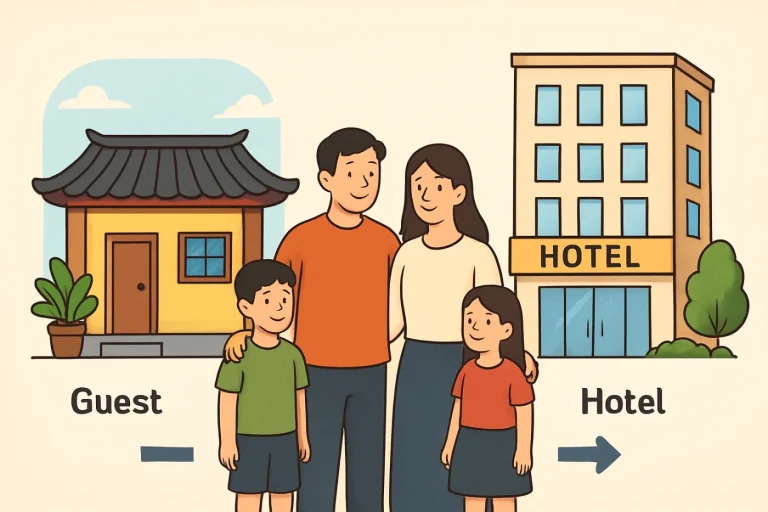
Is a guesthouse or a hotel better for kids and teens in Korea?
Both can work well, depending on your children’s ages and your budget. Hotels usually offer more predictable facilities and soundproofing, which can be helpful with younger kids. Guesthouses can provide more personal interaction, shared kitchens, and sometimes larger family or ondol rooms at lower cost. If you are deciding between them, it can help to read a focused comparison of family accommodation in Korea guesthouse vs hotel and then match those pros and cons to your own family’s needs.