How to pay in South Korea as a tourist: the practical overview
South Korea is one of the most card-friendly and cashless countries in the world, but as a tourist you still need a mix of payment options. For most city spending you can rely on a Visa or Mastercard credit/debit card, plus a local transport card such as T-money. You will also want some Korean won cash for guesthouses, markets, street food, and small local places, and a plan for using ATMs or exchanging money without paying unnecessary bank and exchange fees.
If you prepare one main card, one backup card, a small starter amount of cash, and a way to top up a transport card, you can comfortably pay for guesthouses, food, and everyday expenses across Seoul, Busan, and other cities.
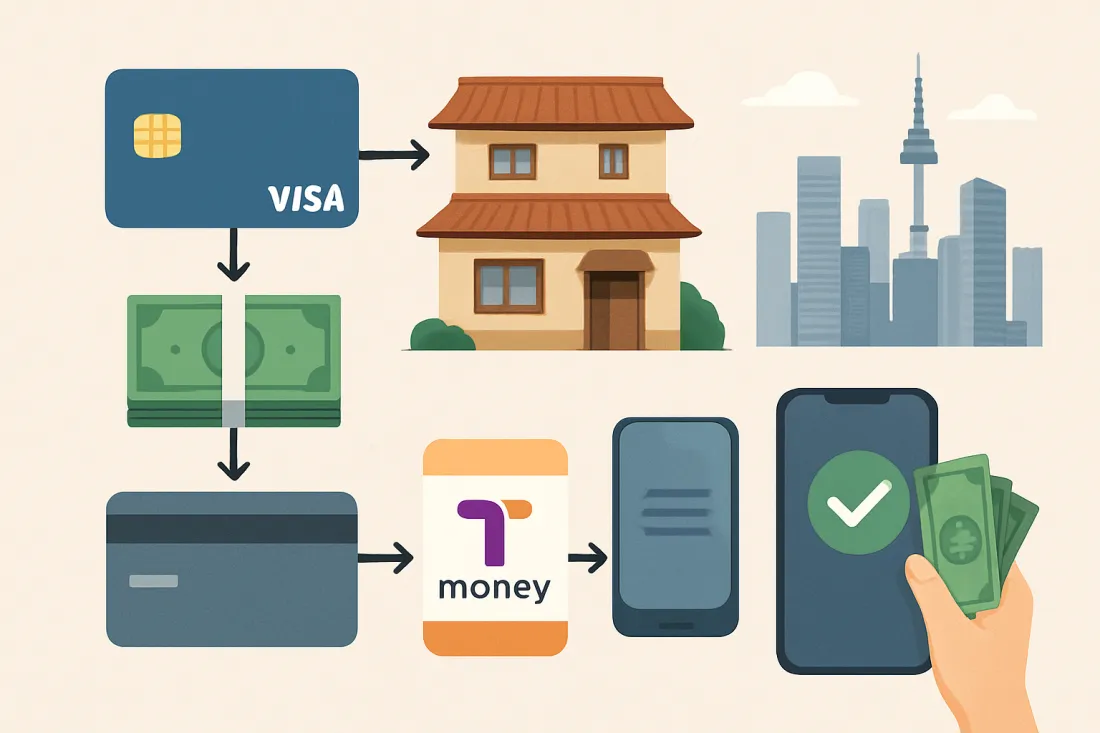
How card-friendly is South Korea for foreign visitors
Tourists are often surprised by how easy it is to pay by card in South Korea, especially in big cities and tourist areas. However, there are still important exceptions that matter for guesthouses and budget travel.
Where foreign cards usually work well
- Mid-range and large hotels – Front desks almost always accept international credit and debit cards.
- Chain cafes and bakeries – Popular coffee chains and bakeries typically accept Visa and Mastercard.
- Department stores and big shops – Large shopping malls and brand stores are very card-friendly.
- Most sit-down restaurants in city centers – Especially in Seoul and Busan, many restaurants accept cards, though very small family places may prefer cash.
- Online bookings for accommodation – If you prepay a guesthouse or hotel through a booking platform, your card is charged in advance and you only pay extras on site.
Where cards can be unreliable or not accepted
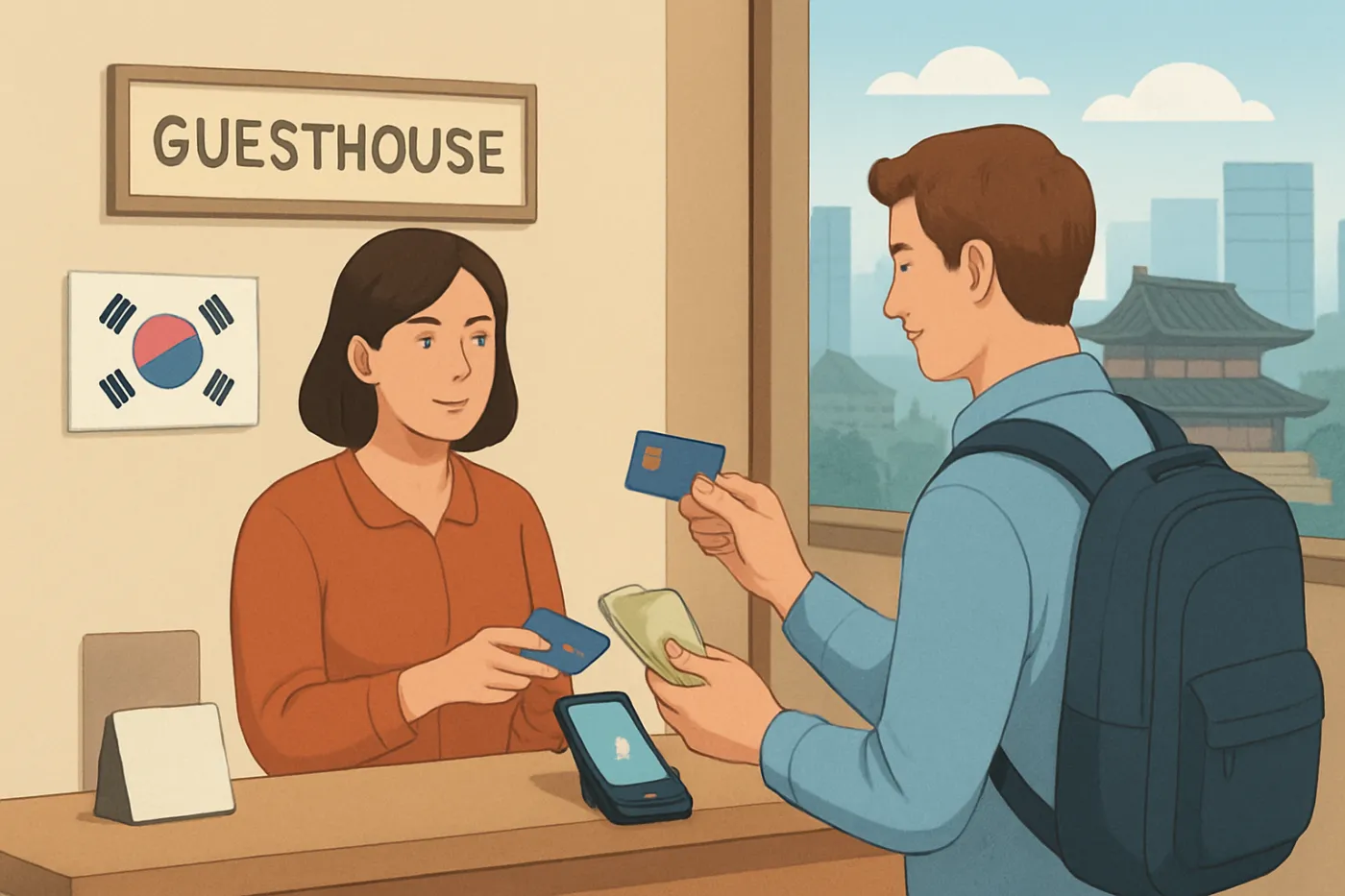
- Small guesthouses and family-run hostels – Some accept card on site, but many prefer cash on arrival or bank transfer. Always check the property’s payment policy before you book. If you are still choosing where to stay, it can help to read a guide on what is a guesthouse in Korea so you know what to expect.
- Traditional markets and street food stalls – Many vendors are cash-only or have card readers that work better with local cards.
- Small neighborhood restaurants and bars – Especially outside tourist zones, some places prefer cash for small bills.
- Transport card top-ups – You usually top up T-money and similar cards with cash at machines or convenience stores.
- Rural areas and small towns – Card acceptance is improving, but cash is still safer for buses, taxis, and small shops.
Credit vs debit cards in Korea
Both credit and debit cards from major networks (Visa, Mastercard, sometimes others) can work in Korea, but there are differences:
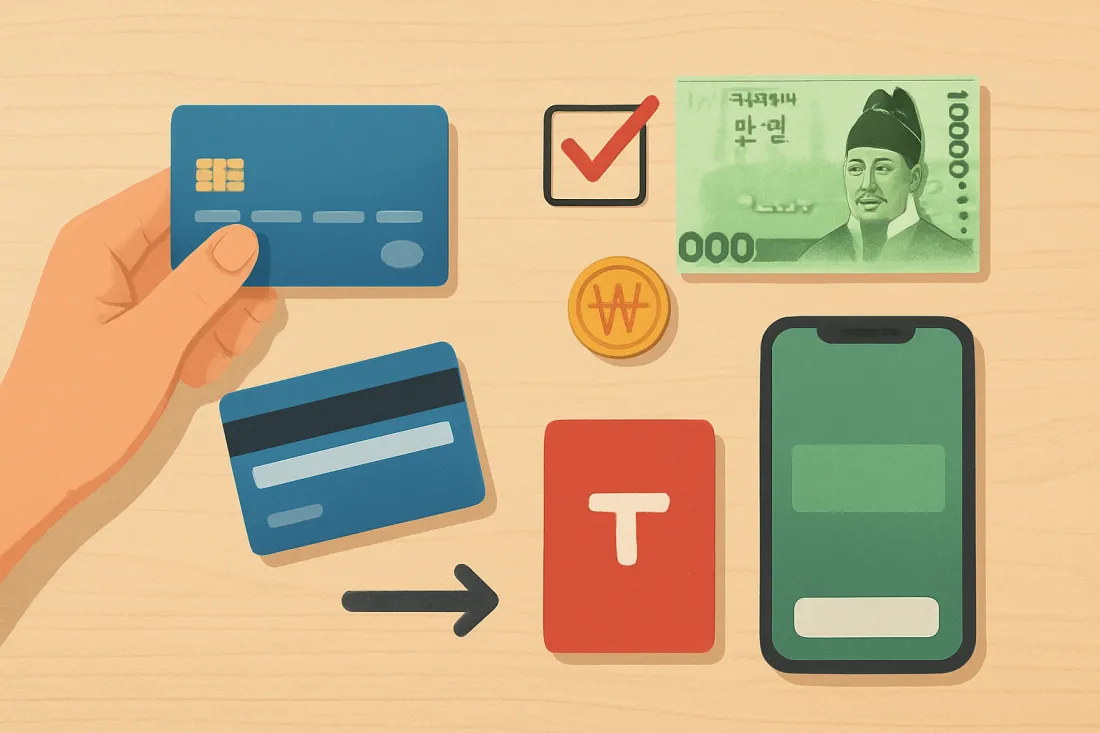
- Credit cards – Often more widely accepted, may include better fraud protection and travel benefits, but can charge foreign transaction fees.
- Debit cards – Useful for ATM withdrawals and everyday spending, but some banks block foreign transactions by default or use less favorable exchange rates.
Before you travel, confirm with your bank that your cards will work in South Korea and ask about fees for purchases and ATM withdrawals.
Foreign transaction fees and dynamic currency conversion
Even when your card works smoothly in Korea, hidden bank and exchange fees can make your trip more expensive. Two main things to watch are foreign transaction fees and dynamic currency conversion.
Foreign transaction fees on your card
Many banks charge an extra percentage on every purchase made in a foreign currency. The exact percentage depends on your bank and card type, so you need to check your own card’s terms. When you look at your card agreement or banking app, pay attention to:
- Foreign transaction fee for purchases – Often shown as a percentage of the amount in Korean won.
- ATM withdrawal fee abroad – A fixed amount per withdrawal, a percentage, or both.
- Extra network or international service fees – Sometimes listed separately.
If you have more than one card, choose the one with the lowest combined foreign transaction and ATM fees as your main travel card, and keep another as a backup.
Dynamic currency conversion (DCC) in Korea
Dynamic currency conversion is when a card terminal or ATM offers to charge you in your home currency instead of Korean won. It looks convenient, but the exchange rate is usually worse than your bank’s own rate.
At shops, hotels, or ATMs in Korea you may see a screen asking something like:
- “Pay in KRW” vs “Pay in [your currency]”
- “Convert to your home currency?”
To avoid extra costs:
- Always choose to pay in Korean won (KRW) when given a choice.
- Decline conversion to your home currency on ATMs and payment terminals.
- Check the receipt if you are unsure which option was selected.
Cash needs for guesthouses, deposits, and everyday spending
Even in a highly cashless country, cash still matters for budget accommodation and small daily expenses.
Paying guesthouses and small hotels
Guesthouses and budget hostels in Korea can have very different payment rules. Common patterns include:
- Cash on arrival – You pay the full amount in Korean won when you check in.
- Partial prepayment online, balance in cash – A deposit is taken by card when you book, and you pay the rest in cash at the property.
- Bank transfer for locals, cash for foreigners – Some guesthouses list a local bank transfer option that is hard for tourists to use, so they ask overseas guests to pay in cash instead.
To avoid surprises, read the payment section of the listing carefully and, if needed, message the host to confirm whether you can pay by card or must bring cash. If you are comparing places, a guide on how to choose a guesthouse in Korea can help you weigh payment rules alongside location and comfort.
Deposits and key money for short stays
For short tourist stays in guesthouses and hostels, deposits are usually small and often handled in cash. Examples include:
- Key deposit – A small amount held in cash when you receive a room key or locker key, returned at checkout if you return it safely.
- Towel or equipment deposit – Some hostels take a small cash deposit for towels, hairdryers, or adapters.
These deposits are typically modest, but you should still keep enough small bills to cover them without breaking a large note.
Everyday situations where cash is useful
- Street food and night markets – Many stalls are cash-only or have card readers that may not like foreign cards.
- Small buses and some taxis outside big cities – Transport cards cover most city travel, but cash can still be needed in rural areas.
- Coin laundries and lockers – Some machines take coins or small notes only.
- Temple stays and local attractions – Smaller attractions or donation boxes often expect cash.
As a rough approach, many travelers feel comfortable carrying enough cash to cover a few days of food, local transport, and small purchases, then topping up from ATMs as needed. The exact amount depends on your budget and comfort level with carrying cash.
Using ATMs in South Korea: where to find them and what to check
ATMs are widely available in Korean cities, but not all machines accept foreign cards. You also need to watch for fees from both the local ATM operator and your home bank.
Where to find ATMs that work with foreign cards
Look for ATMs in places such as:
- Major bank branches – Many have at least one machine that accepts international cards.
- Subway stations – Busy stations often have ATMs that support foreign cards.
- Convenience stores – Some convenience store ATMs accept international cards; check for global card logos on the machine.
- Airports and major train stations – These usually have ATMs designed for international visitors.
On the ATM itself, look for symbols of your card network (Visa, Mastercard, etc.) and any indication of “Global” or “International” service. If the machine rejects your card, try another ATM from a different bank.
Typical ATM fees and how to reduce them
When you withdraw cash in Korea, you may face:
- A local ATM operator fee – Displayed on the screen before you confirm the withdrawal.
- Your home bank’s foreign ATM fee – Shown later on your statement or in your banking app.
- A foreign transaction fee on the withdrawal – Sometimes combined with the ATM fee.
To reduce the impact of these fees:
- Withdraw larger amounts less often so that fixed per-withdrawal fees are spread over more cash.
- Use your bank’s partner networks abroad if they exist; check your bank’s website or app before traveling.
- Avoid DCC at ATMs – Always choose to be charged in Korean won.
- Use a card with low or no foreign ATM fees if you have one available.
Mobile payments and what works for foreigners
Locals in South Korea often use mobile payment apps linked to Korean bank accounts or local cards. For tourists, access to these systems can be limited, but there are still ways to pay with your phone.
Using international mobile wallets
Whether you can use Apple Pay, Google Pay, or similar wallets in Korea depends on:
- Your phone and wallet – Check if your digital wallet supports in-store payments in South Korea.
- Your card issuer – Your bank must allow your card to be used in that wallet and in that country.
- The store’s terminal – The payment terminal must support contactless payments.
Before you travel:
- Add your main travel card to your mobile wallet.
- Make a small test purchase in your home country to confirm it works.
- Check your bank’s website or app to see if there are any restrictions on using the wallet abroad.
Even if mobile wallets work, always carry the physical card as backup in case a terminal does not support contactless payments or the wallet fails.
Local mobile payment apps
Popular Korean payment apps are usually designed for residents with local ID numbers and bank accounts. Some services have started offering options for foreigners, but access can depend on your visa status, phone number, and bank. If you are visiting for a short trip, it is safer to plan around cards, cash, and transport cards rather than relying on setting up a local payment app on arrival.
Transport cards: T-money and other options for tourists
For buses and subways, most tourists use a rechargeable transport card. These cards are easy to get and make public transport much smoother.
Getting and using a T-money-style card
Tourists can usually buy a transport card at:
- Subway station ticket machines or customer service desks
- Convenience stores in major cities
- Some airport kiosks
Once you have the card, you load it with cash and then tap in and out on buses and subways. Many taxis in big cities also accept transport cards.
Paying for transport card top-ups
- Cash top-ups – The most reliable option; machines and convenience stores accept Korean won notes.
- Card top-ups – Some machines or counters may allow card top-ups, but this is less consistent for foreign cards.
Because cash top-ups are so common, it is wise to keep some smaller notes specifically for transport.
Exchanging money at fair rates in Seoul and Busan
You can arrive in Korea with some Korean won already, withdraw cash from ATMs, or exchange money after arrival. To avoid poor rates and high fees, pay attention to where and how you exchange.
Exchanging money before vs after arrival
- Before arrival – Convenient and gives you peace of mind, but the rate from your home bank or exchange office may not be the best.
- After arrival – Often gives more options and sometimes better rates, especially in big cities like Seoul and Busan.
A balanced approach is to bring a small amount of Korean won or another widely accepted currency for immediate needs, then use ATMs or local exchange offices for the rest once you can compare options.
Where to exchange money in Korean cities
In Seoul and Busan, you may find:
- Banks and official exchange counters – Usually reliable and transparent about rates and fees.
- Dedicated currency exchange shops in tourist areas – Often competitive, but compare a couple of places if you can.
- Airport exchange counters – Very convenient on arrival, but rates can be less favorable than in the city.
When comparing exchange options, check:
- The buy rate for your currency (how many Korean won you receive).
- Any commission or service fee listed separately.
- Whether the rate is clearly displayed and easy to understand.
If you are staying in budget accommodation, consider exchanging enough cash in one go to cover your guesthouse bill and a few days of expenses, so you do not waste time searching for exchange offices repeatedly.
Comparison table: cards, cash, and mobile payments for tourists
| Payment option | Best for | Where it may fail | Main risks/costs | How to use it wisely |
|---|---|---|---|---|
| Credit/debit card (physical) | Hotels, restaurants, shops, online bookings | Small guesthouses, markets, some rural areas | Foreign transaction fees, DCC, card blocks | Use low-fee card, pay in KRW, notify bank, carry backup card |
| Cash in Korean won | Guesthouses, markets, street food, deposits | Online payments, some hotels that require card guarantee | Loss or theft, bad exchange rates, ATM fees | Carry moderate amounts, use reputable exchanges/ATMs, store safely |
| Mobile wallet (Apple Pay, Google Pay, etc.) | Quick tap payments in card-friendly shops | Terminals without contactless, unsupported banks | Same card fees as physical card, technical issues | Test before trip, keep physical card as backup, do not rely on it alone |
| Transport card (e.g., T-money type) | Buses, subways, some taxis and small purchases | Online payments, large hotel or restaurant bills | Unused balance at end of trip, lost card | Top up with small amounts of cash, check balance regularly, keep card in safe place |
You are planning a trip to South Korea and want to decide how much to rely on cards versus cash for paying guesthouses and everyday expenses, while avoiding unnecessary bank and exchange fees.
Your realistic options are: rely mainly on a low-fee travel card with cash as backup, carry mostly cash and use ATMs rarely, or split your spending roughly half card and half cash depending on the situation.
Start by checking your main card’s foreign transaction and ATM fees in your banking app or on your bank’s website. If the foreign transaction fee is lower than the combined cost of exchanging large amounts of cash at home and abroad, plan to pay most hotel and restaurant bills by card and withdraw cash in moderate amounts from ATMs for guesthouses, markets, and transport card top-ups. If your card fees are high or your bank is restrictive abroad, shift your plan toward exchanging more cash at reputable counters in Seoul or Busan and using the card mainly as a backup or for online bookings.
By matching your payment mix to your card’s fee structure and your comfort with carrying cash, you reduce hidden costs, ensure you can pay at both card-friendly and cash-only places, and avoid last-minute stress when checking into guesthouses or paying deposits.
After you set your plan, test it with a small real-world check: make a low-value online purchase or booking in Korean won with your chosen card and see what exchange rate and fees appear on your statement. Use that information to confirm whether your planned balance between card payments and cash withdrawals still makes sense or needs adjusting.
Checklist: money prep before arriving in Korea
Use this checklist a week or two before departure so you can pay smoothly once you land.
- 1. Choose your main and backup cards
- Check foreign transaction and ATM fees for each card you own.
- Select one low-fee card as your main travel card and another as backup.
- Confirm that both cards are from major networks commonly accepted abroad.
- 2. Notify your bank about travel
- Set a travel notice in your banking app if your bank recommends it.
- Confirm that your cards are allowed to work in South Korea.
- Write down or save your bank’s emergency contact numbers.
- 3. Decide on your starting cash
- Obtain a small amount of Korean won or another widely accepted currency for arrival expenses.
- Break part of it into smaller notes for transport cards and snacks.
- Plan how much additional cash you will withdraw or exchange after arrival.
- 4. Set up your phone and mobile wallet
- Add your main travel card to your mobile wallet if supported.
- Test a small contactless purchase at home.
- Enable roaming or ensure you will have local data or Wi‑Fi for banking apps.
- 5. Prepare for guesthouse payments
- Re-read booking confirmations to see if payment is card, cash, or mixed.
- Message hosts if payment details are unclear.
- Estimate how much cash you will need for accommodation that is not prepaid.
- 6. Plan for transport
- Decide whether you will buy a transport card on arrival.
- Keep some small notes ready for the first top-up.
- Check how to reach your first guesthouse from the airport and what payment is accepted on that route.
- 7. Back up your financial information
- Photograph or scan the front and back of your cards and store securely.
- Note down card numbers and emergency contacts in a safe digital place.
- Prepare a backup way to access money, such as a second bank account or an emergency fund with a trusted person at home.
Safety tips for carrying and storing cash in guesthouses
Guesthouses and hostels are popular with budget travelers, but they often have shared spaces and less formal security than large hotels. A few simple habits can keep your cash and cards safer.
Carrying cash day to day
- Split your money – Keep some cash on you and some locked away at your accommodation, rather than carrying everything at once.
- Use a money belt or hidden pocket – Especially on crowded subways or in markets.
- Avoid flashing large notes – Pay with smaller bills when possible and keep the rest discreet.
- Keep cards and cash separate – So that losing one wallet does not cut you off from all funds.
Storing valuables in guesthouses
- Use lockers or safes when provided – Bring a small padlock if lockers require your own lock.
- Store only part of your cash in one place – For example, some in a locker, some in a hidden pouch in your luggage.
- Keep your passport and main card secure – Carry a photocopy or digital copy of your passport instead of the original when not required.
- Lock your room when you leave – Even for short periods.
What to do if you lose cash or a card
- Contact your bank immediately – Use the emergency number to block a lost or stolen card.
- Use your backup card or account – This is why it is important not to rely on a single card.
- Adjust your payment mix – If you lose a lot of cash, shift more spending to card where possible, and vice versa.
Common mistakes tourists make when paying in Korea
Avoiding a few typical errors can save you money and stress.
- Relying on one card only – If that card is blocked or lost, you may struggle to pay for accommodation or transport.
- Accepting dynamic currency conversion – Choosing to pay in your home currency at terminals or ATMs often leads to worse exchange rates.
- Arriving with no cash at all – You may need cash immediately for transport cards, snacks, or guesthouse deposits.
- Ignoring guesthouse payment rules – Assuming you can pay by card on arrival can cause awkward situations if the property is cash-only.
- Withdrawing tiny amounts from ATMs many times – Repeated fixed fees can add up quickly.
- Keeping all money in one wallet – Losing it means losing everything at once.
What to do next: putting your payment plan into action
Once you understand how payments work in South Korea, turn that knowledge into a simple plan:
- Review your cards and choose a main and backup option with reasonable fees.
- Decide how much cash you will bring and how much you will withdraw or exchange after arrival.
- Check your guesthouse bookings and note which nights require cash payment.
- Plan your first day: airport to accommodation, where you will get a transport card, and where you might withdraw cash or exchange money.
- Set up basic safety habits for carrying and storing cash and cards.
If you are still choosing where to stay, it can help to read about budget accommodation in South Korea so you can balance price, location, and payment flexibility.
FAQ: paying in South Korea as a tourist
Can tourists use a T-money-style transport card in South Korea?
Yes. Tourists can buy and use rechargeable transport cards similar to T-money for buses and subways in major cities. You can usually purchase them at subway stations, convenience stores, or airports, then load them with cash. These cards make public transport much easier because you do not need to buy a separate ticket for every ride, and you simply tap in and out at the gates or on the bus.
Is it better to use cash or card in South Korea as a visitor?
For most city spending, a mix works best. Use your card for hotels, mid-range restaurants, and larger shops where it is widely accepted, and keep cash for guesthouses, markets, street food, and small local places. The right balance depends on your card’s foreign transaction and ATM fees and how comfortable you are carrying cash, but many travelers find that paying larger bills by card and smaller, informal expenses in cash keeps both costs and hassle under control.
Can foreigners use mobile payments like Apple Pay or Google Pay in Korea?
In many cases, yes, but it depends on your bank and the store’s payment terminal. If your bank supports your card in a mobile wallet and allows overseas use, and the shop’s terminal accepts contactless payments, you can often tap your phone just like at home. However, not every terminal supports this, and some local payment apps are only for residents, so you should treat mobile payments as a convenience rather than your only method and always carry the physical card as backup.
How should I pay at Korean guesthouses and small hostels?
Payment rules vary, so always check your booking confirmation. Some guesthouses take full payment by card when you book, others expect cash on arrival, and some use a mix of online deposit plus cash balance. If the listing is unclear, message the host and ask directly whether you can pay by card or need to bring cash. Plan your cash withdrawals or exchanges so you have enough Korean won to cover any cash-only stays and small deposits such as key money.
What is the safest way to get Korean won without paying too much in fees?
A practical approach is to bring a small amount of Korean won or another widely accepted currency for your first day, then compare options after arrival. Use ATMs that accept foreign cards for moderate withdrawals and check the fee shown on the screen before confirming. If you prefer exchanging cash, look for reputable banks or exchange counters in city areas and compare at least two rates if possible. Always choose to be charged in Korean won rather than your home currency to avoid expensive dynamic currency conversion.