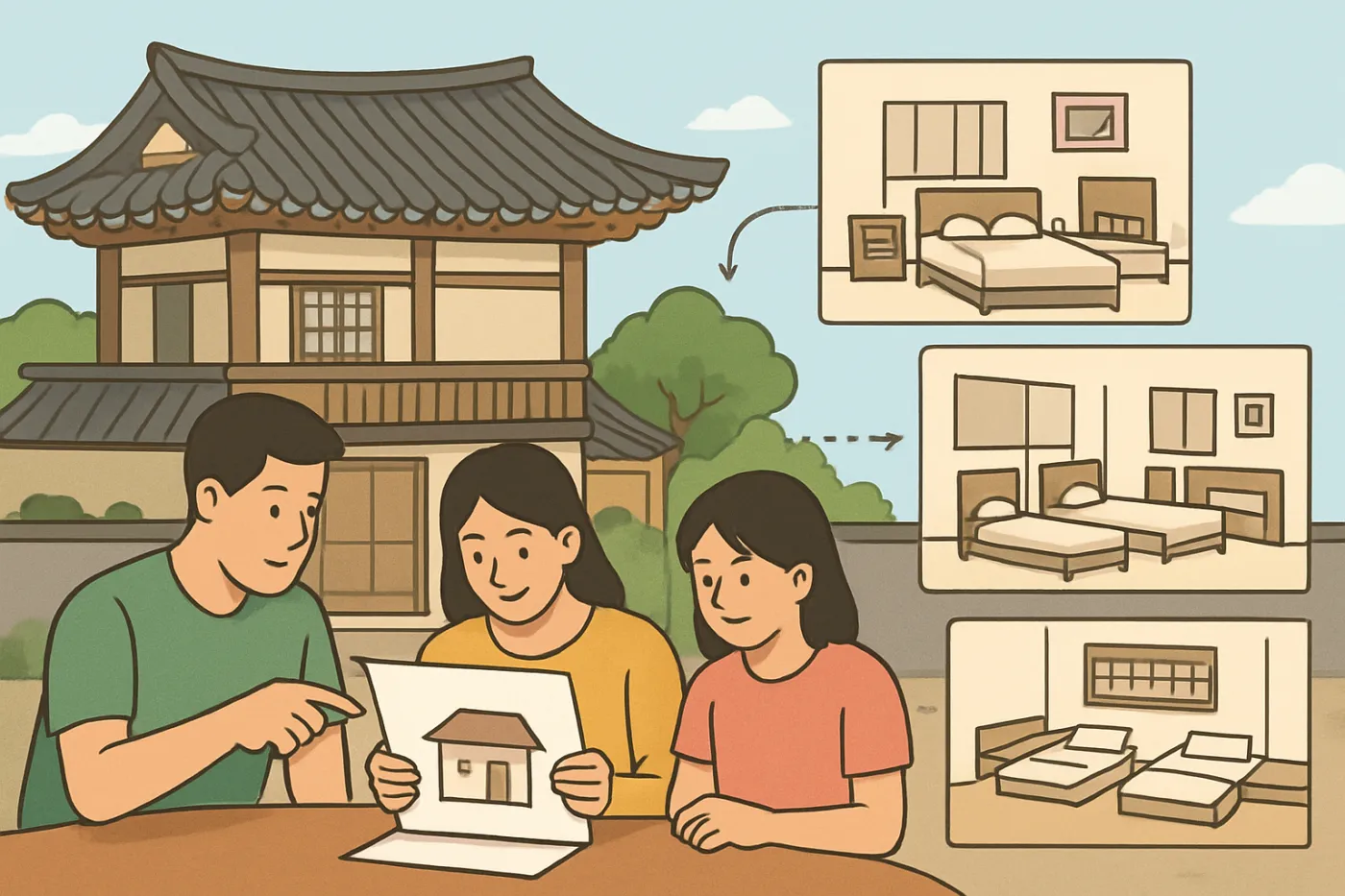
For most families and small groups in Korea, the smartest way to book accommodation is to first decide how many real beds and rooms you actually need, then compare three patterns: one large family room, two (or more) standard rooms, and an entire guesthouse floor or apartment-style stay. In many Korean properties, a family room with a mix of beds and floor mattresses can be cheaper than two hotel rooms, while an apartment-style stay or small guesthouse can become better value once you reach 4–6 people.
The key is to match your group’s size, sleep habits, and supervision needs with the way Korean rooms are laid out and priced, instead of just copying how you would book in your home country.
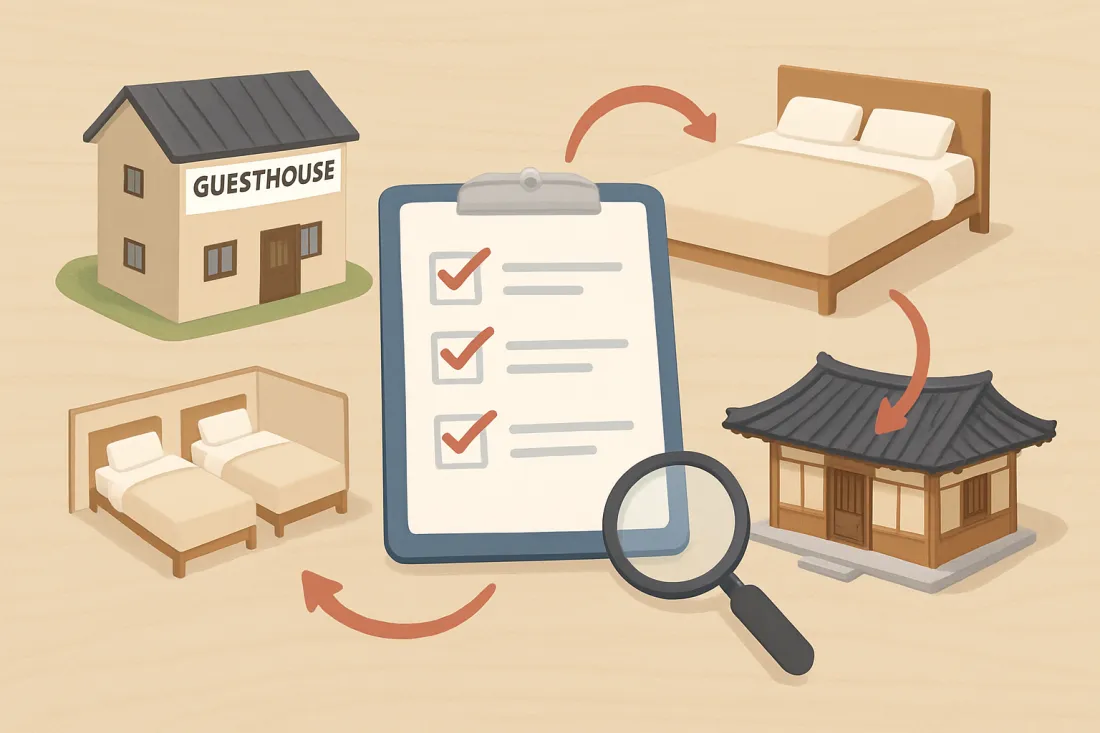
Three main ways to book accommodation in Korea for families and groups
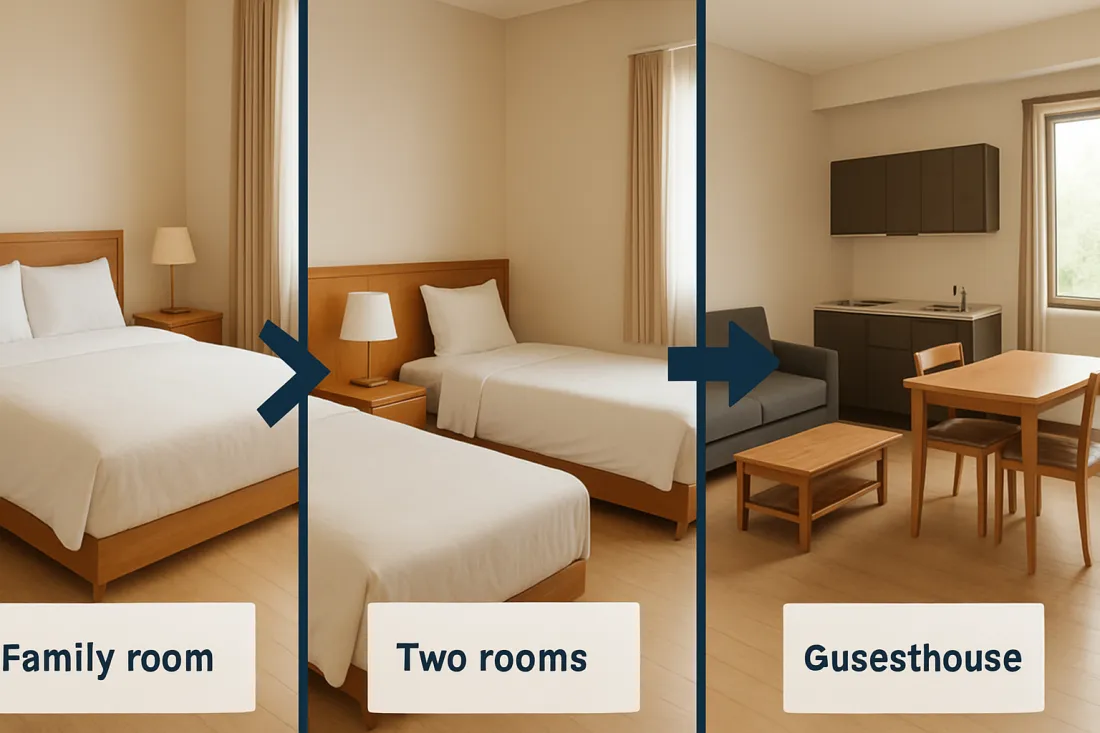
When you search for places to stay in Korea, you will usually be choosing between three booking patterns:
- One large family room
Often labeled as “family room”, “family twin”, “triple”, “quad”, or “ondol room”. These rooms may have a mix of beds and floor mattresses and are common in guesthouses, smaller hotels, and traditional-style stays. - Two or more standard rooms
Typical hotel-style rooms for 2–3 people each. You might book two adjacent rooms, connecting rooms, or rooms on the same floor. - Entire unit: guesthouse floor, whole house, or apartment-style stay
These are self-contained spaces with multiple bedrooms or sleeping areas, often with a kitchen and living space. They are common in guesthouses, pensions, and some city apartments.
Most families and groups can find a good fit within these three patterns. The rest of this guide focuses on how to compare them clearly for your situation.
One large family room vs two standard rooms in Korea
Choosing between a big family room and two standard rooms is the most common dilemma. The answer depends on how many people you have, how much privacy you need, and how flexible you are with Korean-style bedding.
When a large family room usually works better
- Families with young children who sleep better when everyone is in one space and parents want easy supervision.
- Groups that do not need privacy between adults, such as siblings or close friends used to sharing.
- Short stays of 1–3 nights where you care more about location and budget than separate quiet spaces.
- Flexible sleepers who are comfortable with floor mattresses (ondol) or sofa beds.
Advantages of one large family room:
- Often cheaper overall than two separate rooms at the same property, especially in guesthouses and smaller hotels.
- Easier to manage kids at night, because everyone is in one space.
- Shared space for hanging out in the evening without disturbing neighbors by moving between rooms.
- Simple logistics: one booking, one check-in, one key or keycode.
When two standard rooms can be the better choice
- Families with teens who want privacy and different sleep schedules.
- Mixed groups of adults (for example, two couples or friends of different genders) who prefer separate bathrooms and changing spaces.
- Light sleepers who need quiet and darkness to rest well.
- Business plus leisure trips where one person needs a quiet space for calls or work.
Advantages of two standard rooms:
- More privacy for adults and older kids.
- Two bathrooms, which can save time in the morning.
- More predictable bed types (for example, two beds per room) compared with flexible family rooms that mix beds and floor mattresses.
Key decision criteria: one large room vs two rooms
Use these questions to decide which pattern fits your group:
- How many separate sleep zones do you need? If you need a quiet space for a baby or early sleeper, two rooms or an apartment-style stay is usually better.
- How important is privacy? If adults want real privacy, two rooms or a multi-bedroom unit is worth the extra cost.
- Are you comfortable with floor bedding? If yes, a family ondol room can often fit more people at a lower price.
- How tight is your budget? If you are trying to keep accommodation costs low, start by checking family rooms and guesthouses before assuming you need two hotel rooms.
Comparison table: family room vs two standard rooms vs entire unit
| Option | Best for | Typical comfort level | Privacy | Supervision of kids | Cost tendency |
|---|---|---|---|---|---|
| One large family room | 2–4 people, young kids, close friends, short stays | Good if you accept shared space and possible floor bedding | Low – everyone shares one room and bathroom | Excellent – easy to watch children at night | Often lowest total cost for small families |
| Two standard rooms | 4–5 people, teens, mixed adults, longer stays | High – more beds, two bathrooms, quieter | Medium to high – adults can split into separate rooms | Depends on layout – better if rooms connect or are adjacent | Usually higher than one family room, but can be similar in some mid-range hotels |
| Entire guesthouse floor or apartment-style unit | 4–8+ people, multi-generational families, friend groups | Varies – can be very comfortable with living area and kitchen | High within the group, low between group members | Good – kids can move around inside the unit without leaving your space | Per-night total is higher, but per-person cost can be competitive for larger groups |
When to book an entire guesthouse, floor, or apartment-style stay
In Korea, many guesthouses and pensions offer whole floors, houses, or apartment-style units. These can be ideal when your group is large enough that multiple hotel rooms start to feel complicated or expensive.
Good situations for an entire unit
- 4–6 people who want a shared living space for late-night chats, games, or meals.
- Multi-generational families where grandparents, parents, and kids want to be together but still have separate bedrooms.
- Friend groups who prefer a private common area instead of meeting in hotel lobbies.
- Stays of 4+ nights where having a kitchen and laundry can save time and money.
What to check before booking an entire unit
- Exact sleeping arrangements – how many real beds vs floor mattresses, and where they are located.
- Number of bathrooms – important for larger groups and morning routines.
- Noise rules and quiet hours – many guesthouses have strict quiet times, especially in residential areas.
- Access details – stairs vs elevator, parking availability, and how you will enter (key, code, or host meeting).
- Location – walking distance to subway or bus stops, and how long it takes to reach your main attractions.
If you are specifically comparing guesthouses to hotels for families, you may also find it useful to read about family accommodation in Korea guesthouse vs hotel for more examples of how these stays feel in practice.
How Korean bedding and ondol floors can help groups save
One of the biggest differences in Korean accommodation is the use of ondol (heated floors) and floor mattresses. This can change how many people can sleep comfortably in a single room.
What to expect with ondol and floor bedding
- Ondol rooms are designed for sleeping on the floor with thick mattresses and bedding that can be folded away during the day.
- Mixed rooms may have one or two beds plus extra floor mattresses for additional guests.
- Guesthouses and traditional stays often use floor bedding to host more people in a single room than a typical Western-style hotel.
How this can save money for groups
- More people per room: A family ondol room might comfortably sleep 3–4 people who are happy to share the floor space, instead of paying for two separate rooms.
- Flexible layouts: Some properties allow you to add extra floor bedding for an additional fee, which can still be cheaper than another room.
- Comfort in winter: Heated floors can be very comfortable in colder months, which makes floor sleeping more appealing.
If you are on a tight budget and open to Korean-style stays, you can also explore guides on budget accommodation in South Korea to understand how guesthouses and ondol rooms are typically set up.
Who might not enjoy floor bedding
- Travelers with back or knee issues who find it hard to get up from the floor.
- People who strongly prefer Western-style beds and thick mattresses.
- Very light sleepers who may notice more movement when several people share one floor space.
If anyone in your group fits these categories, consider a mixed room (beds plus a couple of floor mattresses) or two standard rooms instead of a full ondol setup.
Safety and supervision when kids are in separate rooms
Many families worry about booking two rooms in Korea when children are involved. The right choice depends on your children’s ages, maturity, and your comfort level.
When it is usually better to keep everyone in one room
- Young children who may wake at night or be nervous in a new place.
- Kids who do not speak Korean and might struggle to ask staff for help if something goes wrong.
- First-time visitors who are still getting used to the environment and building layout.
If you decide on two rooms with kids
Consider these practical steps to keep things safe and manageable:
- Request adjacent or connecting rooms during booking and again at check-in.
- Agree on rules with your children about opening the door, using the phone, and not leaving the room alone.
- Share contact details – make sure older kids know the room number, property name, and your phone number.
- Use messaging apps to stay in touch if everyone has a device.
- Show kids the route between rooms and to the reception or emergency exit during daylight.
If you feel uneasy about separate rooms but still want some adult privacy, an apartment-style unit or guesthouse floor can be a good compromise: kids are nearby, but adults can still close a bedroom door.
Using booking filters and keywords for family and group stays
Major booking platforms used in Korea allow you to filter and search for group-friendly options, but you need to know which filters and keywords to use.
Essential filters for families and groups
- Number of guests: Always enter the real number of adults and children. This helps show rooms that officially allow your group size.
- Room type: Look for filters such as “family room”, “suite”, “apartment”, or “entire place”.
- Property type: Try “guesthouse”, “pension”, “apartment”, or “residence” if you want shared or apartment-style spaces.
- Facilities: For groups, filters like “kitchen”, “washing machine”, “parking”, or “family rooms” can be very useful.
- Cancellation policy: Flexible cancellation can be important when coordinating multiple people.
Helpful keywords to search or scan for in descriptions
- Family room / family twin / family suite – often indicates extra space or bedding.
- Ondol room / Korean-style room – suggests floor bedding and heated floors.
- Connecting rooms / adjoining rooms – useful if you want two rooms side by side.
- Entire floor / whole house / private unit – indicates you will not share the space with other guests.
- Extra bedding available – shows flexibility for one more person in the same room.
When reading reviews, pay attention to comments from families and groups. They often mention whether the space felt cramped or comfortable for several people.
Step-by-step checklist to compare room combinations
You are planning a trip to Korea with a family or group of 3–8 people and want to decide between one large room, multiple rooms, or an entire unit while balancing budget, comfort, and supervision of children.
Start with three pieces of information: total number of people (adults and children), preferred bed types (beds vs floor mattresses), and rough nightly budget range for the whole group, not per person.
First, search for accommodation in your target area and set the guest count to your full group. Filter for family rooms, suites, or apartment-style units. Note at least two options in each category: (1) one large family or ondol room, (2) two standard rooms in the same property, and (3) any entire unit or guesthouse floor that appears. For each option, write down the total nightly price, number of real beds and floor mattresses, number of bathrooms, and whether children can be supervised easily (same room, connecting rooms, or separate). Then compare: if the entire unit is within your budget and offers better supervision and living space than two rooms, treat it as your first choice; if not, see whether a family room gives enough space and acceptable bedding at a lower total cost than two rooms.
To check that you have made a solid choice, confirm that everyone in the group has a clear sleeping place, that the total cost per night fits your budget range, and that you are comfortable with how children will be supervised at night. Re-read the room description and recent reviews to verify that the layout matches your expectations before you finalize the booking.
If you skip checking the exact bedding and layout, you risk arriving to find fewer beds than expected, children in a separate room without safe supervision, or a total cost that feels too high once you add extra bedding or additional rooms on arrival.
To make this process easier, follow this structured checklist:
- Define your group
- Write down number of adults and children.
- Note any special needs (crib, no top bunk, no floor sleeping, mobility issues).
- Set a realistic total nightly budget range
- Think in terms of total per night for the whole group, not per person.
- Decide your ideal range and your absolute maximum.
- Search with full guest count
- Enter the full number of guests into the booking site.
- Apply filters for family rooms, apartments, or guesthouses as needed.
- Collect 3–5 candidate stays
- At least one family or ondol room.
- At least one option with two standard rooms in the same property.
- At least one entire unit (guesthouse floor, apartment, or house) if available.
- Compare key details
- Total nightly price for your dates.
- Number and type of beds and floor mattresses.
- Number of bathrooms.
- Layout for supervising children (same room, connecting, or separate).
- Location and access to transport.
- Check reviews from similar groups
- Look for mentions of families, kids, or group stays.
- Note comments about room size, noise, and comfort.
- Make a short list
- Choose 1–2 options that fit your budget and supervision needs best.
- Save screenshots or links in case availability changes.
- Confirm details with the property if needed
- Ask about connecting rooms, extra bedding, or crib availability.
- Confirm check-in process and any late arrival instructions.
- Book with a clear cancellation policy
- Choose a rate that gives you enough flexibility if your plans change.
Example price comparisons using typical Korean patterns
Exact prices change by season, city, and demand, but you can still compare patterns. The examples below are simplified to show how costs might relate between options. Always check current rates for your dates.
Example 1: Family of four (2 adults, 2 children)
- Option A – One family ondol room
Includes one double bed plus two floor mattresses. Total cost per night is often lower than two standard rooms in the same property. You share one bathroom and one space, but supervision is easy and you only manage one booking. - Option B – Two standard rooms
Each room has two single beds. Total cost per night is usually higher than Option A, but you gain privacy and two bathrooms. You need to ensure rooms are adjacent or connecting for child supervision. - Option C – Small apartment-style unit
One bedroom with a double bed plus a living area with a sofa bed or floor mattresses. Total cost per night may sit between A and B or slightly above B, but you gain a kitchen and more living space, which can be valuable on longer stays.
Example 2: Group of six adults
- Option A – Large family room with mixed bedding
One or two beds plus several floor mattresses. Total cost per night can be attractive, but privacy is low and bathroom sharing may be challenging. - Option B – Three standard twin rooms
Each room has two single beds. Total cost per night is higher than a single large room, but each pair of adults gets privacy and their own bathroom. - Option C – Entire guesthouse floor or house
Multiple bedrooms and a shared living area. Total cost per night may be higher than three hotel rooms, similar, or slightly lower depending on the property. Per-person cost can be reasonable, and the shared space is usually much better for socializing.
Example 3: Multi-generational family of five (grandparent, parents, two kids)
- Option A – One large family room
Everyone shares a space with beds and floor mattresses. This can be the most economical, but the grandparent may not enjoy floor bedding or the lack of privacy. - Option B – Two rooms (parents + kids, grandparent alone)
Gives the grandparent a quiet room and the parents easy access to the children. Total cost per night is higher than one family room but may be worth it for comfort. - Option C – Apartment-style unit with two bedrooms
Grandparent in one bedroom, parents and kids in the other or in the living area. Total cost per night may be similar to or higher than two hotel rooms, but the shared kitchen and living space can make the stay smoother for everyone.
These examples show that once you reach four or more people, it is worth checking all three patterns instead of assuming that two standard rooms are the only option.
Common mistakes when booking group accommodation in Korea
- Ignoring the official maximum occupancy and assuming you can squeeze in extra people without checking. This can cause problems at check-in.
- Not reading the bedding details and being surprised by floor mattresses or sofa beds instead of standard beds.
- Booking two rooms without confirming proximity, then finding out they are on different floors.
- Underestimating the value of a kitchen and laundry for longer stays, especially with children.
- Focusing only on price and ending up far from public transport, which adds time and transport costs.
If you want a deeper dive into how guesthouses work and how to choose a good one, you can also look at how to choose a guesthouse in Korea for more detailed selection tips.
Recommended approach by group size and budget
Use these simple guidelines as a starting point, then adjust based on your group’s preferences and the actual options you find.
2–3 people
- Budget-focused: Standard room in a guesthouse or small hotel, or a compact ondol room if you are comfortable with floor bedding.
- Comfort-focused: Standard hotel room with beds, possibly a small suite if you want extra space.
Family of 4
- Budget-focused: Family or ondol room with a mix of beds and floor mattresses in a guesthouse or mid-range hotel.
- Comfort-focused: Two standard rooms (ideally connecting) or a small apartment-style unit with one bedroom and a living area.
Group of 5–6
- Budget-focused: Large family room or a combination of one family room plus one standard room in the same property.
- Comfort-focused: Entire guesthouse floor, small house, or apartment-style unit with multiple bedrooms, or several hotel rooms with clear supervision plans.
Groups of 7+ or multi-family trips
- Budget-focused: Large guesthouse units or houses where per-person cost can be reasonable, even if the total price is higher.
- Comfort-focused: Multiple units in the same building or a very spacious house with enough bathrooms and living space.
Whichever pattern you choose, always double-check the layout, bedding, and supervision possibilities before confirming your booking.
FAQ about booking accommodation in Korea for families and groups
Can foreigners use Korean accommodation apps like Yanolja for family or group bookings?
Many Korean accommodation apps are primarily designed for local users, but some do allow foreigners to create accounts and book, especially if you have a common international payment card. The main challenges are often language and address formats. If you are not comfortable navigating a Korean-language app, or if your card is declined, you can use international booking platforms that list many of the same properties and offer English interfaces and support.
Is 1,000 USD enough for a week in South Korea including accommodation for a family?
Whether 1,000 USD is enough for a week depends on your family size, travel style, and how you split that budget between accommodation, food, transport, and activities. For a small family that chooses budget guesthouses or simple hotels, uses public transport, and eats at local restaurants, it can be possible to manage a week within that amount. For larger families, those who prefer mid-range hotels, or those planning many paid attractions and shopping, you may need a higher budget. The best approach is to price out a few realistic accommodation options for your dates, then estimate daily food and transport costs to see how your total budget feels.
What should I look for in a Korean guesthouse when traveling with kids?
When staying in a guesthouse with children, focus on room layout, bathroom access, and house rules. Check whether your family will have a private bathroom, how many beds and floor mattresses are provided, and whether there are quiet hours that might affect bedtime. Look for reviews from other families mentioning cleanliness, noise levels, and how staff interacted with children. It also helps to confirm in advance whether the guesthouse has elevators or only stairs, and how far it is from the nearest subway or bus stop.
How far in advance should I book accommodation in Korea for a group?
For popular cities and peak travel seasons, it is wise to start looking several months in advance, especially if you need multiple rooms or an entire unit. Group-friendly options and family rooms are limited in each property, so they can sell out earlier than standard double rooms. If your dates are flexible, you can monitor availability over a few days before committing, but once you see a place that clearly fits your group’s needs and budget, booking with a reasonable cancellation policy can reduce stress later.