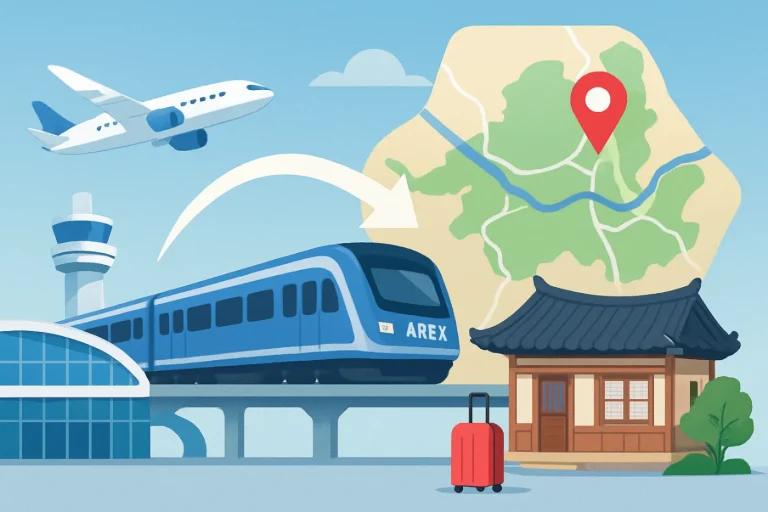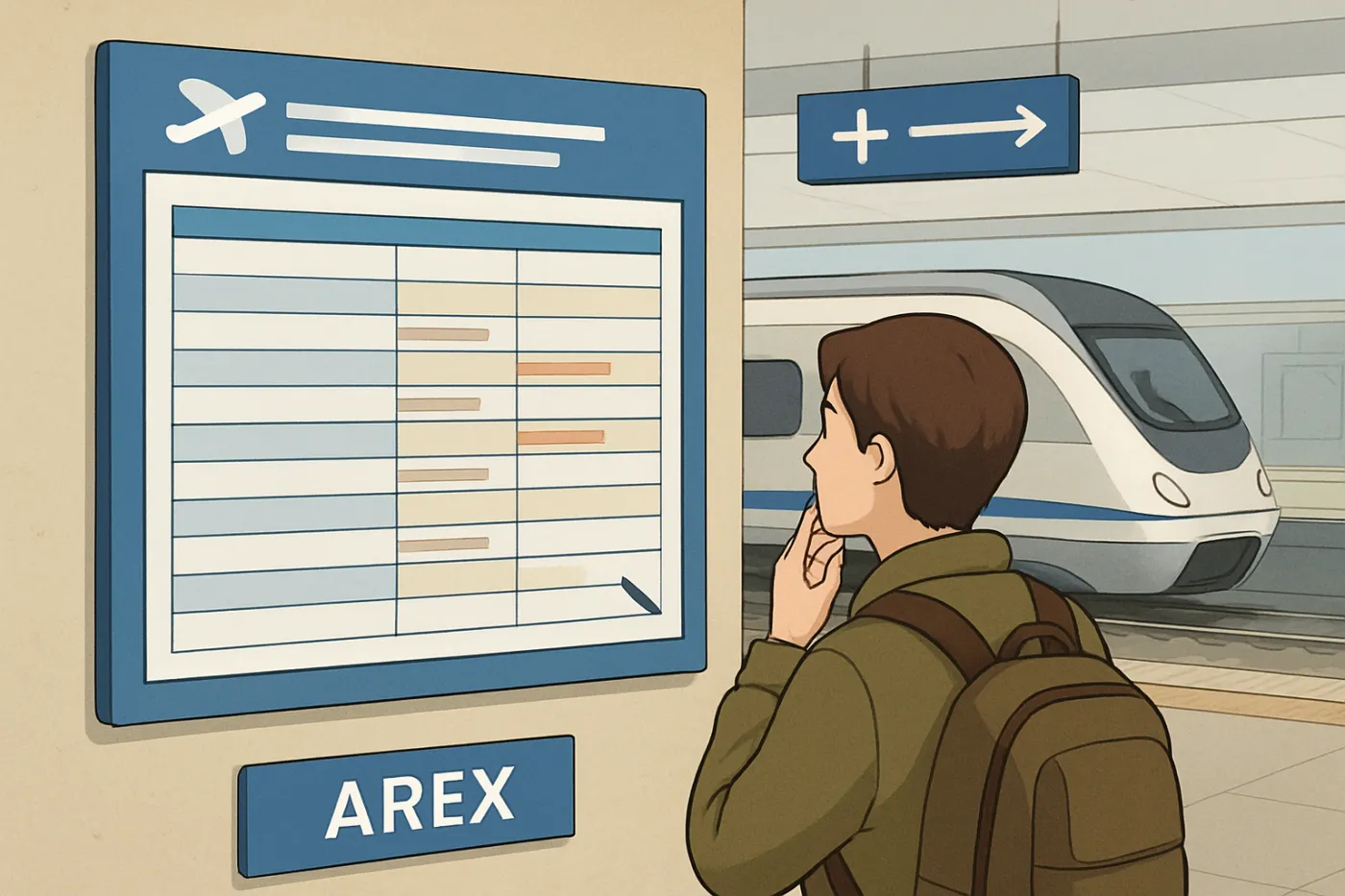
Landing at Incheon and trying to figure out when the next AREX train to Seoul is, how late it runs, and what to do if you miss it? This guide explains the AREX timetable from Incheon to Seoul in plain language, how often trains run at different times of day, and how to avoid common timing mistakes.
AREX timetable Incheon to Seoul explained simply
You do not need to memorize a full timetable to use AREX comfortably. What matters most is understanding the pattern of service:
- AREX runs from early morning until late at night between Incheon Airport and Seoul Station, but it is not 24 hours.
- Frequency changes by time band: more trains in daytime and early evening, fewer very early in the morning and late at night.
- There are two train types on the Incheon–Seoul route: an all-stop commuter train and a faster train that skips most stations. Each has its own timetable.
- Exact minutes can change for holidays, maintenance, or seasonal schedules, so always confirm on the official display at the station.
If you remember only one thing: do not assume a train “every few minutes” all day and night. Check the display when you arrive and have a backup plan if your flight lands very late or is heavily delayed.
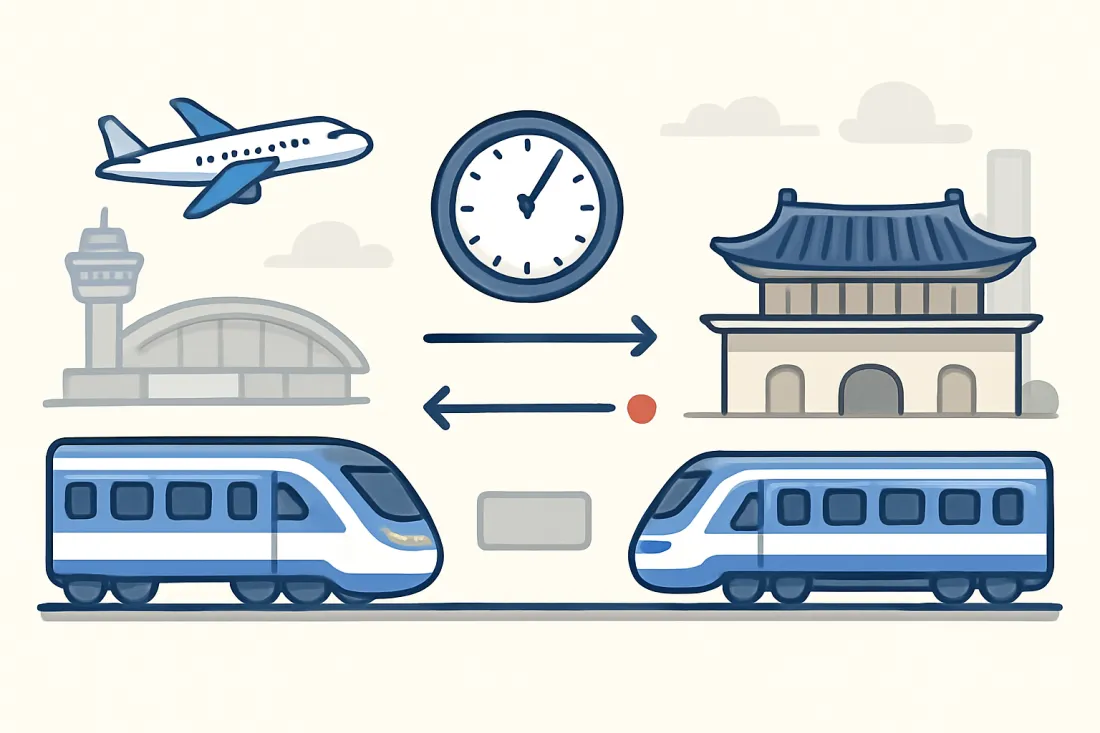
Service hours from Incheon to Seoul: first and last AREX trains
Exact first and last train times are updated by the operator and can differ between:
- Terminal 1 and Terminal 2
- All-stop vs faster trains
- Weekdays vs weekends/holidays
Treat any example times you see online as rough guidance only. Instead, think in terms of service windows and how they affect your plan.
- First trains
Service usually starts early in the morning, around the time the airport becomes busy with early departures. If you land at dawn, you can normally catch a train after a moderate wait, but you may not walk straight onto one. - Last trains
Last departures are typically late at night, but not in the middle of the night. If your scheduled arrival is close to midnight or later, you must check whether you can realistically clear immigration and baggage before the last train. - Terminal differences
First and last departures can differ slightly between Terminal 1 and Terminal 2. Always check the board at your terminal, not a screenshot from the other one. - Direction matters
Make sure you are reading the timetable for trains toward Seoul Station, not toward the airport or the opposite direction.
Practical approach: before you fly, check the official AREX or Incheon Airport information for the current first/last train window for your travel date. When you arrive, confirm again on the station timetable board or digital display before committing to the train.

Weekday vs weekend AREX frequency between Incheon and Seoul
AREX connects a major international airport with Seoul, so it runs every day. However, the pattern of departures can shift between weekdays and weekends or holidays.
Typical patterns you may notice (always confirm locally):
- Weekday rush hours
In the morning and evening commuter peaks, trains often run more frequently to handle office workers and airport staff. - Midday and mid-evening
Frequency is usually steady and comfortable for most travelers, though not as intense as rush hour. - Late night and early morning
Gaps between trains are longer. There may be fewer faster services compared with daytime. - Weekends and holidays
Schedules can shift slightly. First/last train times and the number of faster trains may differ from weekdays.
When planning, always check that the timetable you are reading clearly matches:
- Your day of the week (weekday vs weekend/holiday)
- Your direction (Incheon → Seoul)
- Your train type (all-stop vs faster)
AREX timetable highlights by time band
Instead of memorizing dozens of departure times, use time bands as a mental model. Exact minutes change, but the relative frequency is easier to remember.
| Time band (approximate) | What to expect on AREX Incheon → Seoul | Practical timing tips |
|---|---|---|
| Early morning (first train to around 7:00) | Service has started but trains are less frequent than daytime. Some departures may be all-stop only, with fewer faster trains. | Allow extra waiting time. If you have a tight connection in Seoul (early tour, domestic train, or bus), consider whether a taxi or airport bus is safer than cutting it close with the first trains. |
| Daytime (around 7:00–17:00) | This is usually the most stable and frequent period. Both all-stop and faster trains tend to run regularly. | For most visitors, this is the easiest time to use AREX. You rarely wait long and can choose between speed (faster train) and saving money (all-stop). |
| Evening (around 17:00–22:00) | Trains are still frequent but can be busier due to commuters and many arriving flights. | Keep luggage close and be ready to stand if the train is crowded. If you are exhausted after a long flight, waiting for a slightly later, less crowded train can be more comfortable. |
| Late night (around 22:00–last train) | Departures become less frequent, with longer gaps. Final trains may be all-stop only. | Know the last train time before you leave the arrivals hall. If your flight is delayed into this band, start checking alternatives (bus, taxi, or airport stay) before walking down to the platform. |
Use this table as a quick comparison: flexible and frequent in the middle of the day, more limited at the edges of service hours.
How to read AREX platform displays and timetables at Incheon
Once you reach the AREX station at Incheon Airport, the digital displays and printed timetables are your most reliable source of current information. Here is how to read them without stress.
- 1. Confirm the direction
Look for signs that say “To Seoul Station” or show a line map with Seoul at the end. Make sure the platform you enter is for trains heading into the city, not toward the other terminal or the opposite direction. - 2. Check the train type
Many displays distinguish between the all-stop commuter train and the faster train. The faster train may have a separate platform or gate. Confirm which train your ticket or pass covers. - 3. Look at the next few departures
Digital boards usually show the next one to three trains, with departure time, destination, and sometimes stopping pattern. If you see a long gap before the next train, decide whether to wait or switch to another transport option. - 4. Match the day and timetable
If you are reading a printed timetable, check that you are in the correct column for your day of the week and direction. Do not mix weekday and weekend columns. - 5. Use the line map for timing
Above the platform, there is usually a map of all stations with approximate travel times between stops. Use this to estimate when you will reach your transfer station or guesthouse area. - 6. Listen for announcements
Announcements often include English information about delays, platform changes, or the last train of the day. If you are unsure, point at the timetable and your ticket and ask station staff to confirm.
If you are still deciding how to pay (transport card, bank card, or special pass), a dedicated guide such as how to pay for AREX Incheon Airport can help you prepare before you land.
What happens if you miss the last AREX train
Missing the last AREX train from Incheon to Seoul is stressful, but it is not a disaster. The key is to recognize it quickly and switch to a backup plan instead of waiting on an empty platform.
If you realize you have missed the last train:
- Leave the station area
Once the last train has departed, there will not be another one that night. Head back toward the arrivals hall or ground transport area. - Check late-night buses
Incheon Airport usually has night buses to major parts of Seoul. They run less frequently than daytime buses, but they can still get you close to your guesthouse or a subway line. - Consider a taxi
Taxis operate 24/7 from official stands. They cost more than AREX, but for two or more people sharing, the cost per person can be more acceptable, especially late at night. - Think about staying near the airport
If you arrive extremely late and feel exhausted, an airport-area guesthouse or hotel can be a safer choice. You can then take AREX or a bus into Seoul in the morning. - Update your accommodation
If you will arrive much later than planned, send a quick message to your guesthouse or hostel. They may share a recommended late-night route or self-check-in instructions.
To reduce the risk of missing the last train, compare your scheduled landing time with the last AREX departure before you fly. Allow generous time for immigration, baggage claim, and customs, especially during busy seasons.
Alternative late-night transport options from Incheon to Seoul
AREX is convenient, but it is not the only way to reach Seoul from Incheon Airport, especially late at night. Depending on your arrival time, budget, and luggage, another option may be more realistic.
- Airport limousine buses
These buses connect Incheon with major districts such as Myeongdong, Hongdae, and Gangnam. Some routes have late-night or overnight services, though they run less often than daytime buses. They are useful if they stop close to your guesthouse. - Night buses
Special night bus routes may operate between the airport and central Seoul with limited stops. They can be a good backup when AREX has stopped, but you may need to transfer to a taxi or local bus for the final leg. - Regular taxis
Available at official taxi stands outside each terminal. Fares depend on distance and time. For solo budget travelers this can feel expensive, but for couples or small groups sharing, it can be reasonable compared with multiple bus tickets late at night. - International or large taxis
These are designed for foreign visitors or groups with more luggage. They can be helpful if you have bulky bags or are traveling with family. - Airport-area accommodation
If you are too late or too tired to travel into the city, staying near the airport and taking AREX in the morning can be the least stressful option.
If you are still comparing options for your arrival time and budget, a detailed comparison such as AREX vs airport bus vs taxi Incheon to Seoul can help you choose.
Choosing between all-stop and faster AREX trains
On the Incheon–Seoul route, you will usually see two main options:
- All-stop commuter train
Stops at every station between the airport and Seoul Station. It is slower but typically cheaper and connects easily to many subway lines along the way. - Faster train
Runs non-stop or with very few stops between Incheon Airport and Seoul Station. It is faster and more comfortable, often with reserved seats, but usually costs more and may run slightly less frequently.
When deciding which one to take, consider:
- Arrival time
Late at night or very early in the morning, there may be fewer faster trains. If the next faster train is a long wait but an all-stop train is leaving soon, the slower train may still deliver you to your guesthouse earlier overall. - Destination in Seoul
If you are staying near a station on the AREX line before Seoul Station, the all-stop train can drop you closer to your accommodation without a transfer. - Budget vs comfort
If you have heavy luggage and want a guaranteed seat after a long flight, the faster train can be worth the extra cost. If you are on a tight budget, the all-stop train is usually the better choice. - Ticket or pass type
Some passes or discounts apply only to one train type. Check the conditions before you buy. For more detail, you can read a guide such as buy AREX pass online or at airport.
You have just landed at Incheon Airport and want to reach your guesthouse in Seoul using AREX. You are near the station entrance, you know the current local time, but you do not have a printed timetable. You must quickly decide whether to wait for a faster train, take the next all-stop train, or switch to a bus or taxi.
Key inputs for your decision: current local time and day of week; your guesthouse’s latest check-in time; your budget flexibility; how tired you feel; how much luggage you have; and whether your guesthouse is closer to Seoul Station or to a station along the AREX line.
First, look at the digital display for the next three departures toward Seoul Station, noting departure times and whether they are all-stop or faster trains. If a faster train is leaving soon and you value comfort or have heavy luggage, choose that train. If the next faster train is much later but an all-stop train is leaving shortly, calculate which option gets you to your guesthouse earlier, including waiting time. If the display shows that the last train is approaching or has already left, leave the platform area and follow signs back to the arrivals hall to choose a night bus, taxi, or nearby accommodation instead of waiting in the station.
You know your decision worked if you board a train or alternative transport within a reasonable wait, arrive in Seoul early enough to reach your guesthouse without rushing, and avoid being stranded on a closed platform after the last train. If you reach your accommodation safely with no unexpected long gaps in your journey, your timetable-based choice was effective.
Timing checklist for AREX Incheon to Seoul
Use this printable-style checklist before and during your trip to avoid timetable surprises. You can copy it into your notes app or print it.
- Before flying to Korea
- Check your flight’s scheduled arrival time at Incheon (local time).
- Look up the current first and last AREX train window for your terminal and direction (Incheon → Seoul Station) on the official site.
- Estimate how long you might need for immigration, baggage, and customs (crowded days can take significantly longer than quiet days).
- Decide on at least one backup option (night bus, taxi, or airport-area stay) if you cannot realistically reach the last train.
- Save a simple route plan from Seoul Station or your AREX stop to your guesthouse (subway line, exit number, or walking directions).
- On the plane, before landing
- Check the latest estimated landing time from the in-flight screen or announcement.
- Compare it with your noted last AREX train window and adjust expectations.
- If you are landing much later than planned, review your late-night bus or taxi plan so you are not deciding while exhausted.
- At Incheon Airport, before going down to the station
- Note the current local time after you exit customs.
- Follow signs to the AREX station and find a timetable board or digital display.
- Confirm you are checking the timetable for today’s day of week and the direction toward Seoul.
- Identify the next three departures and whether they are all-stop or faster trains.
- Check whether any of these is marked as the last train of the day.
- Before boarding
- Confirm your ticket, pass, or card is valid for the train type you are boarding.
- Use the line map to estimate your arrival time at your destination station.
- Make sure you know your transfer or exit plan at Seoul Station or your stop (subway line, exit number, or taxi stand).
- If the train is extremely crowded and you are exhausted, consider whether waiting for the next one or using a bus/taxi is better for you.
- If the last train has already left
- Return to the arrivals or transport hall; do not wait on the platform.
- Check information boards for night buses to your area of Seoul.
- If buses are not convenient, go to the official taxi stand and, if possible, ask staff about the approximate fare range.
- Consider booking an airport-area guesthouse or hotel if you are too tired to travel into the city safely.
Common timetable mistakes on AREX (and how to avoid them)
Many timing problems on the Incheon–Seoul route come from a few predictable misunderstandings. Avoid these common mistakes:
- Assuming 24-hour train service
AREX does not run all night. Always check first and last train times for your specific date and terminal. - Mixing weekday and weekend schedules
Departure patterns can differ on weekends and national holidays. Make sure the timetable you are reading matches your travel day. - Reading the wrong direction
Some travelers accidentally read the timetable for Seoul → Incheon instead of Incheon → Seoul. Double-check the direction label on the board. - Ignoring immigration and baggage time
Even if your plane lands before the last train, long queues can push you past the cutoff. Build a generous buffer into your plan, especially for evening arrivals. - Not checking train type
Boarding the wrong train type for your ticket can cause confusion or extra cost. Confirm whether your ticket is for the all-stop or faster train before you tap in or enter the gate. - Relying on old screenshots
Timetables can change. Use screenshots only as a rough guide and always confirm on the station display on the day you travel.
What to do after understanding the AREX timetable
Once you understand how AREX service hours and frequency work, you can plan your whole arrival more confidently. Use this simple next-step process:
- Choose your main route
Decide whether AREX, an airport bus, or a taxi will be your primary way from Incheon to your guesthouse. If budget is your main concern, you may also want to compare the cheapest way from Incheon Airport to Seoul. - Match your flight to a time band
Check whether your scheduled arrival falls into early morning, daytime, evening, or late-night. This tells you how frequent AREX will feel and how much buffer you need. - Prepare a backup
If you are close to the edges of service hours, write down at least one alternative (night bus route or taxi plan) so you are not searching while tired. - Save key details
Keep your guesthouse address in Korean and English, your chosen station name, and any bus route numbers or taxi instructions in your phone. - On arrival, trust the displays
Ignore old online timetables and follow the official boards and announcements at the station for the final decision on which train to take.
FAQ about the AREX timetable from Incheon to Seoul
What is the most important thing to know about the AREX timetable Incheon to Seoul?
The key point is that AREX has fixed service hours with a clear first and last train, and the frequency changes by time of day. Trains are frequent and convenient in daytime and evening, but less frequent early in the morning and late at night. You should always confirm the next departure and last train time on the official display at Incheon Airport for your exact day and direction.
What timetable mistakes do visitors to Korea often make with AREX?
Typical mistakes include assuming the train runs 24/7, mixing up weekday and weekend schedules, reading the timetable for the wrong direction, and underestimating how long immigration and baggage claim can take. Some travelers also rely on old screenshots instead of checking the live display, which can lead to missing the last train or waiting much longer than expected.
How often do AREX trains run from Incheon to Seoul during the day?
During the main daytime hours, AREX trains between Incheon and Seoul usually run at relatively short, regular intervals, with both all-stop and faster services operating. The exact number of minutes between trains can change with the timetable, so treat any example you see online as approximate and always confirm the actual next departures on the digital board at the station.
What should I do after checking the AREX timetable for my flight?
After checking the timetable, decide whether AREX is realistic for your arrival time, especially if you land very early or very late. If it is, note the approximate first or last train window and plan your route from Seoul Station or your AREX stop to your guesthouse. If your arrival is close to or after the last train, prepare a backup plan using night buses, taxis, or an airport-area stay so you are not forced to improvise when you are tired.
Is it better to wait for a faster AREX train or take the next all-stop train?
It depends on your situation. If a faster train is leaving soon and you value a quicker, more comfortable ride, waiting a short time can be worth it. If the next faster train is much later but an all-stop train is leaving soon, the slower train may still get you to your guesthouse earlier overall. Check the platform display for the next few departures and factor in your energy level, luggage, and check-in time when deciding.