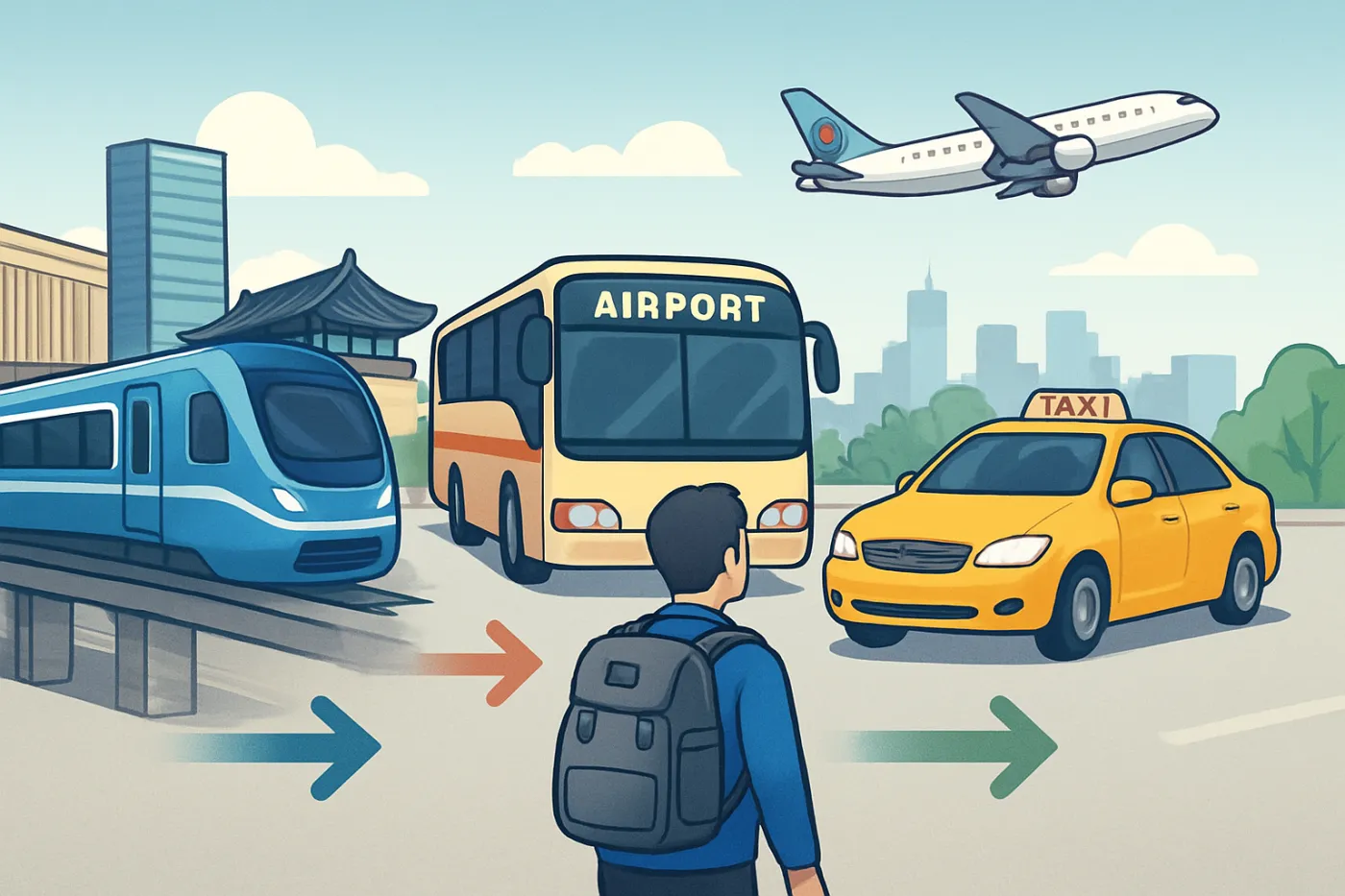
Landing at Incheon and trying to choose between AREX, the airport limousine bus, a taxi, or a private transfer into Seoul? The best option depends on four things: where you are staying, what time you land, how many people you are, and how much luggage or energy you have left.
In practical terms:
- AREX train is usually the fastest and cheapest for solo travelers or couples heading to areas near Hongdae or Seoul Station.
- Airport limousine buses are often most convenient if your hotel is near a bus stop in Myeongdong, Gangnam, Jongno, or Itaewon and you want to avoid transfers.
- Taxis and private transfers are door-to-door and comfortable, best for late-night arrivals, families with kids, heavy luggage, or when you just want to get to bed with zero hassle.
Below is a detailed comparison with concrete examples so you can match the option to your exact situation.
Key differences between AREX, airport bus, taxi, and private transfer
All four options connect Incheon Airport with Seoul, but they trade off time, comfort, and cost differently.
- AREX all-stop train: Frequent trains connecting both terminals to multiple subway lines, including Hongdae and Seoul Station. Good balance of speed and price.
- AREX express train: Non-stop between Incheon and Seoul Station with reserved seats. More comfortable and predictable than the all-stop, still budget-friendly compared with a taxi.
- Airport limousine bus: Several routes into different districts. Fewer stops than regular city buses, luggage goes in the hold, and you usually get a seat.
- Taxi: Metered, 24/7, door-to-door ride. No transfers, but more expensive than public transport and affected by traffic.
- Private transfer / hotel pickup: Pre-booked car or van waiting with your name. Fixed price, meet-and-greet, and door-to-door comfort.
If you decide that AREX is right for you and want to go deeper into payment options and seat types, you can later read more about the AREX ticket choices.
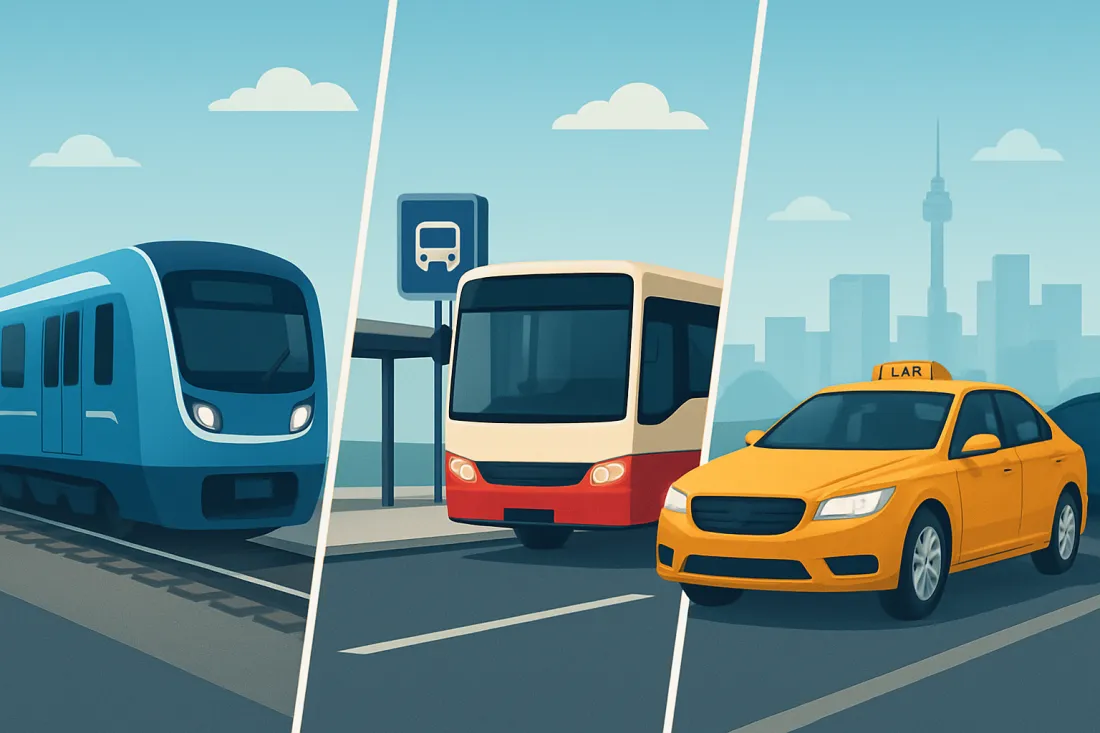
AREX vs airport limousine bus: when train beats bus and when it does not
Most independent travelers end up choosing between AREX and the airport limousine bus. Both are reliable and tourist-friendly, but they suit different priorities.
AREX advantages over the airport bus
- More predictable timing: The train runs on rails, so it is not stuck in highway traffic. This matters during weekday rush hours when road journeys can easily stretch by an extra 20–40 minutes.
- Frequent departures: All-stop trains typically run multiple times per hour during the day. Express trains run on a timetable with reserved seats, so you know exactly when you will arrive at Seoul Station.
- Budget-friendly for 1–2 people: For solo travelers and couples, the total train fare is usually noticeably lower than buying airport bus tickets or taking a taxi.
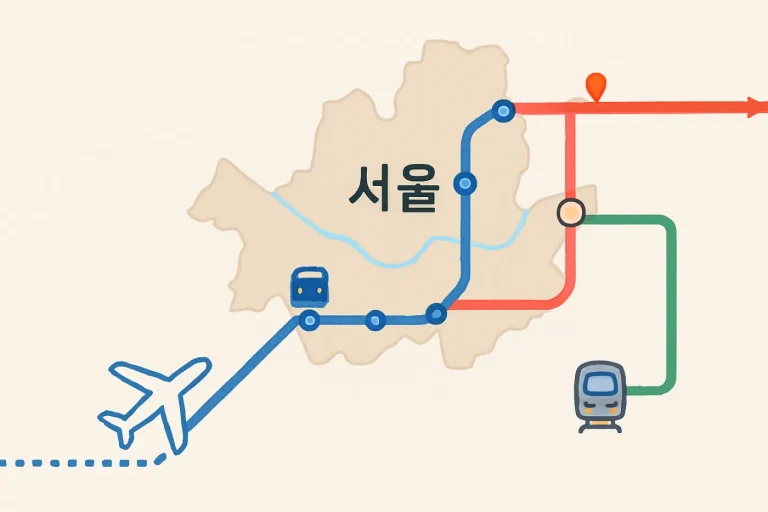
- Perfect for Hongdae and Seoul Station: Hongik University (Hongdae) and Seoul Station are directly on the AREX line, so you avoid transfers and long walks.
AREX drawbacks compared with the airport bus
- Transfers with luggage: If your hotel is not near an AREX-connected station, you will need to change to the subway or a local bus. That can mean stairs, escalators, and crowds while carrying suitcases.
- Standing during busy times: The all-stop train can be crowded at commuter times. You might stand with your luggage for part of the ride.
- Not door-to-door: Even from Seoul Station or Hongdae, you still have to navigate local streets or another subway line to reach your accommodation.
Airport limousine bus advantages over AREX
- Closer to many hotels: Limousine buses serve major hotel zones in Myeongdong, Gangnam, Jongno, Itaewon, and other central areas. Often you walk only a few minutes from the bus stop.
- No transfers: You put your suitcase in the luggage hold, sit down, and get off near your hotel. No subway changes, no ticket gates, and fewer stairs.
- More “sleep-friendly”: Seats are usually wide and reclinable with air conditioning. It is easier to doze off than on a standing-room train.
Airport limousine bus drawbacks compared with AREX
- Traffic delays: Buses share the road with cars. In heavy traffic or bad weather, your journey can take much longer than the train.
- Reduced late-night service: Some routes run less frequently or stop earlier at night. You must check the timetable for your specific bus number.
- Route confusion for first-timers: There are several bus numbers and stops. You need to confirm which route serves your exact area and where to get off.
AREX vs taxi and private transfer: time, comfort, and cost
Trains and buses are designed for visitors, but taxis and private transfers are still very popular, especially for groups, late arrivals, or travelers with mobility needs.
Taxi from Incheon to Seoul
Regular taxis are available 24/7 from official ranks at both terminals. You pay by the meter and are dropped directly at your address.
Key points:
- Door-to-door convenience: No transfers, no escalators, and no hunting for your hotel in the dark. This is a big relief when you are jet-lagged.
- Good value for groups: For three or four people, the per-person cost can be closer to public transport, especially compared with buying several express train or bus tickets.
- Variable travel time: In light traffic, a taxi can be quite fast. In peak congestion, it can become the slowest option, sometimes adding half an hour or more compared with the train.
- Language and address issues: Many drivers are used to tourists, but it still helps to have your hotel address written in Korean or clearly shown on your phone.
Private transfer or hotel pickup
A private transfer is similar to a taxi but pre-booked. A driver meets you at arrivals with your name and takes you directly to your accommodation for a fixed price.
Why travelers choose private transfers:
- No queuing: Your driver is already waiting, which is helpful after long flights or with children.
- Fixed price: You know the cost in advance, so there is no stress about the meter running in traffic.
- Vehicle size choice: You can book a van or minibus if you have a lot of luggage or a big group.
- English-friendly booking: Many services offer English booking forms and instructions, which feels safer for first-time visitors.
Downsides: you must arrange the transfer in advance, and if your flight is heavily delayed, you may need to contact the provider or follow their delay policy.
Side-by-side comparison: AREX vs bus vs taxi vs private transfer
The table below compares the main options by situation, not by exact prices. Use it as a quick decision tool.
| Option | Best for | Typical time feel | Comfort & luggage | Key risks / downsides |
|---|---|---|---|---|
| AREX all-stop train | Solo travelers or couples, budget trips, heading to Hongdae or connecting at Seoul Station | Often similar to or faster than a bus in normal traffic; more reliable during rush hour | Space for suitcases and overhead bags; may need to stand at busy times; transfers often required at the end | Not door-to-door, stairs and crowds with bags, can be confusing for first-timers changing lines |
| AREX express train | Those wanting a reserved seat and predictable timing to/from Seoul Station | Non-stop between airport and Seoul Station; usually one of the fastest options end-to-end | Reserved seats, luggage racks, quieter than all-stop; easy to rest or work | Still requires a subway or taxi transfer from Seoul Station to most neighborhoods |
| Airport limousine bus | Travelers whose hotel is near a bus stop in Myeongdong, Gangnam, Jongno, Itaewon, etc. | Can be similar to train in light traffic; can be much slower in heavy traffic or bad weather | Comfortable seats, luggage in hold, usually no transfers; easier with big bags | Traffic delays, less frequent late at night, need to pick the correct route and stop |
| Taxi | Families, groups, late-night arrivals, heavy luggage, or anyone wanting zero transfers | Fast in light traffic; can become the slowest option in peak congestion | Private, door-to-door, no need to carry bags through stations | Higher total cost than public transport; price and time vary with traffic and route |
| Private transfer / hotel pickup | First-time visitors, large groups, or those wanting fixed price and meet-and-greet | Similar to taxi; depends on traffic and exact route | Door-to-door, driver waiting at arrivals, vehicle size chosen in advance | Must book ahead; changes or delays require coordination with provider |
When AREX is the best choice (and when it is not)
AREX is usually best when
- You are staying near Hongdae or Seoul Station: These areas sit directly on the AREX line, so you avoid extra transfers and long walks.
- You are on a budget: For one or two people, the train is typically cheaper than a taxi or private transfer and often cheaper than the limousine bus.
- You arrive during the day or evening: Trains run frequently and are easy to use when you are not half-asleep.
- You are comfortable with subways: If you already use metro systems in big cities, navigating AREX and transfers will feel familiar.
AREX is not ideal when
- You have very heavy or multiple large suitcases: Maneuvering through stations, gates, and stairs can be exhausting and slow.
- You arrive very late at night or very early in the morning: Train frequency is lower, and connections from Seoul Station or Hongdae may be limited.
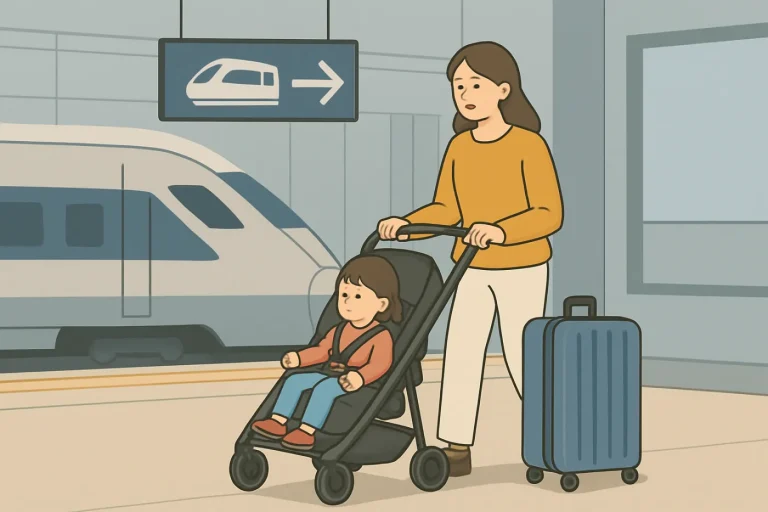
- You are traveling with small children or older relatives: Managing kids, strollers, and luggage on a train and through transfers can be stressful.
- Your hotel is far from any subway station: You might end up walking uphill or through narrow streets with bags, or needing an extra taxi ride from the station.
Realistic neighborhood scenarios: Hongdae, Myeongdong, Gangnam, Jongno, Itaewon
To make the decision concrete, here is how the options usually compare for popular areas. Always double-check the latest route maps and your hotel’s directions.
Hongdae (Hongik University area)
- Best default: AREX all-stop train directly to Hongik University Station. No transfers, clear signage, and popular with backpackers and budget travelers.
- Airport bus: Some limousine buses stop near Hongdae, but they are usually slower than the train and more affected by traffic.
- Taxi / private transfer: Great if you arrive late at night, have kids, or carry bulky luggage and want door-to-door service.
Myeongdong
- Best default: Airport limousine bus that stops near major hotels in Myeongdong. You avoid subway transfers and crowded stations with luggage.
- AREX: Take AREX to Seoul Station, then transfer to the subway or a short taxi ride to Myeongdong. This works but involves stairs and crowds.
- Taxi / private transfer: Very convenient if you are tired or have heavy bags. You are dropped near your hotel entrance.
Gangnam
- Best default: Airport limousine bus on a Gangnam route. It takes you close to many hotels and offices south of the river.
- AREX: Train to Seoul Station, then transfer to subway lines heading to Gangnam. This can be time-consuming with luggage and during rush hour.
- Taxi / private transfer: Comfortable and direct, but travel time can increase significantly in evening traffic.
Jongno (including Insadong and Gwanghwamun)
- Best default: Airport limousine bus serving Jongno, Insadong, or Gwanghwamun. Many guesthouses and hotels are within a short walk of bus stops.
- AREX: Train to Seoul Station, then subway transfer to Jongno-area stations. Reasonable if you travel light and are confident with the subway.
- Taxi / private transfer: Good for late arrivals or if your guesthouse is in a small alley that is tricky to find.
Itaewon
- Best default: Airport limousine bus that stops near Itaewon or nearby main roads, then a short walk or local taxi.
- AREX: Train to Seoul Station, then subway or taxi to Itaewon. This always involves at least one transfer.
- Taxi / private transfer: Very convenient if you are staying on a hill or side street, which is common in Itaewon.
Late-night and early-morning arrivals: what actually works
Flight times rarely line up perfectly with public transport schedules, so planning for odd hours is important.
Late-night arrivals
- Check last train and bus times: Before you fly, look up the last AREX trains and final airport limousine buses for your route. Schedules can change, so rely on current official information at the airport or online.
- Have a backup plan: If your flight is delayed and you miss the last train or bus, you will need a taxi or pre-booked transfer. Budget for this possibility.
- Think about safety and fatigue: After a long-haul flight, navigating transfers in a quiet subway late at night can feel stressful. A taxi or transfer may be worth the extra cost for peace of mind.
Early-morning arrivals and departures
- First train and bus times: If you land very early, you might arrive before public transport runs frequently. For early flights out of Incheon, you must ensure your chosen transport starts early enough.
- Consider an airport hotel: If your arrival or departure is at an awkward hour, staying near the airport and traveling into Seoul later in the morning can reduce stress.
- Pre-booked transfers for early flights: For very early departures from Seoul to Incheon, a pre-booked car removes the worry about catching the first train or bus.
Accessibility and luggage: which option is easiest on your body
Your choice can change completely depending on how much you are carrying and how mobile you are.
Traveling with heavy luggage
- Easiest options: Airport limousine bus, taxi, or private transfer. You load your suitcase once and unload it once, with minimal lifting in between.
- AREX challenges: Even with elevators, you may face long walks inside stations, crowded platforms, and occasional stairs or gaps between train and platform.
Traveling with kids
- Most stress-free: Taxi or private transfer for door-to-door comfort, especially with strollers or multiple children.
- Bus as a middle ground: Limousine buses work well if your hotel is near a stop and your kids can sit still for the ride.
- AREX considerations: The train is fine with older kids, but juggling strollers, bags, and transfers can be tiring with toddlers.
Mobility issues or accessibility needs
- Best choices: Taxi or private transfer, where you can sit immediately and be dropped as close as possible to your accommodation entrance.
- Bus: Some buses have steps and narrow aisles, which may not be ideal if climbing stairs is difficult.
- AREX: Stations generally have elevators, but routes are not always direct, and walking distances inside large stations can be long. Check station maps in advance if you have specific needs.
Structured decision checklist: how to choose your Incheon–Seoul transport
Use this step-by-step checklist to pick the best option for your situation.
- Pin your accommodation on a map
- Confirm the district (Hongdae, Myeongdong, Gangnam, Jongno, Itaewon, etc.).
- Note the nearest subway station and whether it is on the AREX line or requires transfers.
- Check for an airport bus stop nearby
- Look at your hotel’s “How to get here” information or email them asking which airport limousine bus number and stop they recommend.
- If a bus stop is within a short, flat walk and the route is simple, the bus becomes a strong candidate.
- Evaluate your group and luggage
- If everyone has one medium suitcase and a backpack and is comfortable walking: AREX or bus are fine.
- If you have multiple large bags, strollers, or mobility issues: lean toward taxi or private transfer.
- If you are a group of three or more, compare the total cost of train/bus tickets with a single taxi or transfer to see which feels reasonable.
- Check your arrival or departure time
- Daytime or early evening: All options are usually available; choose based on comfort and budget.
- Late night: Confirm last AREX and bus times. If there is any doubt, plan on a taxi or private transfer.
- Very early morning departure: Make sure your chosen transport runs early enough or consider a pre-booked car.
- Decide your top priority
- Save money: Choose AREX (especially the all-stop train) if it connects well to your area.
- Save time and avoid traffic: Choose AREX express to Seoul Station, then a short taxi or subway ride.
- Maximize comfort and avoid transfers: Choose an airport limousine bus if it stops near your hotel, or taxi/private transfer if you want true door-to-door.
- Plan a backup option
- If you plan to take the train or bus, note where the taxi ranks are in case of delays or missed connections.
- Keep your hotel address saved in Korean and English on your phone for drivers and staff.
Common mistakes when choosing Incheon–Seoul transport
- Not checking the exact hotel location: Many travelers assume their hotel is “near” a famous station but then discover a long uphill walk with luggage. Always check walking distance and terrain on a map.
- Ignoring arrival time: Choosing a train or bus without confirming if it still runs when you land can leave you scrambling for a taxi at the last minute.
- Underestimating jet lag: After a long flight, even simple transfers can feel overwhelming. If you know you will be exhausted, consider a more comfortable option.
- Choosing the absolute cheapest option: Saving a small amount of money is not always worth the extra stress, especially at the start of a trip.
- Not preparing payment methods: While you can usually buy tickets with cash or card, having a transport card and some local currency ready makes the process smoother.
FAQ about AREX, airport bus, taxi, and private transfer from Incheon to Seoul
What is the best way to travel from Incheon Airport to Seoul for a first-time visitor?
For a first-time visitor who feels nervous about public transport, a limousine bus or private transfer is usually the easiest. The bus is simple if your hotel is near a stop: follow the signs at the airport, buy a ticket, put your luggage in the hold, and get off near your hotel. A private transfer is even simpler: a driver meets you at arrivals and takes you directly to your accommodation. If you are comfortable with trains and have light luggage, AREX to Hongdae or Seoul Station is also very manageable.
Is it better to take the bus or train from Incheon to central Seoul?
It depends mainly on your final neighborhood. If you are staying near Hongdae or Seoul Station, the AREX train is usually faster and more predictable because it avoids traffic. If you are staying in Myeongdong, Gangnam, Jongno, or Itaewon, the airport limousine bus often wins because it takes you much closer to your hotel with no transfers. Consider your arrival time, luggage, and comfort with transfers when deciding.
How much does a taxi fare from Incheon Airport to Seoul usually cost?
The exact fare depends on traffic, time of day, and your exact destination in Seoul. Instead of relying on a fixed number, think in terms of relative cost: a taxi is generally significantly more expensive than a single AREX or bus ticket, but the total can make sense when split between several people or when you value door-to-door comfort. To avoid surprises, check an up-to-date fare estimate using a local taxi fare calculator or ask your accommodation for a current typical range.
Can I use T-money for AREX and airport buses?
You can generally use a transport card such as T-money on the AREX all-stop train and on many airport buses, tapping in and out like on regular public transport. For the AREX express train with reserved seats, you usually need a separate ticket rather than just tapping with a card. Because payment options can change, confirm at the airport information desk or ticket machines when you arrive.
What should I choose in bad weather like heavy rain or snow?
In heavy rain or snow, the AREX train is often the most reliable because it is not affected by road conditions. However, you still need to walk or transfer at your final station. If you want to minimize walking in bad weather, a taxi or private transfer is more comfortable, especially if your hotel entrance is far from a station or bus stop. Airport buses can be delayed by road conditions, so allow extra time if you choose them during storms or snow.
Which option is best if I get motion sickness easily?
If you are prone to motion sickness, the AREX express train is usually the most comfortable: the ride is smooth, and you can face forward with a reserved seat. Buses and taxis are more affected by stop-and-go traffic and sudden braking, which can make symptoms worse. If you must take a bus or taxi, sit near the front, look ahead, and consider taking motion sickness medication recommended by your doctor before the ride.
What is the easiest option when traveling with jet lag and kids?
With jet lag and children, the priority is usually simplicity. A taxi or private transfer is often worth the extra cost because you avoid transfers, crowds, and long walks with tired kids and luggage. If your budget is tighter and your hotel is close to a limousine bus stop, the airport bus is a good compromise: you sit down once and get off near your hotel without managing kids on escalators or through busy stations.
Can I decide on the spot, or should I book my transport from Incheon to Seoul in advance?
You can usually decide between AREX and airport buses on the spot at the airport, as tickets are sold at machines and counters. For taxis, you simply go to the official taxi ranks. Private transfers generally need to be booked in advance, especially if you want a specific vehicle size or are arriving late at night. If your arrival time is unusual or you are traveling with a large group, booking ahead for a transfer can reduce stress.