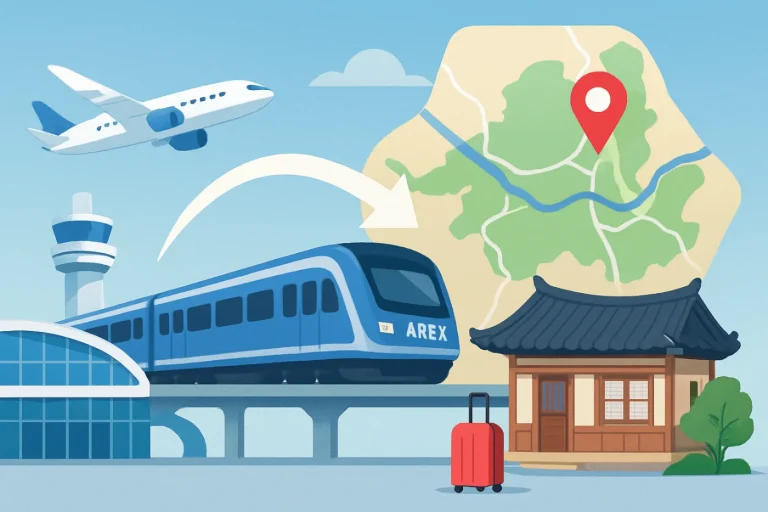
AREX Express vs All Stop with kids: simple recommendation
For most families with young kids, a stroller, and big suitcases:
- To / from central Seoul Station or further south (Myeongdong, Gangnam, Jamsil) – AREX Express is usually easier: no standing, more luggage space, quieter, and no intermediate stops.
- To / from Hongdae (Hongik Univ.), Gimpo, or western Seoul – AREX All Stop is usually better: you can get off directly at Hongik Univ. or Gimpo without changing trains.
- On a tight budget and older kids/teens who can stand – All Stop is the cheaper option and runs more frequently.
If you are jet‑lagged with a baby or toddler and heavy luggage, prioritize fewer transfers and guaranteed seats over saving a few thousand won.
Quick explanation: AREX Express vs All Stop
If you just landed at Incheon and need to decide fast between AREX Express and the All Stop train, this is the core difference:
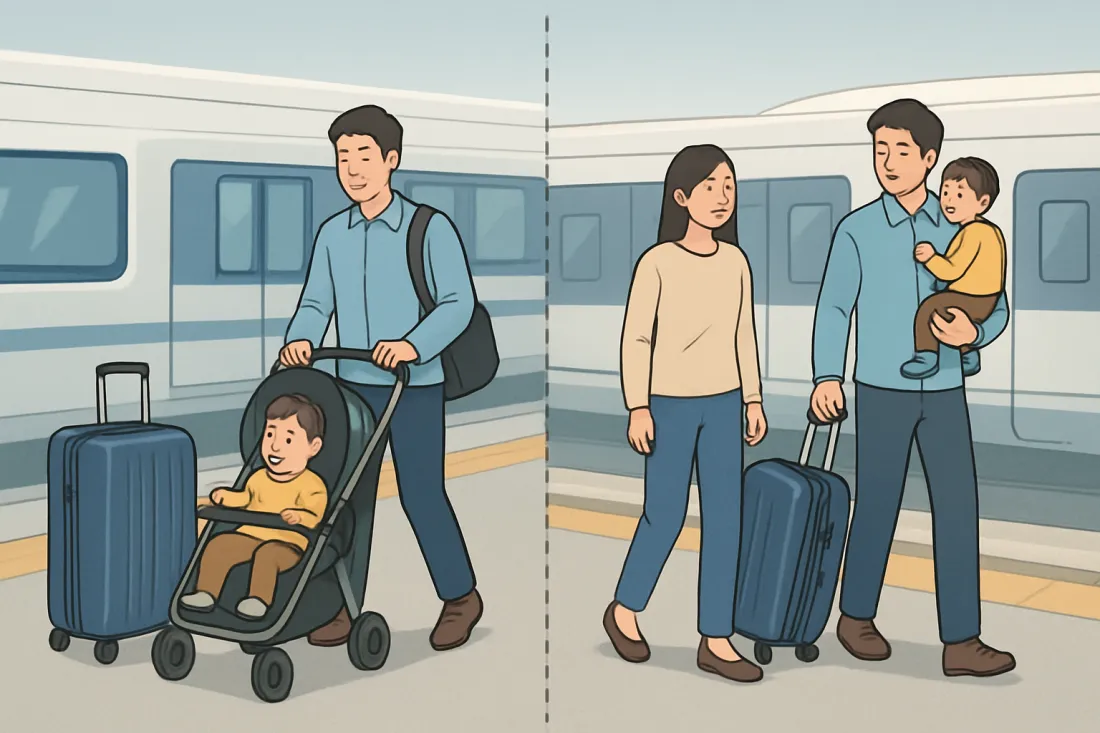
- AREX Express – Non‑stop train between Incheon Airport and Seoul Station only.
- Separate ticket and reserved seats for every passenger.
- More luggage space and onboard toilets.
- Usually the most comfortable option with kids and big bags.
- AREX All Stop – Regular metro‑style train between Incheon Airport and Seoul Station with many stops.
- No seat reservation; you tap in and out with a transit card.
- Cheaper, runs more often, but can be crowded and has no toilets.
- Best when your hotel is near Hongdae (Hongik Univ.), Gimpo Airport, or another intermediate station.
So for a quick rule: choose Express for comfort and guaranteed seats, and choose All Stop for budget or direct access to Hongdae / Gimpo.
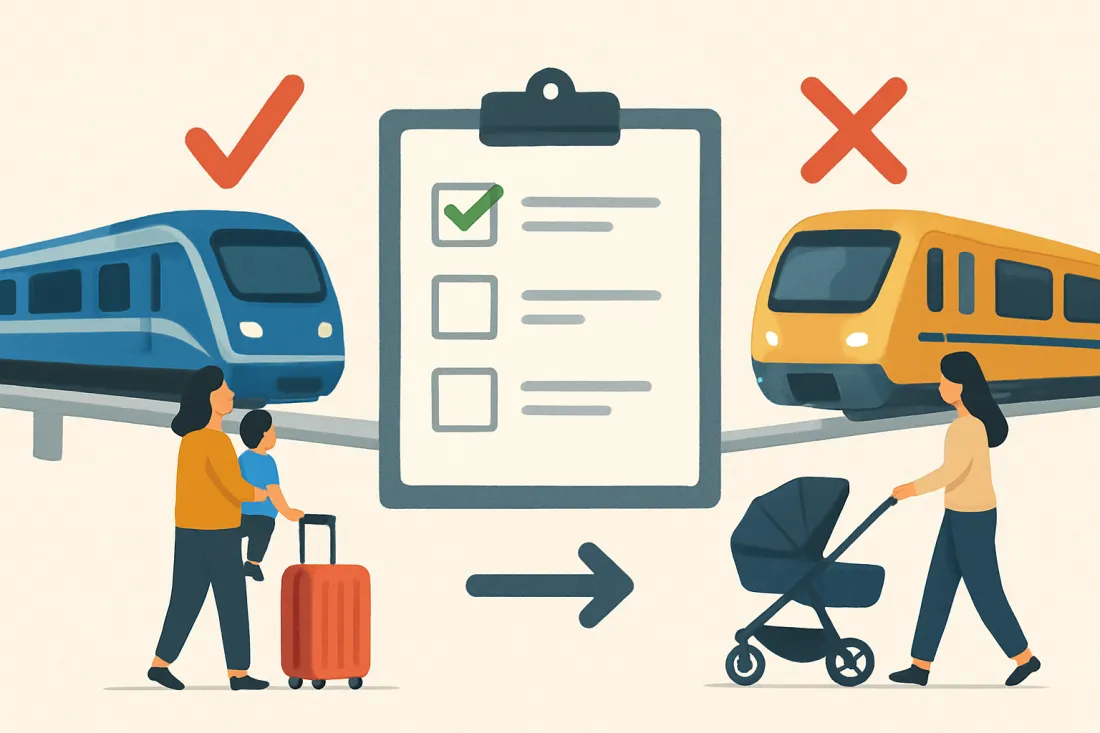
Family‑relevant facilities on AREX trains and stations
Both AREX options share some family‑friendly basics, but they feel very different when you are juggling a stroller and bags.
Onboard facilities that matter with kids
- Seating
- Express: Reserved, forward‑facing seats in a 2+2 layout. Families can sit together, and you know you will not have to stand.
- All Stop: Metro‑style benches along the sides, plus standing space. You may need to stand at busy times, especially between Hongdae and Seoul Station.
- Luggage space
- Express: Dedicated luggage racks and more open floor space near doors, designed for airport passengers.
- All Stop: Overhead shelves and some open space near doors, but no big dedicated racks. Large suitcases can be awkward if the train is crowded.
- Toilets
- Express: Has onboard toilets, very helpful with small children after a long flight.
- All Stop: No toilets on the train. You must use station toilets before boarding or after getting off.
- Noise and motion
- Express: Fewer stops and announcements, smoother ride – better for naps.
- All Stop: More stops, more people getting on and off, more announcements and door beeps – fine for most kids but can overstimulate tired toddlers.
Station facilities: elevators, escalators, and space
Most AREX stations, including Incheon Airport and Seoul Station, have:
- Elevators connecting platform, concourse, and street levels – essential for strollers and heavy suitcases.
- Escalators – faster than elevators but not ideal with a loaded stroller.
- Wide ticket gates for wheelchairs and strollers – look for the wider gate with a wheelchair symbol.
- Toilets and baby‑changing areas – usually in the concourse near ticket machines or exits.
However, transfers at Seoul Station or Hongik Univ. can still mean several minutes of walking through tunnels and up/down ramps. With kids, the number of changes often matters more than the raw train travel time.
AREX Express vs All Stop for families: detailed comparison
Key differences that matter with children
- Route pattern
- Express: Non‑stop between Incheon Airport and Seoul Station.
- All Stop: Stops at intermediate stations such as Gimpo Airport and Hongik Univ. (Hongdae).
- Journey time
- Express: Faster overall between Incheon and Seoul Station.
- All Stop: Slightly slower end‑to‑end, but can be faster door‑to‑door if your hotel is near an intermediate station like Hongdae.
- Comfort and crowding
- Express: Quieter, more space per person, easier to park a stroller or keep kids in their seats.
- All Stop: Can be busy, especially near the city. Fine with older kids but stressful with a baby and multiple suitcases.
- Transfers
- Express: Often requires a subway or taxi transfer at Seoul Station to reach your final area.
- All Stop: Lets you get off closer to some neighborhoods (Hongdae, Gimpo), reducing or removing transfers.
- Tickets and payment
- Express: Uses a separate ticket with seat reservation. You can combine it with a transit card for the rest of your journey – see the AREX ticket guide for details.
- All Stop: Works like a regular subway line; tap in and out with a transit card or single‑journey ticket.
Price, time, and comfort comparison: AREX Express vs All Stop
Exact fares and timetables can change, but this overview shows how AREX Express and All Stop usually compare for families traveling between Incheon and Seoul.
| Factor | AREX Express | AREX All Stop | Family takeaway |
|---|---|---|---|
| Ticket type | Separate airport train ticket with reserved seat for each passenger. | Standard subway fare; no seat reservation, tap with transit card. | Express is more structured; All Stop is more flexible but less predictable. |
| Typical price level | Higher per adult than All Stop, but usually cheaper than a taxi from Incheon to central Seoul. | Lower, distance‑based subway fare; one of the cheapest airport options. | Choose Express if comfort matters more than a small fare difference; choose All Stop if you are very budget‑focused. |
| Travel time (Incheon ↔ Seoul Station) | Shorter, non‑stop run between airport and Seoul Station. | Longer due to multiple stops, but can be similar door‑to‑door if you get off at Hongdae or Gimpo. | Express saves time to Seoul Station; All Stop can win if your hotel is near an intermediate stop. |
| Frequency | Runs regularly but usually less often than the All Stop train. | Runs more frequently, like a metro line. | With tired kids, the next train leaving soon is often the best choice. |
| Seating and comfort | Forward‑facing, padded seats in 2+2 layout; quieter and less crowded. | Side benches and standing space; can be crowded near the city. | Express is better for naps and jet‑lag; All Stop is fine for short hops with older kids. |
| Luggage handling | Dedicated luggage racks and more open space near doors. | Limited racks; large suitcases may block doors if the train is busy. | Express is easier with multiple large suitcases or a bulky stroller. |
| Onboard toilets | Available on the train. | Not available; use station toilets only. | Express is safer for potty‑training kids or long gaps between toilets. |
| Best for destinations | Seoul Station, Myeongdong, City Hall, Gangnam (with transfer or taxi). | Hongdae (Hongik Univ.), Gimpo Airport, western Seoul neighborhoods. | Match the train to the station closest to your hotel to reduce transfers. |
Comparison table: which AREX is better for your family?
| Criteria for families | AREX Express | AREX All Stop | Best choice when… |
|---|---|---|---|
| Kids’ age and energy | Great for babies/toddlers who need a quiet nap and a guaranteed seat. | Fine for school‑age kids and teens who can stand and handle crowds. | Choose Express with under‑5s or after overnight flights; All Stop with older, active kids. |
| Stroller and luggage | More luggage racks and floor space; easier to park a folded stroller. | Less dedicated luggage space; big bags can block doors at busy times. | Choose Express with 2+ large suitcases or a bulky stroller. |
| Onboard toilets | Available, useful for potty‑training kids or emergencies. | Not available; must plan toilet breaks at stations. | Choose Express if you worry about toilet access during the ride. |
| Destination area | Best for Seoul Station, Myeongdong, City Hall, Gangnam (with one transfer or taxi). | Best for Hongdae (Hongik Univ.), Gimpo, or western Seoul. | Match the train to the closest station to your hotel to reduce transfers. |
| Budget sensitivity | Costs more per adult; still cheaper than most taxis from the airport. | Cheaper, distance‑based fare like a subway ride. | Choose All Stop when saving money is more important than comfort. |
| Crowding and noise | Quieter, fewer people, easier to keep kids close. | Can be crowded near the city; more stops and announcements. | Choose Express if your child is sensitive to noise or strangers. |
| Transfers required | Often 1 extra subway or taxi ride from Seoul Station. | Sometimes 0 transfers if staying near Hongdae or Gimpo. | Choose the option that gives you the fewest total changes. |
AREX Express vs All Stop: realistic door‑to‑door time
Timetables only show train time. With kids, the real question is how long it takes from airport arrivals to your hotel lobby, including walking and transfers.
Typical door‑to‑door patterns
- Incheon → Seoul Station area (Seoul Station, City Hall)
- Express: Fast non‑stop ride + 5–15 minutes walking inside Seoul Station + short taxi or subway hop if needed.
- All Stop: Slightly longer train ride + similar walking and transfers at Seoul Station.
- Result: Door‑to‑door time is usually similar; Express feels easier because the long segment is more comfortable.
- Incheon → Myeongdong
- Express: Express to Seoul Station → transfer to Line 4 → Myeongdong.
- All Stop: All Stop to Seoul Station → same Line 4 transfer.
- Result: Express saves a bit of time and energy on the airport–Seoul leg; the Seoul Station transfer is the slow part for both.
- Incheon → Hongdae (Hongik Univ.)
- Express: Express to Seoul Station → subway back to Hongik Univ.
- All Stop: Direct All Stop to Hongik Univ., no transfer.
- Result: Door‑to‑door is usually faster and simpler on All Stop because you avoid the Seoul Station transfer.
- Incheon → Gangnam / Jamsil
- Express: Express to Seoul Station → 1–2 subway lines or a taxi to southern Seoul.
- All Stop: All Stop to Gimpo or Hongik Univ. → transfer to Line 9 or Line 2 toward Gangnam/Jamsil.
- Result: Total time can be similar. Express gives a calmer long segment; All Stop may give a more direct transfer depending on your exact hotel.
With children, a route that is 5–10 minutes slower but has fewer changes often feels easier than the technically fastest route.
When AREX Express is worth it (with kids, luggage, and jet‑lag)
AREX Express costs more than the All Stop train, so it is natural to ask if it is really worth it. For many families, the answer is yes in these situations:
- After an overnight or very long flight
- Your kids are exhausted, and you want a quiet, predictable ride where everyone can sit.
- The non‑stop Express segment lets children nap without constant announcements and people getting on and off.
- Traveling with a baby or toddler
- You need onboard toilets for diaper changes or potty‑training emergencies.
- You want to avoid standing with a baby carrier or wrangling a stroller in a crowded car.
- Multiple large suitcases or bulky stroller
- You have 2+ big suitcases, a travel crib, or a wide stroller.
- Dedicated luggage racks and extra floor space on Express reduce stress and keep aisles clear.
- Staying near Seoul Station, Myeongdong, City Hall, or southern Seoul
- Your hotel is a short subway ride or taxi from Seoul Station.
- Express gets you quickly and comfortably to Seoul Station, then you deal with just one final transfer.
- Traveling at busy times
- You are arriving in the evening or during a local rush hour when the All Stop train can be crowded near the city.
- Reserved seats on Express mean you are not competing for space with commuters.
- First‑time visitors nervous about the subway
- You prefer a simple, one‑seat ride from the airport to a major hub.
- Express has clear signage, staff nearby, and a straightforward boarding process.
If several of these apply to your family, paying extra for AREX Express usually feels like money well spent.
When AREX All Stop or bus is better for families
AREX Express is not always the winner. In many cases, the All Stop train – or even an airport bus – is a better match for your route and budget.
When the AREX All Stop train is better
- Your hotel is in Hongdae (Hongik Univ.) or near Gimpo Airport
- You can ride the All Stop train directly to Hongik Univ. or Gimpo without changing trains.
- This often saves more time and energy than the comfort upgrade of Express.
- You are on a tight budget
- You want the cheapest rail option from Incheon to Seoul.
- Your kids are old enough to stand and are used to busy public transport.
- You are traveling light
- You have backpacks or small suitcases only, and no bulky stroller.
- It is easier to move around inside a metro‑style car when you are not carrying heavy luggage.
- You prefer more frequent departures
- You do not want to wait for the next Express train.
- The All Stop train often has a departure sooner, which can matter with restless children.
- You are used to subways and want flexibility
- You are comfortable standing, changing trains, and navigating station maps.
- You may decide to get off earlier or later depending on how your kids are doing.
When an airport bus might be better than either AREX option
In some cases, an airport limousine bus from Incheon can beat both AREX Express and All Stop for families:
- Your hotel is directly on a bus route
- Some buses stop right outside major hotels or in the middle of tourist areas.
- This can mean no transfers at all with kids and luggage.
- You want to avoid stairs and long station walks
- Buses usually involve one lift or escalator at the airport and then a short walk at your stop.
- No underground tunnels or multiple escalators like at Seoul Station.
- Your children get anxious underground
- The bus lets them look out of the window and see the city as you arrive.
However, buses can be slower and are affected by traffic. If your kids get carsick easily, AREX Express or All Stop may still be better.
AREX Express vs All Stop: which is better in common scenarios?
These quick scenarios can help you decide between AREX Express and All Stop based on your situation.
- Late‑night arrival
- Express: Good if the schedule matches your landing time and you want a calm, predictable ride.
- All Stop: Useful if it has the next departure and you do not want to wait.
- Tip: Check the last train times in advance; if both AREX options are tight, an airport bus or taxi may be safer.
- Peak‑hour arrival or departure
- Express: Often better with kids because seats are reserved and cars are less crowded with commuters.
- All Stop: Can be very busy near Seoul, especially between Hongdae and Seoul Station.
- Winner for families: Usually Express, unless you are staying right at Hongdae or Gimpo.
- Traveling with big suitcases
- Express: Dedicated racks and more space make it easier to store multiple large bags.
- All Stop: You may need to stand near the doors and move bags around as people board.
- Winner for families: Express, especially with 2+ big suitcases.
- Staying in Hongdae
- Express: Requires a transfer at Seoul Station and back‑tracking to Hongik Univ.
- All Stop: Direct to Hongik Univ. Station, then walk to your hotel.
- Winner for families: All Stop almost every time.
- Staying in Myeongdong or near Seoul Station
- Express: Non‑stop to Seoul Station, then short subway or taxi ride.
- All Stop: Slower train to the same station and same transfer.
- Winner for families: Usually Express, if your budget allows.
- Staying in Gangnam or Jamsil
- Express: Comfortable long leg to Seoul Station, then subway or taxi south.
- All Stop: Option to transfer at Gimpo (Line 9) or Hongik Univ. (Line 2) toward Gangnam/Jamsil.
- Winner for families: If you value comfort and have heavy luggage, choose Express. If you want a possibly more direct subway transfer and are fine standing, All Stop can work well.
- Older kids or teens, light luggage, tight budget
- Express: More comfortable but may feel unnecessary.
- All Stop: Cheaper, frequent, and fine if everyone can stand.
- Winner for families: All Stop.
How and where to buy AREX Express vs All Stop tickets
Buying AREX Express tickets
You can decide whether to book AREX Express in advance or just buy tickets after landing. Both approaches work; choose based on how much you value certainty versus flexibility.
Booking AREX Express online (before you fly)
Many families like to secure Express seats before their trip so they do not have to think about tickets after a long flight. Typical online options include:
- Official AREX or partner websites – Some sites allow advance purchase of Express tickets or vouchers.
- Travel platforms and apps – Well‑known booking platforms often sell AREX Express tickets or discount passes that include the Express train.
When booking online, check:
- Which terminal (Incheon T1 or T2) your flight uses.
- Whether your ticket is for a specific departure time or can be exchanged for any Express train on the day.
- How to redeem the voucher at the station (for example, at a ticket counter or machine).
Online booking is most useful if you are traveling in a group, during busy seasons, or you simply want one less decision at the airport.
Buying AREX Express tickets on‑site (after landing)
If you prefer to decide after you see how your kids feel, you can easily buy Express tickets at the airport:
- Ticket counters – Staffed counters near the AREX entrance at Incheon Airport. You can ask questions, choose seats together, and pay with card or cash.
- Ticket machines – Self‑service machines near the Express gates. They usually have an English option and clear prompts for selecting destination and number of passengers.
On‑site purchase works well if:
- You are not sure how long immigration and baggage claim will take.
- You want to compare the next Express departure time with the All Stop train before deciding.
- You are comfortable using machines or asking staff for help.
Even without a reservation, families usually find seats together on most days, but this can depend on season and time of day.
Paying for the AREX All Stop train
The All Stop train works like a normal subway line:
- Transit card (T‑money, Cashbee, etc.) – Tap in at the gate and tap out at your destination. This is the easiest option if you will use public transport during your stay.
- Single‑journey ticket – Buy a one‑time paper or plastic ticket from the machines near the gates. Choose your destination station and pay the displayed fare.
There is no seat reservation on the All Stop train. You simply board and look for available seats or standing space.
Seat reservations, boarding process, and seat layout on AREX Express
Understanding how AREX Express works in practice makes it easier to decide if it is worth booking in advance for your family.
How seat reservations work on AREX Express
- Every Express ticket includes a seat – You are assigned a specific car and seat number.
- Families can sit together – When buying tickets at a counter or machine, you can usually choose seats in the same row or across the aisle.
- Children’s tickets – Check age rules at purchase; younger children may have discounted fares or may be allowed to share a seat with an adult depending on height and policy.
Reserved seating means you do not have to rush onto the platform or compete for space with other passengers.
Typical AREX Express seat layout
The exact layout can vary slightly by train, but most AREX Express cars follow a similar pattern:
- 2+2 seating – Two seats on each side of the aisle, all forward‑facing or in fixed directions.
- Overhead shelves – For small bags, backpacks, and coats.
- Luggage racks near doors – For large suitcases and strollers (usually at the ends of each car).
- Accessible spaces – Some areas are reserved for wheelchairs or priority seating; avoid blocking these with luggage.
For families, a common setup is one adult and one child on each side of the aisle, or all four seats in a row if you have a larger group.
Boarding process on AREX Express with kids
The boarding flow is straightforward once you know what to expect:
- Enter the AREX Express area
- Follow the Express signs from arrivals to the AREX concourse.
- Buy or redeem your Express tickets at the counter or machine.
- Scan your ticket or QR code at the Express gates.
- Find your car on the platform
- Check your ticket for the car number and seat number.
- Platform signs usually show where each car stops; stand near the correct car to avoid rushing with kids when the train arrives.
- Board and store luggage
- Let one adult step on first to guide children to the seats.
- The other adult can lift suitcases into the luggage racks near the doors.
- Keep passports, wallets, and phones in a small bag with you, not in the suitcase racks.
- Settle kids before departure
- Seat children by the window if they like to look outside.
- Take out snacks, water, and a small toy or book before the train starts moving.
At Seoul Station, announcements and screens will tell you when you are arriving. Start gathering your things a few minutes before the stop so you can exit calmly with your family.
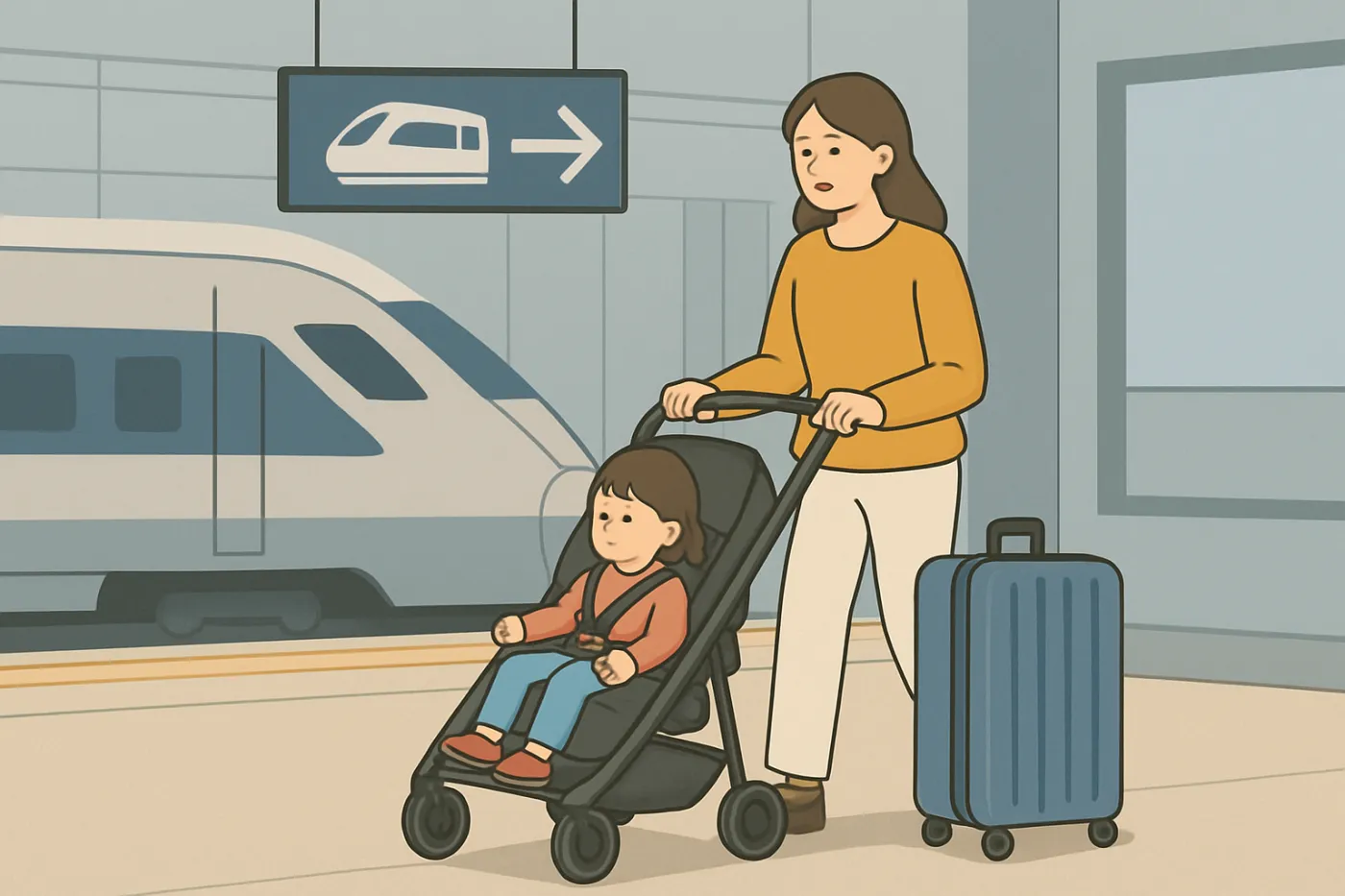
Boarding AREX with stroller and suitcases: practical tips
Before you reach the platform
- Use elevators, not escalators, with a loaded stroller. Elevators are usually signed with a wheelchair/stroller icon. If you cannot see one, follow the signs to the nearest lift or ask station staff.
- Keep one adult hands‑free. If possible, have one adult in charge of the stroller and one in charge of tickets and luggage.
- Prepare tickets and transit cards in advance so you are not searching for them at the gate while a toddler runs off.
- Use wide gates. Look for the wider ticket gate; it is easier for strollers and suitcases.
On the platform
- Stand away from the edge. Hold children’s hands and keep the stroller brakes on while waiting.
- Position near doors with more space. On Express trains, the middle doors of a car usually have more standing room and luggage racks. On All Stop trains, doors near the middle of the train often align better with elevators at major stations.
- Fold the stroller if possible. A folded stroller is easier to maneuver through doors and aisles, especially on the All Stop train.
- Let others board first if the train is busy. Then board together quickly, aiming for the open space near the doors or luggage racks.
Once onboard
- Secure the stroller. Park it against a wall or luggage rack, lock the brakes, and keep valuables on you, not in the stroller basket.
- Keep kids seated or holding a pole. Trains can accelerate and brake suddenly; explain to older kids to hold on.
- Use the ride for snacks and water. This can prevent meltdowns before you face the subway or street outside.
- Prepare for your stop early. Start packing up snacks and toys a few minutes before arrival so you can exit calmly.
Where to stand for easier elevators at Incheon and Seoul Station
Exact elevator positions can change with station renovations, but these patterns help reduce walking with kids and luggage.
Incheon Airport Terminal 1 and 2
- Follow the AREX signs from arrivals; they lead you down to the AREX concourse and ticket machines.
- Look for elevator icons on overhead signs. They usually show which end of the platform has elevators.
- Rule of thumb for families:
- On the Express platform, aim for near the middle of the train. This often lines up with central concourse elevators and ticket gates.
- On the All Stop platform, check the platform map: elevators are typically at one or both ends. If you are unsure, stand near the middle so you can adjust quickly after arrival.
- Ask staff if you are unsure. Station staff can point you to the nearest elevator or family‑friendly route.
Seoul Station (AREX side)
Seoul Station is large and can feel confusing with kids, but there are elevators between the AREX platform, concourse, and subway lines.
- Follow the blue AREX signs to reach the main concourse and transfer to subway lines or the taxi area.
- For subway transfers (to Myeongdong, Gangnam, etc.), look for signs to the relevant line number and the wheelchair/elevator symbol.
- Family‑friendly positioning tips:
- On the Express train approaching Seoul Station, move toward the middle cars before arrival. These usually stop near central escalators and elevators.
- On the All Stop train, again aim for the middle of the train to be close to the main vertical connections.
- Allow extra transfer time. With a stroller and luggage, expect 10–20 minutes to navigate from the AREX platform to some subway lines or the taxi rank.
Because station layouts can change, always double‑check the current station maps and signs when you arrive.
Tips for smooth transfers at Seoul Station
Many families find the transfer at Seoul Station more tiring than the airport train itself. A little planning makes it easier.
AREX Express / All Stop to subway
- Follow line‑number signs (for example, Line 1, 4, or others) as soon as you leave the AREX gates.
- Use elevators where possible – look for the wheelchair symbol on overhead signs.
- Tap out and back in correctly if you switch from Express tickets to a transit card for the subway.
- Keep your group together in narrow corridors; agree on a meeting point near a wall or column in case someone moves ahead.
AREX to airport buses at Seoul Station
- Look for bus stop maps in the concourse or near exits; some airport buses stop around Seoul Station and nearby streets.
- Use elevators or ramps to street level instead of long staircases.
- Check bus numbers and destinations on the front of the bus and at the stop to be sure it serves your area (Myeongdong, Gangnam, etc.).
AREX to taxis at Seoul Station
- Follow taxi signs from the AREX concourse to the official taxi stands.
- Join the queue rather than accepting offers from unofficial drivers.
- Have your hotel address written in Korean (for example, on your booking confirmation) to show the driver.
For many families, taking AREX Express to Seoul Station and then a taxi for the last short segment is a good balance between cost and comfort.
Example family routes from Incheon to popular Seoul areas
These example itineraries show how Express vs All Stop can change your total effort with kids.
Incheon Airport to Myeongdong (central shopping area)
Option 1 – AREX Express + subway
- Take AREX Express from Incheon Airport to Seoul Station.
- At Seoul Station, transfer to Subway Line 4 toward Myeongdong.
- Get off at Myeongdong Station and walk to your hotel.
Family pros: Comfortable ride after the flight, toilets on board, easier with strollers and big suitcases. Good if your hotel is close to Myeongdong Station and you can handle one subway transfer.
Family cons: The transfer inside Seoul Station can be long with a stroller; Line 4 may be crowded.
Option 2 – AREX All Stop + subway
- Take AREX All Stop from Incheon Airport to Seoul Station.
- Transfer to Subway Line 4 as above.
Family pros: Cheaper than Express; trains run frequently.
Family cons: Less comfortable with luggage, no toilets, and the same transfer challenge at Seoul Station.
Which is better with kids? If budget allows, most families prefer Express for this route because the hardest part is the Seoul Station transfer, not the fare difference.
Incheon Airport to Hongdae (Hongik Univ. area)
Option 1 – AREX All Stop direct
- Take AREX All Stop from Incheon Airport to Hongik Univ. Station.
- Exit toward your hotel in Hongdae.
Family pros: No transfers; you get off right in Hongdae. This can save a lot of time and energy with kids and luggage.
Family cons: Metro‑style seating, possible crowds near Hongdae, no onboard toilets.
Option 2 – AREX Express + subway
- Take AREX Express to Seoul Station.
- Transfer to a subway line back to Hongik Univ. Station.
Family pros: More comfortable main leg of the journey.
Family cons: Adds an extra transfer and back‑tracking, which usually cancels out the comfort benefit when traveling with kids.
Which is better with kids? For Hongdae, All Stop is usually the clear winner for families because it is direct.
Incheon Airport to Gangnam (southern Seoul)
Option 1 – AREX Express + subway or taxi
- Take AREX Express to Seoul Station.
- Transfer to a subway line heading toward Gangnam (for example, Line 2 or another suitable route depending on your exact hotel) or take a taxi from the official taxi stand.
Family pros: Comfortable long leg, fewer people on the airport segment, toilets available.
Family cons: At least one busy subway transfer; travel time from Seoul Station to Gangnam can be significant if you choose the subway.
Option 2 – AREX All Stop + subway
- Take AREX All Stop to Gimpo Airport or Hongik Univ., depending on your preferred transfer point.
- Transfer to a line that goes toward Gangnam (for example, Line 9 from Gimpo or Line 2 from Hongik Univ.).
Family pros: Potentially more direct subway lines to southern Seoul; can be cheaper.
Family cons: More time standing on metro‑style trains; can be crowded at peak times.
Which is better with kids? If you have heavy luggage and small children, many families prefer Express + taxi from Seoul Station. If you are comfortable with subways and want to save money, All Stop + subway can work well.