When an AREX pass is worth it (and when it is not)
For most visitors who only ride between Incheon Airport and Seoul once in each direction, an AREX pass or combo is usually not the cheapest option. Paying per ride on the all-stop AREX train with a transport card is often enough. An AREX pass or combo starts to make sense when at least one of these is true:
- You want the non-stop AREX Express and can get a meaningful discount through a pass or package.
- You are already planning to buy a tourist city pass for several attractions and unlimited transport, and it happens to include AREX.
- You value reserved seats, luggage space, and a calmer ride more than squeezing out the absolute lowest fare.
If you are on a strict budget, staying near an AREX station, and only need airport–city transfers, paying per ride on the all-stop AREX is usually the most economical and flexible choice.
How AREX pricing works for express vs all-stop
To judge whether any AREX pass is worth it, you first need to understand the two train types and how their pricing logic differs.
- AREX Express
Non-stop between Incheon Airport and Seoul Station. You get a reserved seat, more luggage space, and a quieter cabin. The base fare is higher because you are paying for speed and comfort. - AREX All-stop
Runs like a regular metro line, stopping at multiple stations between the airport and Seoul (including Hongik Univ. for Hongdae). No reserved seats, but usually cheaper than the express.
Key pricing ideas (exact figures change, so always check current fares before you travel):
- Express costs more per ride than the all-stop train. You pay extra for a faster, non-stop journey and guaranteed seating.
- All-stop fares depend on distance. Going only to Hongik Univ. is cheaper than going all the way to Seoul Station.
- Most AREX-related passes discount the express, not the all-stop. They try to make the express feel closer in price to the all-stop, or bundle it with other benefits.
- Using a transport card (like T-money) on the all-stop train is usually the simplest and often the lowest-cost option for budget travelers.
If a pass or combo only covers one express ride and you ignore the other perks, you are typically paying more than you would for a single all-stop ride. The value appears when you either:
- Would have chosen the express anyway and the pass makes it cheaper than buying a normal express ticket, or
- Use several of the bundled extras (subway days, attractions, or other transport) so that the total package beats buying everything separately.
If you want more detail on paying per ride, you can also read about how to pay for AREX Incheon Airport.
Quick comparison: AREX pass vs regular tickets
The table below compares a typical AREX-focused pass or combo with simply buying regular tickets or using a transport card.
| Option | Best for | When it tends to save money | Main drawbacks | Comfort & convenience |
|---|---|---|---|---|
| AREX-focused pass (express ride + extras) | First-time visitors who want a smooth airport transfer and plan to use several bundled benefits (e.g., subway days, attractions) | When you: • Would already buy an express ticket • Use at least a few of the included extras • Travel within the pass validity period |
• Can be more expensive than all-stop + T-money • Valid only on specific routes/dates • Requires planning to use all benefits |
High – reserved seat, luggage space, clear instructions for tourists |
| Regular AREX Express ticket | Travelers with heavy luggage or kids who want a fast, calm ride to Seoul Station | Rarely the very cheapest, but good value if you prioritize comfort and time over a small saving | • Higher fare than all-stop • Only runs to/from Seoul Station • Need separate tickets for onward subway rides |
High – non-stop, reserved seat, easier with big bags |
| All-stop AREX with transport card (e.g., T-money) | Budget travelers, solo backpackers, and guests staying near an AREX station such as Hongik Univ. | Often the lowest cost for airport–city transfers, especially if you only ride once each way | • No reserved seats • Slightly slower due to stops • Can be crowded at peak times |
Moderate – direct and simple, but feels like a normal subway ride |
| Tourist city pass that includes AREX | Short-stay visitors who plan to visit multiple paid attractions and use public transport heavily over 1–3 days | When you: • Visit enough included attractions • Use the transport benefits daily • Time your airport trip within the pass validity |
• Easy to overbuy if you skip attractions • Time-limited (for example, 24–72 hours) • Some attractions may not interest you |
High – one product for many things, but needs planning |
Which AREX option fits common visitor scenarios
Different trip styles use passes very differently. Use these scenarios as a guide, then adjust to your own itinerary.
1. Solo budget traveler staying near Hongdae or western Seoul
- Typical pattern: One ride from Incheon to Hongik Univ. (Hongdae) on arrival, one ride back on departure, plus normal subway and bus use in between.
- Best choice most of the time: All-stop AREX with a transport card.
- Why: You only need two airport rides. A pass that includes an express ride plus extras rarely beats the low cost of two all-stop trips, especially if you are not using many paid attractions.
- When a pass might still work: If you also want a city pass for museums, observatories, or theme parks and that pass happens to include AREX, then the bundle can be reasonable. But you should be buying it for the attractions first, not for AREX alone.
2. Family with kids, lots of luggage, staying near Seoul Station
- Typical pattern: Two adults, one or two kids, big suitcases, hotel near Seoul Station. You want the least stressful way into the city.
- Best choice most of the time: AREX Express, either via a discounted pass/combo or regular express tickets.
- Why: Reserved seats, luggage racks, and a non-stop ride are worth a small extra cost. If a pass or combo makes the express ride cheaper or similar in price to buying express tickets separately, it can be a good deal.
- When to skip the pass: If the pass forces you to pay for extra days of transport or attractions you are not sure you will use, you may end up spending more than necessary. In that case, just buy express tickets for the family.
3. Short city-break (2–3 days) with heavy sightseeing
- Typical pattern: You land at Incheon, stay in central Seoul, and plan to visit several paid attractions and ride the subway a lot in 48–72 hours.
- Best choice most of the time: A well-chosen tourist city pass that includes AREX and attractions you genuinely want to see.
- Why: If you already plan to visit multiple included sights and ride public transport frequently, the pass can beat buying everything separately. The AREX ride becomes a bonus that sweetens the deal.
- When to be careful: If your sightseeing list is mostly free spots (markets, parks, neighborhoods, viewpoints), a city pass may not pay off. In that case, use the all-stop train and pay attractions individually.
4. Long stay (7+ days) in a guesthouse, slow travel style
- Typical pattern: You stay in a guesthouse, cook some meals, explore slowly, and mix Seoul with day trips. You are very price-conscious.
- Best choice most of the time: All-stop AREX with a transport card, plus separate tickets for any intercity trains or buses.
- Why: Long stays spread your spending out. A short-validity pass (for example, 24–72 hours) will only cover a small slice of your trip. It is usually cheaper to pay for the airport transfer and daily transport separately.
- When a pass might fit: If you plan a very intense first 1–3 days packed with attractions and subway rides, you could use a city pass just for those days and rely on regular transport for the rest of your stay.
5. Transit stopover or late-night arrival
- Typical pattern: You have a short stopover in Seoul or arrive late at night.
- Best choice most of the time: Depends on timing. Sometimes the express or all-stop train may not match your arrival time, and you might need an airport bus or taxi instead.
- Why: A pass that includes AREX is useless if the train is not running when you land or if you do not have time to use the other benefits.
- What to do: Check the first and last train times and your arrival time before buying any pass that includes AREX.
For a broader look at airport transport choices, you can compare options in AREX vs airport bus vs taxi Incheon to Seoul.
Step-by-step: compare an AREX pass with regular tickets
Because exact prices change over time, the safest way to decide is to run your own simple comparison. Use this process before you buy anything.
Step 1 – Count your AREX rides
- Most visitors only need two rides: airport → city and city → airport.
- Some need one ride (if they arrive at Incheon and leave from another airport or city).
- A few need more than two rides if they use Incheon as a base for side trips.
Write down how many times you will realistically use AREX.
Step 2 – Decide express vs all-stop for each ride
For each ride, ask yourself:
- How tired will I be when I board?
- How much luggage do I have and can I manage it on a regular subway-style train?
- Am I traveling with kids, older relatives, or anyone who needs a seat?
- How far is my accommodation from Seoul Station compared with another AREX stop (for example, Hongik Univ.)?
If you value comfort and speed, you might choose the express at least one way. If you are fine with a regular metro-style ride, the all-stop is usually cheaper.
Step 3 – Check current regular fares
Because fares can change, do a quick check shortly before your trip:
- Look up the current base fare for the AREX Express between Incheon and Seoul Station.
- Look up the current fare for the all-stop AREX between Incheon and your nearest station (for example, Hongik Univ. or Seoul Station).
- Note whether there are any online discounts for express tickets bought in advance.
Multiply the relevant fare by the number of rides you expect to take on each type of train. This gives you a rough total cost for the “no pass” option.
Step 4 – List what an AREX pass or combo actually includes
If you are considering a specific pass or combo, list its benefits in plain language. Typical inclusions are:
- One or two AREX Express rides.
- Unlimited subway rides in Seoul for a certain number of hours or days.
- Free or discounted entry to certain attractions.
- Shopping or restaurant discounts.
Then mark which of these you will definitely use, which you might use, and which you do not care about.
Step 5 – Estimate the value of the benefits you will really use
For each benefit you marked as “definitely use,” check the current separate price:
- How much does a single express ticket cost if you buy it alone?
- How much would you spend on subway rides per day without a pass (rough estimate based on how many trips you expect)?
- What is the normal ticket price for each attraction you plan to visit?
Add these up. This gives you a rough “separate purchase” total.
Step 6 – Compare your totals
Now compare:
- Option A: Regular AREX tickets (express or all-stop) + normal subway/bus fares + individual attraction tickets.
- Option B: The AREX pass or combo price, assuming you use all the benefits you marked as “definitely use.”
If Option B comes out clearly lower than Option A, the pass is likely worth it. If the difference is small or the pass is more expensive, you are usually better off without it.
Pros and cons of relying on an AREX pass
Advantages of an AREX pass or combo
- Convenience: One purchase can cover your airport transfer and some city transport or attractions, reducing ticket decisions after a long flight.
- Predictable costs: You know a big part of your transport and sightseeing budget in advance, which helps with planning.
- Comfort upgrade: Many passes focus on the express train, giving you a reserved seat and more space for luggage.
- Potential savings: If you fully use the included benefits, you can pay less than buying everything separately.
Disadvantages and risks
- Overbuying: A common mistake is buying a pass “just in case” and then not using enough of the included benefits to justify the cost.
- Limited validity: Many passes are valid for a fixed number of hours or days. If your flight is delayed or your plans change, you may not fully use them.
- Route restrictions: Some passes only cover specific lines or zones. You may still need to pay extra for certain buses, intercity trains, or late-night options.
- Less flexibility: When you have already paid for a pass, you may feel pressured to stick to a plan instead of exploring freely.
How and where to buy AREX tickets and passes
Buying regular AREX tickets
At Incheon Airport
- Ticket machines: Located near the AREX platforms. You can buy single-journey tickets for both express and all-stop trains. Machines usually have English menus.
- Ticket counters: Staffed counters can help if you are unsure which ticket to buy or if you want to ask about current discounts.
- Transport cards: You can buy or top up a transport card at convenience stores or vending machines, then tap in at the all-stop gates.
Online or via apps
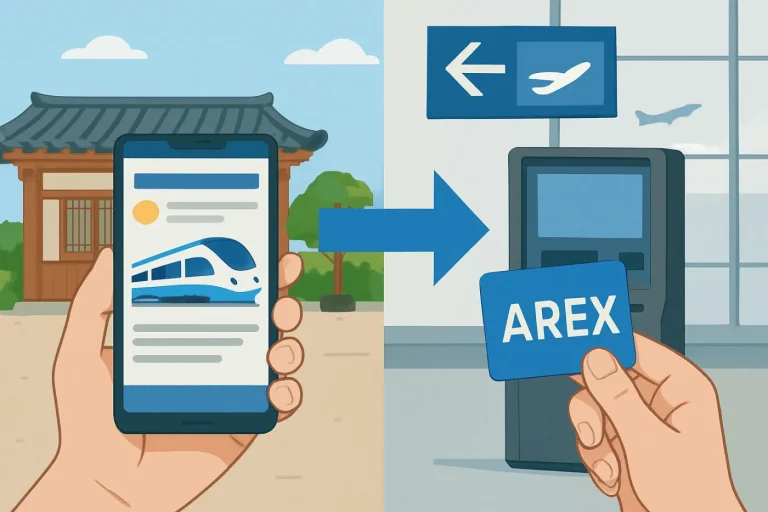
- Some platforms allow you to reserve express seats in advance, sometimes with a small discount.
- You typically receive a QR code or booking number to scan or exchange for a ticket at the station.
- Always check the refund and change policy before booking, especially if your flight times are uncertain.
For more detail on ticket types and cheap options, see the guide to the AREX ticket.
Buying AREX passes and combos
Before you travel
- Many tourist passes and combos can be purchased online and then activated when you arrive in Korea.
- Some require you to choose a specific start date; others start counting from the first use. Read this carefully.
- Check whether you need to pick up a physical card or if a mobile QR code is enough.
After arrival
- Some passes can be bought at airport counters or tourist information desks.
- Staff can explain which lines and attractions are included and help you avoid buying the wrong product.
- Availability can vary by time of day, so do not rely on a specific counter being open late at night.
Refunds, changes, and fine print to check
Policies differ by product and can change, so always check the current terms before paying. Use this checklist of what to look for:
- Refund window: Until when can you cancel for a full or partial refund if your plans change?
- Change fees: Is there a fee to change the date or time of an express train seat?
- No-show rules: What happens if you miss your booked train due to flight delay or immigration queues?
- Validity period: For city passes, does the time count from first use or from a calendar date? Is it based on hours or calendar days?
- Coverage limits: Are late-night trains, certain lines, or premium services excluded?
- Child discounts: Are there separate rules or prices for children, teenagers, or seniors?
- Physical vs digital: Do you need to keep a physical card in good condition to get a refund deposit, or is everything handled digitally?
If any of these points are unclear, ask at a ticket counter or contact customer support before you buy.
Checklist: is an AREX pass worth it for you?
Use this practical checklist as a final filter. If you answer “yes” to most questions in a group, that option is likely a good fit.
A. Signs an AREX pass or combo is a good idea
- ☐ I plan to ride the AREX Express at least once and value a reserved seat and luggage space.
- ☐ I will visit several paid attractions that are included in the pass.
- ☐ I expect to ride the subway or buses many times per day during the pass validity.
- ☐ The pass validity (hours or days) matches my arrival and departure times.
- ☐ When I roughly add up separate prices for express + transport + attractions, the pass clearly comes out cheaper.
- ☐ I am comfortable planning my days to make full use of the pass.
B. Signs you should stick with regular tickets and a transport card
- ☐ I only need one round trip between Incheon and Seoul (two rides total).
- ☐ I am happy to use the all-stop train and do not mind a slightly longer ride.
- ☐ Most of my sightseeing list is free or low-cost places (markets, neighborhoods, parks).
- ☐ My schedule is flexible or uncertain, and I do not want to be locked into specific dates or times.
- ☐ I prefer to pay as I go and keep options open for buses, taxis, or other routes.
If Group A has more checkmarks, an AREX pass or combo can be worth it. If Group B dominates, regular tickets and a transport card are usually the smarter choice.
Common mistakes when judging whether an AREX pass is worth it
Avoid these typical errors that cause travelers to overspend or get frustrated.
- Buying a pass for “peace of mind” without doing basic math: A few minutes of comparison can easily save you the cost of a nice meal in Seoul.
- Ignoring train schedules: Buying a pass that includes AREX when your flight arrives after the last train or leaves before the first train means you pay for something you cannot use.
- Overestimating how many attractions you will visit: Jet lag, weather, and crowds often slow people down. If you only manage half your planned list, a city pass may not pay off.
- Forgetting about your accommodation location: If you stay near an intermediate AREX station such as Hongik Univ., the all-stop train can be both cheaper and more convenient than going all the way to Seoul Station on the express.
- Not checking child and group options: Families sometimes miss out on better value because they only look at adult passes or do not compare group tickets vs individual passes.
FAQ about whether an AREX pass is worth it
What is the most important thing to understand about AREX pass value?
The key point is that an AREX pass rarely saves money on the airport train alone. Its value usually comes from the bundle: express train plus city transport plus attractions. If you would not already buy most of those extras, the pass is unlikely to beat simple all-stop tickets and a transport card. Always compare the total cost of what you will actually use, not the full list of theoretical benefits.
What mistakes should travelers avoid when choosing an AREX pass or combo?
The biggest mistakes are buying a pass without checking your arrival time against train schedules, assuming you will visit more attractions than you realistically can, and ignoring where your accommodation is. Many people also forget to read the refund and validity rules, so they lose flexibility if flights change. A quick checklist and rough price comparison before purchase usually prevents these problems.
What should I do next if I am still unsure about buying an AREX pass?
Write down your arrival and departure times, where you are staying, and how many days of intense sightseeing you truly expect. Then follow the step-by-step comparison above: count your AREX rides, choose express vs all-stop for each, look up current fares, and compare that total with the price of any pass you are considering. If the pass is not clearly cheaper or more convenient for your exact plan, stick with regular tickets and a transport card. You can always buy attraction tickets and extra transport as you go once you are in Seoul.